English






Federal Funds Rate and Its History from 1990 to 2023
Explore the dynamic history of the Federal Funds Rate from 1990 to 2023 in our comprehensive article. Discover how interest rate fluctuations shape the economy and financial markets. Stay informed about the Federal Reserve's impact on your financial decisions.

 11442
11442








The federal funds rate, a critical tool in the Federal Reserve's monetary policy toolkit, wields significant influence over the U.S. financial landscape. It shapes interest rates on savings accounts and credit card balances, essentially governing the cost of capital in the American economy.
In the world of finance, understanding Federal Reserve interest rate policy is paramount, and as Mark Twain quipped, it may not entertain like "The Million Pound Bank Note," but it certainly exhibits a rhythmic pattern. Delving into the rationale behind Federal Open Market Committee (FOMC) decisions, such as the 1994 fed funds target rate hike, can shed light on present-day policy actions and their underlying motivations.
TOPONE Markets Analyst has meticulously crafted this historical account as a practical reference to trace the trajectory of the federal funds rate and the strategic monetary policy moves made by the Federal Reserve throughout the past three decades.
What Is the Federal Reserve and the Role of Fed?

The Federal Reserve, commonly known as "the Fed," is the central banking system of the United States, established in 1913 by the Federal Reserve Act. It occupies a central and influential role in the nation's economic and financial landscape. The Federal Reserve operates as an independent entity within the U.S. government, designed to provide a degree of insulation from political pressures while working to fulfill its critical functions.
Fed has five core functions that define its role and responsibilities within the U.S. financial and economic system:
Monetary Policy: The Fed's primary task is to formulate and implement monetary policy to promote the goals set by Congress. These goals include fostering maximum sustainable employment and maintaining stable prices. The Fed uses various tools, such as adjusting interest rates, to influence the money supply and achieve these objectives.
Financial System Stability: Ensuring the stability and resilience of the financial system is another critical role of the Fed. It acts as a "lender of last resort" during financial crises, provides liquidity support to banks, and implements measures to mitigate systemic risks that could threaten the financial system's integrity.
Supervision and Regulation: The Federal Reserve supervises and regulates banks and other financial institutions to ensure their safe and sound operation. It establishes and enforces rules and standards to maintain the overall stability and integrity of the banking sector.
Payment and Settlement Systems: The Fed oversees and operates payment and settlement systems, such as the Automated Clearing House (ACH) and the Fedwire Funds Service. These systems facilitate the smooth flow of funds and transactions within the U.S. financial system.
Consumer Protection and Community Development: The Fed also plays a role in consumer protection by enforcing laws related to fair lending practices and ensuring consumers have access to financial services. Additionally, it supports community development initiatives aimed at promoting economic growth and access to financial resources in underserved communities.
What Is FOMC?

The FOMC, or Federal Open Market Committee, is a vital component of the U.S. Federal Reserve System. It consists of twelve members, including seven governors of the Federal Reserve Board and five presidents of regional Federal Reserve Banks. The committee convenes regularly to assess the state of the U.S. economy and make decisions about monetary policy, particularly the federal funds rate—the interest rate at which banks lend money to each other overnight. This rate, set by the FOMC, has a profound impact on various economic facets, including borrowing costs, investment choices, and overall economic growth.
The primary mission of the FOMC is to achieve the dual mandate defined by Congress for the Federal Reserve: promoting maximum employment and maintaining stable prices. To make informed decisions, the committee scrutinizes a wide range of economic indicators, including employment figures, inflation rates, and overall economic growth. By adjusting interest rates in response to economic conditions, the FOMC aims to support the achievement of its dual mandate and uphold economic stability.
During its meetings, the FOMC engages in thorough discussions about current economic conditions, potential risks, and challenges facing the U.S. economy. Based on this analysis, the committee decides whether to modify interest rates, using rate changes as a tool to steer the economy in the desired direction and ensure overall economic stability. In summary, the FOMC plays a pivotal role in shaping U.S. monetary policy, significantly influencing interest rates and, consequently, the financial well-being of individuals and businesses nationwide.
What Is Federal Funds Rate?
The Fed Interest Rate, often referred to as the federal funds rate, occupies a central role in the intricate web of financial mechanisms overseen by the Federal Reserve. This pivotal benchmark rate represents the interest rate at which financial institutions lend reserve balances to one another overnight. In essence, it's the rate at which banks and credit unions borrow money from each other to meet their reserve requirements and maintain stability in the banking system.
This rate's significance is far-reaching, extending its influence into virtually every nook and cranny of the U.S. economy. First and foremost, it acts as a primary lever through which the Federal Reserve can steer the course of monetary policy. When the Fed wishes to stimulate economic activity and spending, it might lower the federal funds rate to encourage borrowing and investment. Conversely, when it seeks to cool down an overheating economy or curb inflation, it may opt to raise this rate. Thus, the Fed Interest Rate serves as a powerful tool for fine-tuning economic conditions.
For investors and consumers alike, the Fed Interest Rate holds paramount importance. Its movements have a direct impact on the rates offered by banks on products such as savings accounts, certificates of deposit (CDs), and money market accounts. A higher federal funds rate often translates to higher interest rates on these financial instruments, which can be a boon for savers seeking better returns on their deposits. On the flip side, borrowers face increased costs as the interest rates on credit card balances, mortgages, and personal loans tend to rise in tandem with the Fed Interest Rate. Consequently, staying attuned to the ebb and flow of this crucial rate is essential for anyone looking to navigate the ever-shifting currents of the financial landscape.
How Federal Funds Rate Works?
The Federal Open Markets Committee (FOMC) wields the authority to establish the federal funds rate, a metric known by various monikers such as the federal funds target rate or the fed funds rate. This rate isn't cast in stone but is instead expressed as a range, comprising both an upper and lower limit.
At present, the federal funds rate spans between 5.25% and 5.50%.
Here's the mechanics of how it operates: When customers deposit funds into their bank accounts, these deposits serve as the financial lifeblood of banks, enabling them to extend loans and various forms of credit to their clientele. Regulatory authorities mandate that banks and other depository institutions maintain a specific percentage of their overall capital as reserves, a safeguard ensuring their financial soundness and stability.
The capital held by banks undergoes constant fluctuations as deposits ebb and flow and loans are approved and repaid. Consequently, their reserve requirements remain in a perpetual state of flux. Banks frequently find themselves in need of overnight borrowing from fellow financial entities to meet these regulatory reserve mandates, or they may find themselves with surplus reserve capital available for lending to their peers. In this intricate dance of capital management, the federal funds rate emerges as a crucial reference point for institutions engaged in the borrowing and lending of reserves.
Federal Funds Rates and U.S. Monetary Policy
Congress has given the Federal Reserve a "dual mandate," which means it has two main jobs: to keep prices stable and control inflation, and to support maximum employment. Additionally, it's expected to help keep long-term interest rates reasonable and maintain a stable financial system.
The Fed funds rate is a crucial tool that the central bank uses to manage how much money is circulating in the economy. It does this by influencing the interest rates that banks charge each other, which, in turn, affects the rates they charge you and other customers.
Think of the prime rate, a benchmark for consumer and business loans. It closely follows changes in the fed funds rate because banks pass on the cost changes they face in meeting reserve requirements.
When the Fed raises the fed funds rate, it's trying to make short-term borrowing more expensive across the board. This reduces the amount of credit available and makes loans more costly for everyone. It's a move to curb inflation by slowing down the flow of money in the economy.
Conversely, lowering the fed funds rate has the opposite effect. It lowers short-term interest rates throughout the economy, making it easier to get credit. This can help turn around periods of low or negative inflation and may encourage companies to hire more as they can expand their businesses more affordably.
How the Federal Funds Rate Impacts the Economy
The federal funds rate has a far-reaching impact that extends beyond just interest rates; it touches various aspects of the economy.
Anticipations about future changes in the fed funds rate significantly influence Treasury yields, which serve as the benchmark for pricing many other types of credit used in businesses, government, and mortgages.
The stock market is highly sensitive to shifts in the federal funds rate. When the Fed lowers rates, stock markets usually see a boost, as it reduces borrowing costs for public companies. This makes it more affordable for them to grow their businesses and increase their profits.
However, when rates go up, the stock market may face challenges. Rising rates make borrowing more expensive, and lenders benefit from higher rates. This can potentially lead to a tougher environment for equity markets.
Understanding Fed Monetary Policy Decisions
The Federal Reserve adjusts the federal funds target rate based on what's happening in the economy. They do this to achieve their two main goals: keeping prices stable and maximizing employment.
Here's how it works: When the economy is heating up and inflation is rising too fast, the Fed raises interest rates. But when the economy is weak, and unemployment is high, they lower rates.
The Fed also looks at other things like how much the country is producing (GDP), how much people are spending, and how factories are doing. Big events like financial crises, global pandemics, or major attacks can also make the Fed change rates.
In this collection of historical fed funds rate data, we'll explain why the Fed made its decisions. The Fed has a lot of smart economists and experts, but it also pays attention to what's going on in politics.
Fed Interest Rate History from 1990 to 2023
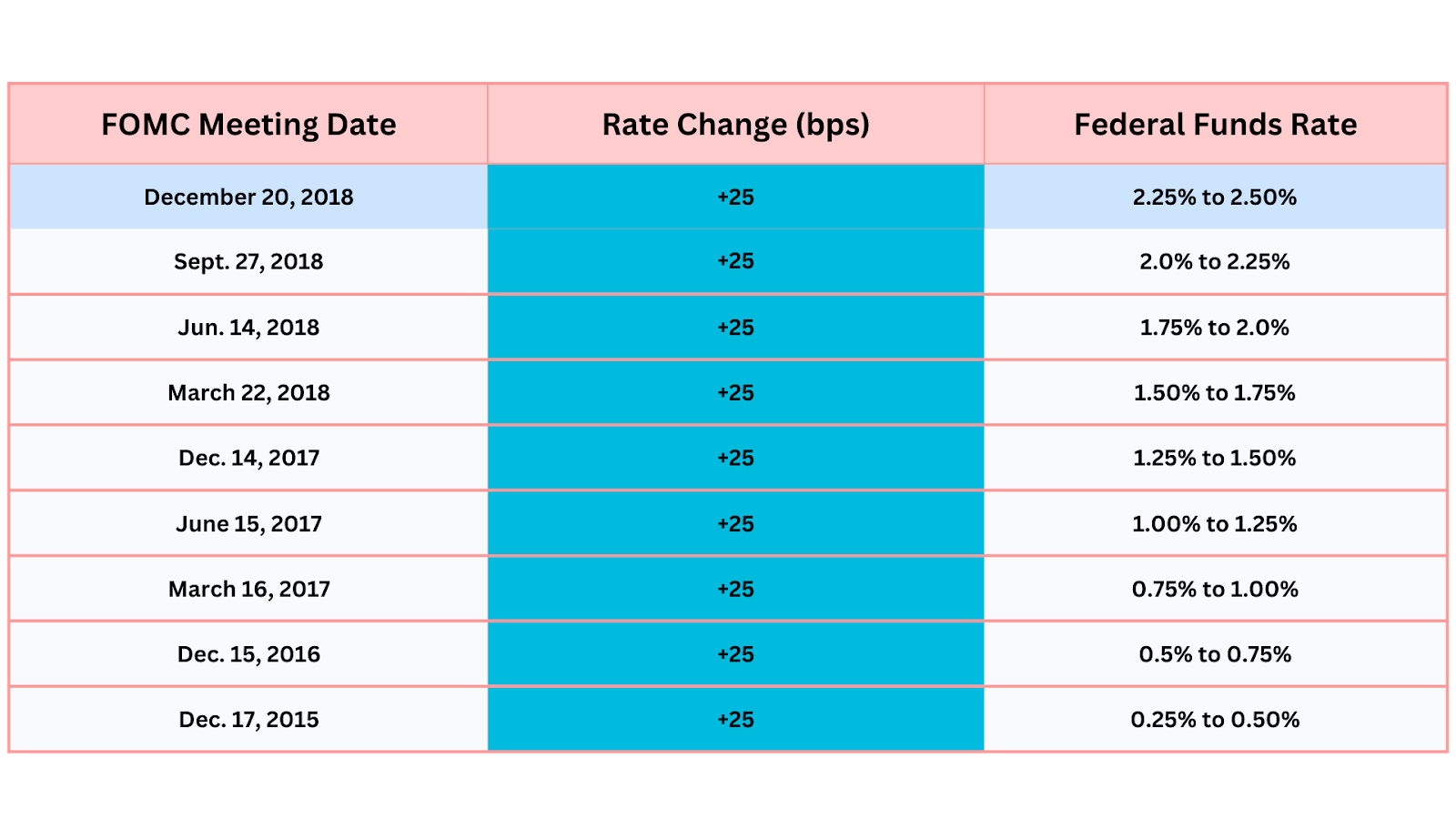
The following tables provide information about when the Fed had meetings and changed interest rates, showing the size of each rate change in basis points (abbreviated as bps), and the resulting federal funds target rate range.
To understand basis points, think of them as a common way to measure interest rates. One basis point is equivalent to 1/100th of a percentage point, or 0.01%. For example, if an interest rate changed by half a percentage point, it would equal 50 basis points.
It's important to note that before 1990, the Fed didn't explicitly set a specific federal funds rate. If you're curious about earlier rate policies, you can explore this Federal Reserve document, which was obtained through a Freedom of Information Act request.
2022-2023 Fed Rate Hikes: Taming Inflation
It's important to remember that not too long ago, in the first quarter of 2022, the Fed kept the federal funds rate close to zero. During this time, the Fed was also buying billions of dollars in bonds each month to boost the economy, even though various measures of U.S. inflation had reached their highest levels in 40 years.
When the Fed decided it was time to address the issue of inflation, it took bold steps. In the past 16 months, the central bank raised the fed funds rate by more than five percentage points. This move was aimed at curbing the excessively high inflation rates that were eroding the purchasing power of everyday Americans.
Federal Reserve Chair Jerome Powell emphasized the importance of price stability during an August 2022 speech in Jackson Hole. He noted, "Without price stability, the economy does not work for anyone. In particular, without price stability, we will not achieve a sustained period of strong labor market conditions that benefit all."
2020 Fed Rate Cuts: Coping with Covid-19
The story begins on January 29, 2020, with the Federal Open Market Committee's (FOMC) policy statement, which stated, "Information received since the Federal Open Market Committee (FOMC) met in December indicates that the labor market remains strong and that economic activity has been rising at a moderate rate." Little did they know, just days later, the U.S. economy would plunge into the Covid-19 recession.
Within a few weeks, the Covid-19 pandemic had spread globally. To curb the virus's spread and ease the strain on hospitals, public health officials recommended lockdowns, leading to a staggering loss of around 20.5 million jobs in April 2020 alone, and the unemployment rate soared to 14.7%.
In response to this crisis, the FOMC took swift action with two significant rate cuts during emergency meetings in March 2020, effectively setting the federal funds target rate at a range of zero to 0.25%.
While the economy technically rebounded by May 2020, marking the shortest recession on record, the aftermath of the measures taken to combat the Covid-19 outbreak still lingers today, impacting various aspects of our lives.
2019 Fed Rate Cuts: Mid-Cycle Adjustment
In 2019, the Fed made a series of three interest rate cuts, each a quarter of a percentage point, which Chair Powell referred to as a "mid-cycle adjustment." In simpler terms, the Fed was taking action to lower rates during the middle of the typical economic cycle, aiming to keep the economy on a stable path.
During this time, the U.S. and China were embroiled in a "trade war," and the Fed was concerned that this trade conflict could harm the economy and lead to higher unemployment rates. The three modest rate cuts, which occurred in the latter part of 2019, had a positive impact on the economy, helping to mitigate some of these concerns.
Inflation was also a consideration for the Fed. At that point, inflation, as measured by the core personal consumption expenditures price index (PCE), which is the Fed's preferred gauge, was well below the central bank's target of 2%. In June 2019, core PCE had increased by 1.7% compared to the previous year, and by February 2020, it had only edged up to 1.9%.
2015-2018 Fed Rate Hikes: Return to Normal
In late 2008, facing the unprecedented fallout from the global financial crisis, the Fed took the extraordinary step of reducing interest rates to zero in a bid to support the U.S. economy. Fast forward seven years, and the central bank cautiously began to raise rates as the economy embarked on a gradual recovery.
The first rate hike occurred in December 2015, under the leadership of former Fed Chair Janet Yellen, who currently serves as Treasury Secretary in the Biden administration. Another year passed before the next rate increase, which happened in December 2016.
In the statement accompanying the initial 2015 rate hike, the Fed noted, "The Committee judges that there has been considerable improvement in labor market conditions this year, and it is reasonably confident that inflation will rise, over the medium term, to its 2% objective." At that time, core PCE inflation was at 1.1% in December 2015, significantly below the Fed's target, and it didn't reach the 2% mark until March 2018. Additionally, the nation's unemployment rate had another 1.5 percentage points to drop over the next four years.
However, in early 2016, alarming economic reports emerged from China, causing widespread panic in stock markets and prompting the Fed to pause its rate hikes for a full year. The FOMC took a cautious approach in returning to a more normal monetary policy stance, a strategy that held until a changing economic landscape in 2019 altered their outlook.
2008 Fed Rate Cuts: The Great Recession
The Great Recession officially kicked off in December 2007, lingering until June 2009. During this challenging period, the Fed paused its rate cuts between April 2008 and October 2008, a time when the global financial crisis was intensifying.
As the crisis deepened, American families witnessed the collapse of their home values, and the stock market didn't hit rock bottom until early 2009. The unemployment rate climbed from 5% in December 2007 to a staggering 10% by October 2009.
The FOMC acknowledged this dire situation in its statement accompanying the decision on December 16, 2008, noting, "Since the Committee’s last meeting, labor market conditions have deteriorated, and the available data indicate that consumer spending, business investment, and industrial production have declined. Financial markets remain quite strained and credit conditions tight."
This was an understatement of monumental proportions.
Unable to lower rates any further, the Fed initiated a novel monetary policy approach known as quantitative easing, or QE. In this strategy, they started buying trillions of dollars' worth of bonds to reinvigorate the economy and spur job creation. Despite these efforts, many Americans are still grappling with the long-lasting impact of the recession, and some may never fully recover.
2007-2008 Fed Rate Cuts: The Housing Market Crash
The Fed's campaign of raising interest rates concluded in June 2006. However, by early 2007, trouble was brewing as the housing bubble burst, and the unemployment rate started to climb. Faced with a struggling economy, the FOMC initiated a series of rate cuts in September 2007, ultimately reducing rates by 2.75 percentage points in less than a year.
In an April 2008 statement, the Fed stated, "The substantial easing of monetary policy to date, combined with ongoing measures to foster market liquidity, should help to promote moderate growth over time and to mitigate risks to economic activity."
Following the rate cut in April 2008, then Fed Chair Ben Bernanke decided to take a pause to assess how the lower interest rates were impacting the economy. Some analysts were concerned about the potential for higher inflation, but few could foresee the severity of the impending global financial crisis.
Rich Yamarone, the director of economic research at Argus Research at the time, explained, "Policymakers know all too well that when real rates are negative for an extended period of time, inflation pressures rise swiftly and dramatically."
2005-2006 Fed Rate Hikes: The Housing Market Boom
Following the dot-com recession of the early 2000s, the U.S. economy rebounded swiftly. The Fed had reduced rates in mid-2003, setting the fed funds target rate at 1%. This accommodative monetary policy helped the GDP grow from +1.7% in 2001 to +3.9% in 2004. By 2005, concerns were already emerging about a housing bubble in the U.S.
Economist Robert Shiller pointed out in a June 2005 NPR interview that various indicators, such as home prices relative to rent, construction costs, and income, were reaching high or record levels. People were becoming increasingly aware of these concerning trends.
To address the overheating economy and the growing real estate bubble, the Fed embarked on a series of 17 interest rate hikes in just two years, raising the fed funds target rate by a total of 4 percentage points.
Interestingly, despite the Fed's hawkish stance, inflation remained relatively subdued. Core PCE inflation, for instance, reached its highest point at 2.67% in August 2006. By the end of this cycle of rate increases, the unemployment rate stood at 4.6%, and PCE inflation began to move down toward the Fed's 2% target.
2002-2003 Fed Rate Cuts: Flagging Recovery, Low Inflation
The dot-com recession, which spanned from March to November 2001, raised concerns for the Fed about the sluggishness of the economic recovery. Consumer confidence measures hit their lowest points in nine years, prompting the FOMC to make a significant move in November 2002—a substantial 50 basis points (bps) rate cut. Their rationale cited "greater uncertainty" and "geopolitical risks."
This decision left financial markets somewhat perplexed, as analysts had expected either a smaller 25 bps reduction or at least an indication that future cuts were being considered.
By mid-2003, another concern emerged: inflation was alarmingly low. Core PCE inflation, for instance, started at 1.78% in January and dipped further to 1.47% nine months later. Fearing the onset of deflation, the FOMC made a cautious rate cut of 25 basis points. However, this move placed the fed funds rate at its lowest level in 45 years.
Explaining their decision, the Fed noted, "With inflationary expectations subdued, the committee judged that a slightly more expansive monetary policy would add further support for an economy which it expects to improve over time."
2001 Fed Rate Cuts: The Dot-Com Bust and 9/11
Following the dot-com bubble of the late 1990s and 2000, the dot-com bust of 2001 came crashing down. The period was marked by a frenzy of what Alan Greenspan famously termed "irrational exuberance," where vast sums of money poured into increasingly questionable dot-com investments, ultimately leading to a inevitable stock market collapse.
The Nasdaq Composite, which had reached its zenith in February 2000, didn't find its bottom until September 2002. Along this tumultuous journey, the stock market crash spilled over into the real economy, resulting in a modest contraction in GDP and elevated unemployment levels. This economic downturn persisted for eight long months.
Adding to the economic challenges, the tragic events of the 9/11 terrorist attacks further compounded the nation's woes.
In response to these multiple crises, the Fed embarked on a series of interest rate cuts in 2001, reducing rates by a total of 5.25 percentage points.
1999-2000 Fed Rate Hikes: The Dot-Com Boom
Between 1995 and its peak in March 2000, the Nasdaq witnessed an astounding 400% surge in value. This meteoric rise was fueled by a speculative frenzy that drove up the prices of internet stocks and tech companies.
Recognizing the ballooning bubble, the Fed took action by initiating rate hikes starting in June 1999. At that time, the unemployment rate stood at around 4%, and inflation was inching closer to the Fed's 2% target. Alan Greenspan, the former Fed Chair, aimed to prevent the entrenchment of inflation expectations, which is why he implemented a significant 50 basis points (bps) increase to conclude this tightening cycle.
Interestingly, from today's perspective, investors welcomed this news with enthusiasm, leading to an immediate "relief rally" in the stock market. While some analysts speculated that rates might climb even higher, the Fed held off as inflation leveled off.
1998 Fed Rate Cuts: Global Currency Crisis
The rate cut cycle of 1998 was unusual because most of the economic tensions driving the FOMC's decisions originated from international sources.
A chain of interconnected events led to the three rate cuts in the autumn of 1998. It all began with an Asian currency crisis that started in Thailand in 1997 and then spread throughout Asia and Latin America. This crisis, in turn, triggered a currency crisis in Russia in late 1998. These global issues culminated in a critical moment for a major U.S. hedge fund called Long-Term Capital Management (LTCM), which teetered on the brink of bankruptcy.
In September 1998, the Fed issued a brief statement—by modern standards—accompanying the rate cut. They simply stated that the action was taken "to cushion the effects on prospective economic growth in the United States of increasing weakness in foreign economies and of less accommodative financial conditions domestically."
1997 Fed Rate Hike: FOMC Lightly Taps the Brakes
In March 1997, inflation was at 1.94%, showing a modest uptick. The 1990s were marked by a booming economy, with around six years of continuous expansion out of its eventual ten-year run. The Fed aimed to keep prices firmly anchored to its 2% target.
The Fed's statement at the time noted, "The slight tightening of monetary conditions is seen as a cautious measure that provides more confidence in extending the ongoing economic expansion while maintaining low inflation for the rest of that year and the following year."
1995-1996 Fed Rate Cuts: Mid-Cycle Adjustment, 90s-Style
The 1990s are often remembered as a time of exuberant wealth creation and remarkable productivity growth. So, it might come as a surprise to see three rate cuts taking place right in the middle of this prosperous decade.
In 1994 and early 1995, the Fed took a strong stance against inflation. Following their decision in July 1995, the FOMC explained that "[a]s a result of the monetary tightening initiated in early 1994, inflationary pressures have lessened enough to allow for a slight adjustment in monetary conditions."
However, just six months later, the Fed was faced with an unemployment rate of 5.6%, unchanged from the previous year. Coupled with lower-than-expected retail sales, the Fed concluded that additional stimulus was necessary.
1994-1995 Fed Rate Hikes: A Soft Landing
The monetary policy tightening cycle of 1994-1995 is often remembered as a rare instance of the Fed successfully executing a "soft landing" for the economy. Between February 1994 and February 1995, Alan Greenspan led the FOMC in nearly doubling the fed funds rate through seven incremental increases.
At that time, the U.S. economy was experiencing a robust period of growth, with GDP figures at +3.5% in 1992, +2.8% in 1993, and a remarkable +4% in 1993. This era saw baby boomers at the pinnacle of their careers, a steady influx of immigrants, and transformative technological advancements reshaping the economy.
Amid strong productivity rates that kept unemployment in check, the Fed chose to raise rates despite the robust economic backdrop. Their statement in February 1994 read, "The decision was made to gradually tighten monetary policy to support and enhance the ongoing economic expansion."
Notably, this marked the first time the Fed announced rate hikes in real-time. However, the market was taken by surprise, resulting in the onset of the 1994 Bond Crash.
1990-1992 Fed Rate Cuts: The Gulf War Recession
When examining reports of Fed interest rate decisions before 1994, a notable difference from the current era of transparency becomes apparent. In those days, analysts were often left to interpret the Fed's actions without much guidance, as the central bank didn't issue policy statements or hold press conferences.
In fact, for a significant part of the 1980s, the Fed didn't even use the federal funds rate as a primary tool for shaping interest rate policy.
Nonetheless, whenever the Fed decided to cut interest rates, it usually did so with one clear objective: stimulating economic growth.
The Gulf War recession, which spanned from July 1990 to March 1991, had a lasting impact on households' financial stability. It took some time for the economy to recover fully, with the unemployment rate surging from 5.2% in June 1990 to 7.8% two years later.
Final Thoughts
In conclusion, the Federal Funds Rate has undergone significant fluctuations and changes from 1990 to 2023, impacting the U.S. economy in various ways. Understanding its historical trajectory is essential for businesses, investors, and economists alike. As we move forward, it's crucial to stay informed about the Federal Reserve's monetary policy decisions and how they can influence interest rates, financial markets, and economic stability. Keeping a close eye on the Federal Funds Rate's evolution will help us make informed decisions in an ever-changing financial landscape.


Trending Articles
- Who Is Andrew Tate and Why Is He Famous? 10 Things to Know the Controversial Influencer
Discover who is Andrew Tate and why he's making waves in the digital sphere. Uncover 10 intriguing facts about this controversial influencer, his journey, and his impact on the online world.
2024-03-01 TOPONE Markets Analyst - Andrew Tate Net Worth 2024: Is the Internet's Most Controversial Man Worth $800 Million?
Explore the enigmatic Andrew Tate's net worth and delve into the controversies surrounding the internet's most polarizing figure. Is he truly worth $800 million? Uncover the truth behind his wealth and reputation here.
2024-02-23 TOPONE Markets Analyst - 20 Strongest Currencies in the World in 2024
Want to know the strongest currencies in the world in 2024? Here are the list for you!
2024-01-30 TOPONE Markets Analyst - Falling Wedge Pattern: The Ultimate Guide
A falling wedge is a bullish pattern characterized by a wide top and shrinking bottom. It is an extremely bullish pattern in a trading market.
2023-09-25 TOPONE Markets Analyst

 Bonus!
Bonus rebate to help investors grow in the trading world!