English






What Is XIRR in Mutual Funds?
XIRR considers multiple cash flows at different times. These cash flows are periodic investments in multiple mutual funds.

 2480
2480
Do you know what XIRR is in a mutual fund? XIRR, which stands for the Extended Internal Rate of Return, is a way to determine the return on SIP mutual fund investments (Systematic Investment Plan).
Hari Shyamsunder, the CEO of Navi Mutual Fund, says, "Your investments should always be weighed against other options. But to make that comparison, you need to know what XIRR is about.
This article helps mutual funds understand XIRR, why it's important, and how to determine their SIP returns. Let's dive into the discussion below.
What is XIRR in mutual funds?
Imagine that you have used SIPs to put money into mutual funds. But because of the way the market is, you put the investment on hold for a few months.
Later on, you start investing again when the market is doing well. How do you figure out the exact return on investment in this case? This is where the scenario of Extended Internal Rate of Return (XIRR) comes in.
In mutual funds, XIRR considers multiple cash flows at different times. These cash flows are periodic investments in multiple mutual funds.
CAGR and XIRR are the two most common ways to figure out how much money an investment in a mutual fund makes.
CAGR, which stands for "Compound Annual Growth Rate," is a way to figure out how much your investment grows each year over the time you have it.
Thus, CAGR, on the other hand, doesn't consider investments made over time and is usually used to figure out the rate of return on one-time investments in mutual funds.
This is why investors figure out XIRR by looking at the average annual return for each installment. This gives the average return on investments as a whole.
How does XIRR in mutual funds work?
IRR, or Internal Rate of Return, is a way to measure the returns of a series of cash flows. For simplicity, you can think of IRR as the annualized discounted cash-flows (DCF) rate of return.
In this method, cash-flows are discounted at a certain rate (IRR) based on when the cash-flows happen to know the present value of the investment (NPV).
Cash flows, which can be either inflows or outflows that happen earlier in the investment period, are discounted less than those that happen later. The reason for this is that the value of money goes down over time. IRR is the discount rate where the present value (NPV) equals zero.
Investors can use IRR to determine their SIP, SWP, and lump sum investment returns. It even counts with some additional purchases, multiple redemptions, and other transactions involving more than one cash flow.
IRR looks at all cash flows, inflows, and outflows and the times they happen. Thus, IRR is hard to figure out by hand because the equation is complicated, and you have to try things out.
But the built-in formula for IRR in Microsoft Excel Sheet makes it easy to figure out the IRR of cash flows.
Importance of XIRR in mutual funds
If you invest a lump sum in a mutual fund, you could use CAGR to determine your return. But XIRR is the best way to determine the SIP return. XIRR considers all of the small investments you've made over time.
Since the investment time for each installment is different, the compounded annual growth rate (CAGR) for each installment is also different.
When the CAGR of each of these monthly investments is considered, it can be hard for investors to figure out how well the scheme is doing.
To solve this problem, they can add up all of these CAGRs and change them to a single rate. This CAGR that has been changed is called XIRR in mutual funds.
Limitations of XIRR
XIRR makes complicated calculations easier. This makes it easier to figure out how much money a mutual fund makes. But this method could be better.
The biggest problem with XIRR is that it needs to consider time differences between investments. This can significantly affect how Excel sheets are used to do calculations. The cash flows don't stay the same over the life of an investment.
Think about the following example to help you understand:
Let's say that the date of your monthly SIP is the fifth of every month. Now, even if this date stays the same, there will be a difference in the number of days because each month has a different number of days, like 28, 30, or 31.
There are also holidays in between, which will make the time even longer. Because of this, the dividend payments will change for the same reasons, even if the investments stay the same. All of these things will have a big impact on the XIRR value.
How to calculate XIRR in mutual funds?
You can use Excel or Google Spreadsheets to figure out XIRR. To get a certain value, all you have to do is use the XIRR formula. Let's go over how to figure out XIRR in Excel.
"= XIRR (value, dates, guess)" is the Excel formula for XIRR.
Open the app on your device and do the steps below to figure out the yearly returns for multiple cash flows that come at different times:
First, write down all of your transactions in one column.
All cash outflows, like purchases and investments, should be marked as "negative," while all cash inflows, like redemptions, should be marked as "positive." Make a second column to add the dates of the transactions that went into or out of this account.
Write the current value of your holdings and the date in the last row.
Now is the time to use the XIRR formula in Excel.
You need to pick values for a cash flow series that match the dates of the payments. The date column showed when you made your first investment and when cash flows started.
You don't have to use the Guess parameter. If you do not enter any value in excel, use a value of 0.1.
Example
Let's say you started a SIP of Rs. 10,000 per month in a mutual fund scheme and kept it up for five years. Now, let's also say that your total investment grew to Rs. 8.84 lakh after many ups and downs over five years.
In this case, your first investment of Rs. 10,000 has been in the market for five years or 60 months. The annual return on this first month's payment will differ because it has been invested for most months.
In other words, since each payment is invested for a different amount of time, their CAGRs are also different.
If you look at the CAGR of each of these parts of a mutual fund scheme, it will take time to understand and figure out how well it is doing.
So, to make things easier, you have to add up all CAGRs and put them into a single CAGR. You can calculate XIRR in excel.
What is a good XIRR in mutual funds?
It's hard to say what a good XIRR is. But in general, an XIRR of 12% on an equity mutual fund for a 10-year investment could be good enough.
In the same way, an XIRR of more than 8% should be fine for debt mutual funds.
But remember that the rate of return depends on several things, such as the length of the investment, the risk factor, and inflation, to name a few.
Can we Use CAGR instead of XIRR?
People often think that CAGR and XIRR are the same things.
CAGR is the correct way to determine returns on each installment without considering money coming in and going out.
XIRR, on the other hand, is the average of all the CAGRs and considers all cash is coming in and going out.
Here are some simple ways to tell the difference between them:
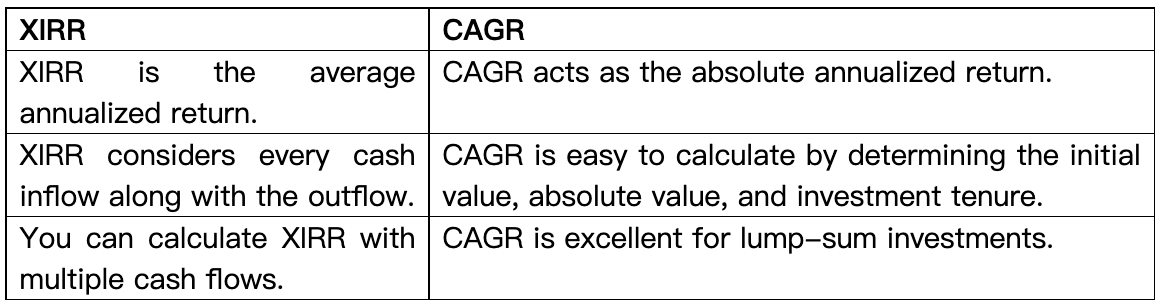
XIRR is the best way to determine your returns when you have more than one transaction, especially if your investment time could be more consistent. You will send and receive cash when you use a SIP to invest in mutual funds.
Your time on any investment will impact the total return value in certain situations. Since this is the case, the Extended Internal Rate of Return (XIRR) is a very important part of mutual funds.
Things to remember when computing XIRR
When figuring out XIRR for mutual funds, keep these things in mind:
Mark as negative all outflows, such as lump sum investments and SIP payments.
Enter positive numbers for all inflows (SWP/redemptions).
If you have yet to sell all of your units in a fund, you need to put in both the current value of the investment and the NAV date when figuring out XIRR.
There is no real cash flow when dividends are reinvested, or similar things happen. So, you must leave these out when you figure out the XIRR.
If you switched to a different mutual fund scheme, treat the transaction as an inflow or an outflow, depending on whether you're calculating XIRR for the target or the source fund.
Note that this only matters when you are trying to figure out XIRR at the scheme level. This point doesn't matter if you are figuring out the XIRR of your mutual fund portfolio, which includes all the schemes you have invested in.
XIRR: What are the major advantages?
The XIRR method is best available to evaluate the performance of an investment in the following ways:
Useful for cash flows that come and go
XIRR can be used to figure out the return on investments made at different times. This is the main benefit of using the XIRR method to determine how well an investment did.
Universal performance evaluation
Since the XIRR calculation doesn't depend on a certain amount of time, investors can use it for both lump sum and SIP investments.
Even when investments are made at regular intervals, XIRR can be used instead of CAGR and IRR to determine how well an investment is doing.
Fit for different transactions with mutual funds
The XIRR method can look at both flows into and out of a data set. XIRR helps you determine the investment returns for SIP, STP, Systematic Withdrawal Plan (SWP), and other mutual fund transactions.
What are the disadvantages of XIRR?
There are a few bad things about XIRR that investors in real estate should be aware of.
When calculating XIRR for a real estate investment, the order in which you enter the cash flows can make a big difference. Also, the XIRR function assumes that all cash flows happen at the end of the period, which may not be true for some investments.
Because of this, it is important to be careful when using the XIRR function and to consider all assumptions before drawing any conclusions about the results.
Find out how XIRR is different from CAGR, IRR, and ROI
XIRR vs. IRR
When determining how well an investment is doing, XIRR considers when cash flows will happen. This means it is a better way to compare investments with different holding times than the internal rate of return.
On the other hand, the IRR is a simpler way to look at an investment's success because it only looks at the overall cash flow.
This measure needs to take into account when cash flows happen. Because of this, comparing different investments may be less accurate.
XIRR vs. CAGR
There are two main ways to measure return on real estate investments: the internal rate of return (XIRR) and the compound annual growth rate (CAGR). Both ways have their pros and cons, so it's important to know what sets them apart.
In a discounted cash flow analysis, XIRR is a discount rate that makes all cash flows' net present value (NPV) equal zero. It needs to consider how much money is worth over time, which can lead to wrong conclusions.
On the other hand, CAGR is much easier to figure out and is a good way to compare investments.
Ultimately, it is up to you to decide which metric to use. XIRR is the way to go if you want a better idea of the return on investment.
But CAGR is another important performance metric if you want a simple number that makes it easy to compare investments.
XIRR vs. ROI
When evaluating your real estate investments, it's important to keep track of both ROI and XIRR. Both look at how much money you make on an investment, but they look at cash flows differently.
ROI is a pretty easy metric to understand. It only looks at the return on your investment for that period. For example, your ROI would be 10% if you put $100,000 into a property and it went up in value by $10,000 in a year.
XIRR is a little more difficult to calculate. When looking at returns, it looks at how quickly cash flows. So, if you bought an investment property that sold slower than you thought it would, your XIRR would go down.
On the other hand, your XIRR would go up if you could quickly refinance the property and take out some equity. Because of this, XIRR can be a better way to figure out how profitable something is.
FAQs: Questions people often ask
How much XIRR can a mutual fund handle?
It's hard to say what a good XIRR is, but generally, an XIRR of 12% on an equity mutual fund for a 10-year investment period could be good enough. In the same way, an XIRR of more than 8% should be fine for debt mutual funds.
Is XIRR better than CAGR?
When there is more than one cash flow, the IRR or XIRR method is usually better than CAGR. Investors should know how to determine the return on investment and which return to look at when making investment decisions.
Can you use XIRR for less than a year?
It will also annualize the return if your period is less than a year. For example, if your period is six months and your return is 5%, XIRR would return 10%.
How does XIRR work?
Using the XIRR function, a person can find out the monthly internal rate of return on investment. We will know the exact IRR if we know how long each month lasts.
Final thoughts
XIRR is the best way to determine your returns when you have made more than one transaction, especially if your investment time has been all over the place.
In other words, putting money into mutual funds through a SIP will lead to money going out and money coming in. Well, in these situations, the amount of time that has passed since the investment is made is also a big part of figuring out the returns.
In SIP, the role of Extended Internal Rate of Return (XIRR) becomes very important.


Trending Articles
- 25 Richest People in the World in 2023
Compared with last year, these 25 richest people are $200 billion poorer than last year, but still worth $2.1 trillion.
2024-01-30 TOPONE Markets Analyst - Best Stocks for Covered Calls in 2024
A covered call strategy deploys by traders who wish to hold the stock in the future and minimize the risk by selling its call option. This guide will help you to find out the best stocks for covered calls.
2024-01-20 TOPONE Markets Analyst - 20 Most Recognized Brands in the World in 2024
The financial success of a corporation is frequently determined by its brand. Here, we'll walk you through the world's top 20 most recognizable businesses and how you can invest in their stock.
2024-01-05 TOPONE Markets Analyst - 10 Biggest Short Squeezes in History
Short Squeeze plays a vital role in short-term traders who randomly decide to reduce losses and leave their positions.
2023-10-20 TOPONE Markets Analyst

 Bonus!

Bonus rebate to help investors grow in the trading world!