English






The Wheel Strategy in Options Trading: A Complete Guide
Would you like to know how the Wheel strategy can be used to trade options and the risks of doing so? This guide compiles every detail about wheel strategy, including tips and best practices for trading it.

 4437
4437The option wheel strategy is a very effective and systematic way of selling cash-secured puts and sand-covered calls as a part of long-term trading strategies. This is a great method of generating a passive income from trading stocks.
Among all the option trading strategies, the options wheel has one of the lowest risk profiles. As a result, the options wheel strategy can provide extra income during early retirement while staying engaged with the markets. The average premium for this strategy is about USD600 to USD1000 a week, depending on the market situation.
To maximize income and capital appreciation, the combination of cash-secured puts and covered calls offers investors a great way to buy low (with cash-secured puts) and sell high (with covered calls). Occasionally, this is referred to as the wheel strategy.
Investing in this way can generate income while investors wait to buy and sell securities. For example, it is preferable to acquire stocks with cash-secured puts rather than buy limit orders because they provide a better risk or return profile. Similarly, selling covered calls rather than sell limit orders is also a better risk or return profile once security is acquired.
In this guide, you'll find all the information you need about the options wheel, as well as any questions you might have.
What is the wheel option strategy?
An options trading strategy like a wheel strategy, also known as a triple income strategy, is the way to generate income from option premiums. You can use this strategy to generate premium income or possibly acquire the stock at an attractive price if you have enough cash to purchase 100 or 200 shares of target stock.
Wheel Options Strategy
As one of the best semi-passive steady income strategies available, the Wheel Strategy offers extremely high returns consistently throughout the year while presenting lower risk than other option strategies and generally outperforming a simple Buy&Hold strategy.
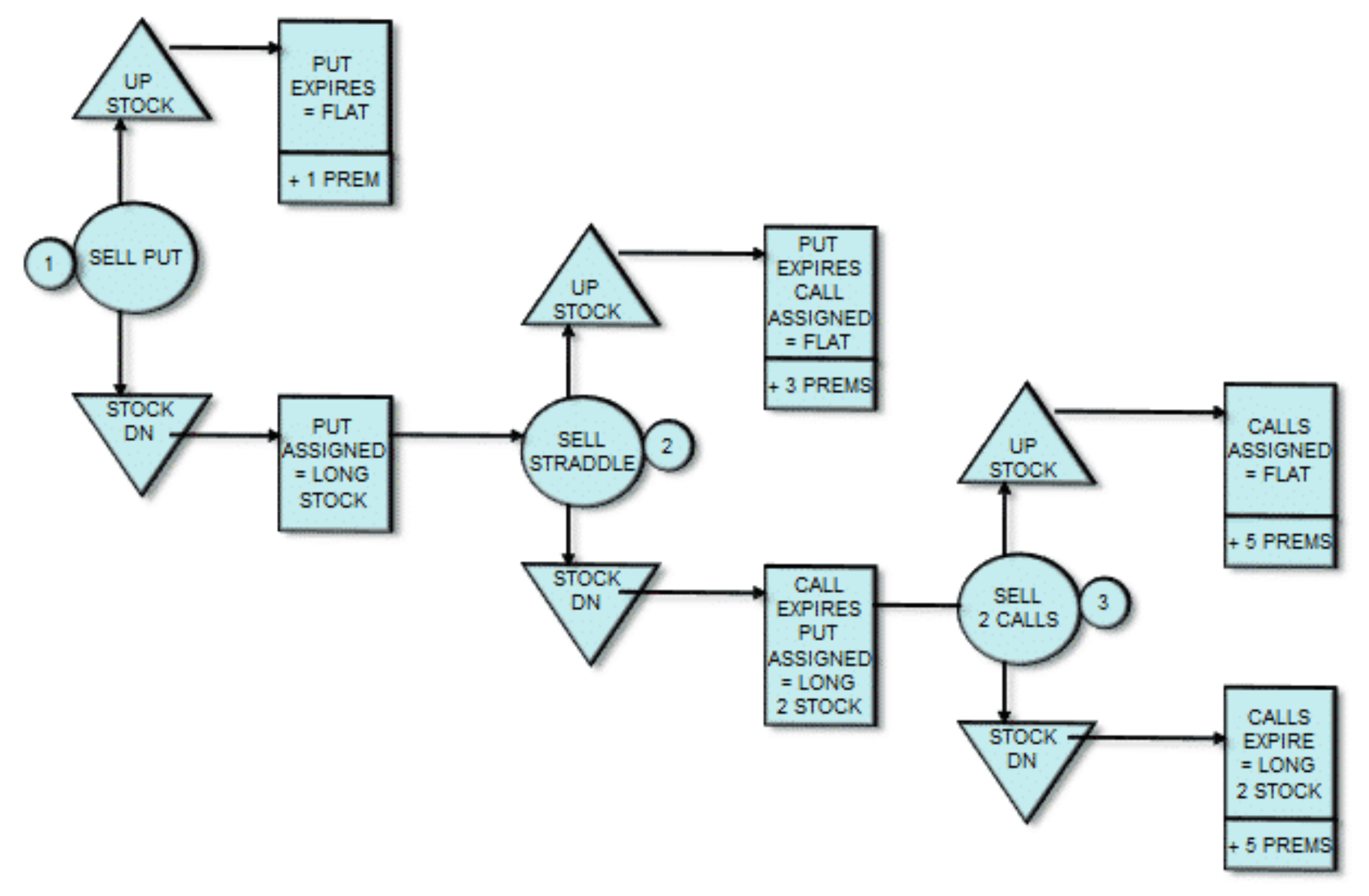
There are a few steps involved in the wheel option strategy:
Sell a cash-secured put
You are supposed to collect a premium without assignment, but you are supposed to take the assignment and hold the stock if the put is assigned.
Create a straddle
When a cash-secured put is assigned, sell a covered call and an additional cash-secured put to create a straddle.
Sell two covered calls.
You will receive three premium payments if the stock goes up and the assigned call option. If the stock declines and you are assigned 200 shares, you can sell two covered call options, resulting in five premium payments.
To sell the stock, continue selling covered calls.
In addition to acquiring shares throughput assignments, you also continue to sell covered calls across your entire position. You can begin the process again once the covered calls are assigned. It is possible to use the same stock again or a different one.
The wheel option can be simplified by omitting some steps:
A cash-secured put may be sold to collect premiums without assignment.
If the stock is assigned to you, sell covered calls against it until exercised.
You should repeat the process once you sell the stock through an assignment. It can be repeated on the same stock or a different one.
The biggest risk with this strategy is to average down too far, as this can result in a capital loss that exceeds the premium payments received. In lesser cases, you may face a significant opportunity cost when the stock rises sharply higher since you must sell the stock at the covered call strike price.
How does wheel strategy work?
The wheel option trading strategy uses a combination of trades to collect premiums. You should have around $10,000 in cash, plus a margin to get the best results. SPY, QQQ, TNA, MSFT, and AMZN are some of the best stocks for the wheel strategy.
To make the most out of stock wheel strategy, you should focus on the following three key trades:
Sell out of the money put.
Get the shares assigned.
Sell a covered call on those shares.
It would help with the money sale to implement the wheel trading strategy. If you own the option at the strike price on or before the expiration date, you have the right but do not have a legal obligation to hold the underlying security. You will receive a premium when you sell a placement option, which you may keep regardless of the purchase outcome.
Examples of Wheel strategy
You can understand the wheel options strategy better with the help of the following examples. Let's consider one:
$ABC is currently trading at the rate of $100 per share
Goal: To purchase $ABC at $98/share with a target of $120
Enter Buy Limit @ $98 | Sell Oct 15, $98 Put @$2 | |
Risk | $98/share | $96/share ($98-$2 premium received) |
Reward | $22/share ($120-$98) | $24/share ($120-$96) |
Profitable | Above $98 | Above $96 |
Time | No exposure until $ABC declines to $98 | Rinse and repeat as income strategy until $ABC declines to $98 |
As shown above, $ABC stock can be acquired for $2 per share less than a buy limit order. A short-term retracement would be ideal for this strategy before a long-term rise. Investors should maintain a neutral to slightly bearish short-term outlook, meanwhile maintaining a bullish long-term outlook.
The investor keeps the premium received as income without assignment and no strike price. It is possible to generate an income stream by repeating cash-secured puts each period. For example, if the investor acquired the stock at $98, they could begin selling covered calls to maximize capital appreciation by selling the stock after a sharp rally:
After acquiring the stock from selling the short put, the investor now owns 100 shares of stock $ABC with a current market price of $98.
The goal is to sell $ABC @ $120 after the rally.
Enter Sell Limit @ $120 | Sell Oct $120 Call @$2 | |
Risk | $96/share ($98 – $2 premium received from short put) | $94/share ($98-$2-$2) (premium of covered call and premium from selling cash secured put) |
Reward | $24/share ($120-$96) | $26/share ($120-$96-$2) |
Profitable | Above $96 | Above $94 ($98-$2-$2) |
Time | Exposure until $ABC rises to $120 | Rinse and repeat as income strategy until $ABC rises to $120 |
Risks of option wheel strategy
Financial markets are a place where there are no free lunches. No matter how safe a trading strategy looks, there will ALWAYS be risk associated with it. For example, options are a good example of a dumpster fire. This is why they're compared to casinos.
Your wins are big, and your losses are even bigger.
A similar strategy is the Options Wheel. Again, it can be very risky if you are unsure of what you are doing. However, you must understand and accept this strategy despite the risk of losing money.
Is it possible to lose money trading options by wheel strategy?
Options wheels are based on a simple concept. When you sell calls or puts, you collect premiums and wait for theta decay. However, it becomes problematic when you're assigned stocks and market tanks.
We will simulate the sale of a cash-secured put on AAPL at the strike price of $100 just before COVID. Imagine you have a $5 loss after collecting $100.00 in premium on March 9th. The share price is now $95, and you've been assigned the stock.
The markets go haywire next week as Apple's stock drops quickly to $80, causing a 20% loss for you. The stock could reverse its trend at this point and rally past your strike price, ensuring a realized loss if you sell a covered call at this point. You will seldom make any money from a $100 covered call because since you bought the stock at $100, it is so far out of the money.
If you don't want to let this happen, you should wait for the stocks to return to the area you purchased them at when you first bought them. Unfortunately, you can't predict how much time it will take, and it might take a few weeks or a few years. This is often referred to as "bag holding."
Opportunity cost
Selling puts the first step in option wheeling. A stock on an uptrend means that your put options will always expire worthless, which means you can sell additional puts and keep all the premium. Although it is easy to earn a steady income, collecting premiums means you miss out on the stock's appreciation.
It would have been far better to buy 100 shares and sell covered calls continuously instead of selling puts. The critics of the options wheel often emphasize this fact, and they claim that selling covered calls is more profitable than selling options. However, it would help if you kept it in mind as it is not a common risk.
Risk is relatively low with the options wheel strategy
One of the lower-risk strategies for options trading is the options wheel. The risk will never be absolute if you choose blue-chip names with little YOLO.
If you're assigned a stock that reaches zero and your portfolio disappears, the maximum loss is your entire portfolio. However, if you select the right long-term stable names for your retirement account, you should not have to worry about that happening.
Long-term investors should buy stocks they want to hold.
Choosing stocks that you are bullish on in the long term is one of the most important things you should do when trading the Options Wheel to manage risk. You can face a market crash by chance, and you wouldn't mind holding these stocks since you know the market will eventually recover.
To reduce risk, you should invest primarily in blue-chip stocks. There is never a free lunch, and stable stocks are less volatile, resulting in lower premiums.
Likely, you won't see that great returns if you tend to wheel smaller ETFs like XLF. Simple and safe, but plain and boring.
In contrast, while it is true that wheeling some of the higher IV stocks might yield better returns, you need to keep in mind that those stocks have such high IVs for good reasons – their prices are subject to high volatility. So if you keep an eye on those stocks, that might be true.
Ideally, it is preferable to stick with a stable stock with a strong balance sheet and fundamentals or just major index ETFs.
Alternatives strategies to consider
To earn income, the options wheel strategy mostly relies on cash secured puts, while covered calls serve as insurance against stock assignment losses. It may be worthwhile to consider alternative strategies to maximize upside potential, reduce risk, or target specific outcomes in different market conditions, depending on your goals.
There are other income-generating options as well, such as:
A call option generates additional income on a long stock position in covered calls. The strategy is more profitable when the stock moves near the strike price without exceeding it.
Matching options are bought and sold with different expiration dates and strike prices in a credit spread. Traders have a lot of flexibility with spreads, which can be bearish, bullish, or neutral depending upon the options selected.
Selling a cash-secured put involves selling the option and setting aside enough cash to buy the stock if the put is assigned. Investors can use CSPs to strategically acquire stocks rather than write out-of-the-money options, such as the wheel option strategy.
The key to using any option strategy is understanding its pros and cons and risks. In addition, you can review how to minimize losses by rolling up or down to a different strike price or extending expiration dates.
Best practices and tips of wheel strategy
Let's find out the best tips and practices to use the wheel options strategy.
Stock selection
A good tip for the wheel strategy is to pick a small basket of stocks, around five to ten, that you are comfortable trading and holding. The guideline for the stock selection is not fixed, but you should choose stocks that you feel comfortable holding for a long time.
The following is a stock selection criteria you may refer to:
Holding the stock for a period longer than two years
The price movement over the long term has been predictable and bullish
You can afford an assignment if it costs $10-$50 if you share the share price between them
You will receive an additional stream of income if you choose to receive a nice dividend on this stock, and you will remain assigned long-term.
There may be instances where specific stocks will not perform the wheel strategy, such as high-risk trades that yield low rewards or are too expensive to execute. Therefore, choosing a small basket of stocks that meet your criteria is imperative to your success.
Sell cash-secured puts (CSPs)
As soon as you have decided which stock you will use for the wheel strategy, you will need to sell a CSP. Then, if the option is assigned, you can buy over the shares at the strike price if you sell a cash-secured put. The key difference is you have the capital to buy over the shares at the strike price you choose.
While strategies are successful when the strike price and the expiration date ate chosen correctly thus, the following criteria can help determine which specific option is best for selling CSPs.
A good time decay state is 30 to 45 days to expiry (DTE) because it offers a good premium.
More than 70% probability of expiring out of the money (OTM), which is also *0.3 delta
The number of contracts depends on the number of shares assigned to the account.
If profits are greater than 50% 15 days before expiration, close, otherwise hold until expiration.
(Optional) If possible, roll for credit
Some traders would recommend never closing for profits and holding until expiration. This is because you risk losing your profits right before expiration if the share price moves against you. However, if you want to prevent this, it is possible to close the position early and open a new one later.
To collect as much premium as possible, CSPs should be able to sell over and over. Then, if the stock fundamentally changes, close the position for a net profit and move on to the next stock in your basket.
Bottom line
Overall, the wheel strategy is an excellent options strategy for investors seeking to accumulate stock over the long term and generate consistent streams of income that can lower the cost-per-share. The strategy sounds good in theory, but it certainly has disadvantages such as being assigned shares for a long period and keeping your capital "stuck." Therefore, investors must understand when to apply this strategy to avoid losses and maximize profits.
This strategy, also known as the Triple Income Strategy, aims to generate premium income by using cash-secured put, straddle, and covered call options. You can increase your chances of success by following these stock and option selection tips and start generating more income than only conventional dividend stocks and fixed-income investments.
A key objective is to ensure consistent income during retirement by utilizing a combination of stocks, options, and cash and specific methods to maximize potential income.


Trending Articles
- Who Is Andrew Tate and Why Is He Famous? 10 Things to Know the Controversial Influencer
Discover who is Andrew Tate and why he's making waves in the digital sphere. Uncover 10 intriguing facts about this controversial influencer, his journey, and his impact on the online world.
2024-03-01 TOPONE Markets Analyst - Andrew Tate Net Worth 2024: Is the Internet's Most Controversial Man Worth $800 Million?
Explore the enigmatic Andrew Tate's net worth and delve into the controversies surrounding the internet's most polarizing figure. Is he truly worth $800 million? Uncover the truth behind his wealth and reputation here.
2024-02-23 TOPONE Markets Analyst - 20 Strongest Currencies in the World in 2024
Want to know the strongest currencies in the world in 2024? Here are the list for you!
2024-01-30 TOPONE Markets Analyst - Falling Wedge Pattern: The Ultimate Guide
A falling wedge is a bullish pattern characterized by a wide top and shrinking bottom. It is an extremely bullish pattern in a trading market.
2023-09-25 TOPONE Markets Analyst

 Bonus!

Bonus rebate to help investors grow in the trading world!