English






How Will the Four Outcomes of the U.S. Election Affect Your Investments?
As the U.S. election on November 5 approaches, there are only two weeks left. The election situation is unprecedentedly fierce and uncertain. At such a historic moment, how should we seize the opportunity and make smart investment arrangements?

 11324
11324


1.Time Arrangement of the U.S. Elections
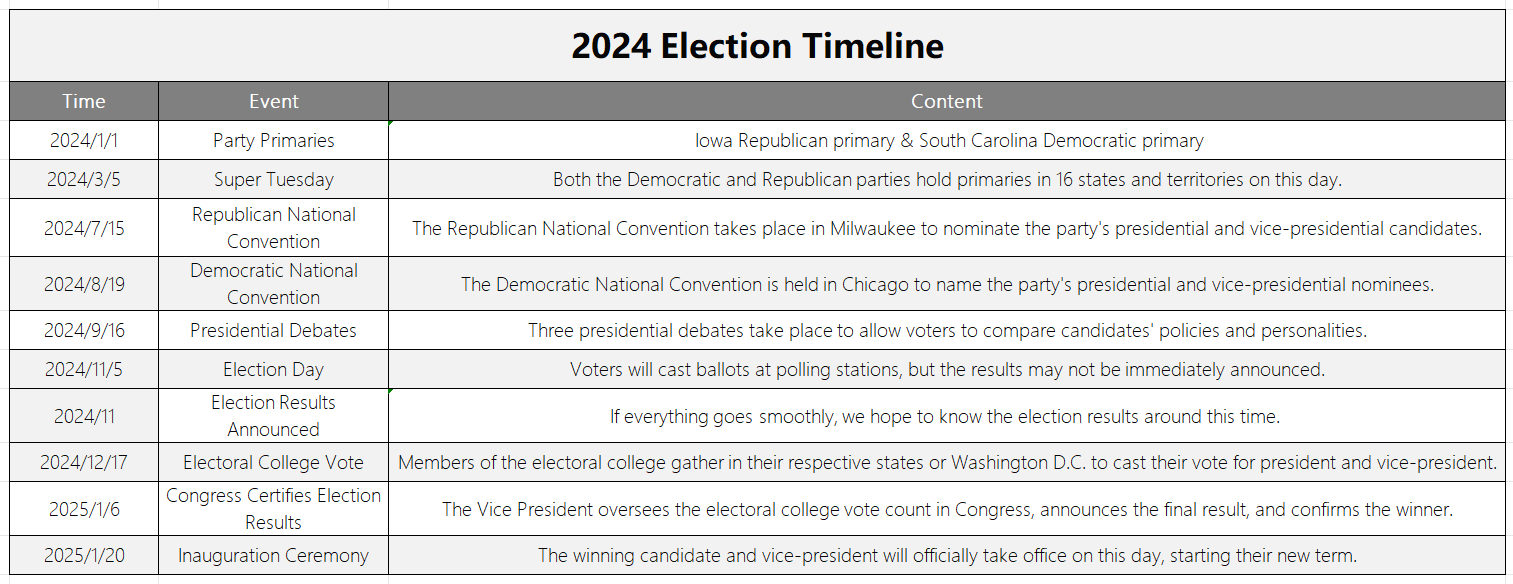
Let’s first understand the schedule of the US election
1. Intra-party Primaries
Starting in January 2024, the Iowa Republican Party and the South Carolina Democratic Party hold their primaries.
2. Super Tuesday
On March 5, the Democratic Party and the Republican Party held primaries in 16 states and regions respectively. This is the most important day in the primaries and can usually determine the success or failure of candidates.
3. National Congress
From July 15 to 18, the Republican National Convention was held in Milwaukee; from August 19 to 22, the Democratic National Convention was held in Chicago. These conventions will formally nominate each party's presidential and vice presidential candidates.
4. Presidential Candidate Debates
From September 16 to October 9, three presidential candidate debates will be held to provide voters with the opportunity to compare the policies and personalities of different candidates.
5. Election Day
On November 5, voters voted for electors to form the Electoral College. This is the climax of the election. Although not the final presidential election, the results of the Electoral College vote are usually determined that night.
6. Electoral College Voting
On December 16, the Electoral College votes in each state capital to elect the president. This is according to the procedures stipulated in the U.S. Constitution. The Electoral College vote actually determines the outcome of the presidential election.
7. Presidential Inauguration Day
On January 20, 2025, the new president and vice president were sworn in. This is the official start of a new government and marks the official end of the electoral process.
2. Who is the final winner? Hard to tell until the last minute!
As Bitcoin, the U.S. dollar index, and U.S. Treasury bond rates rise, the market seems to have formed a consensus: If Trump is re-elected, it may bring a new round of inflationary pressure. Investors are reassessing the impact a Trump administration could have on financial markets.
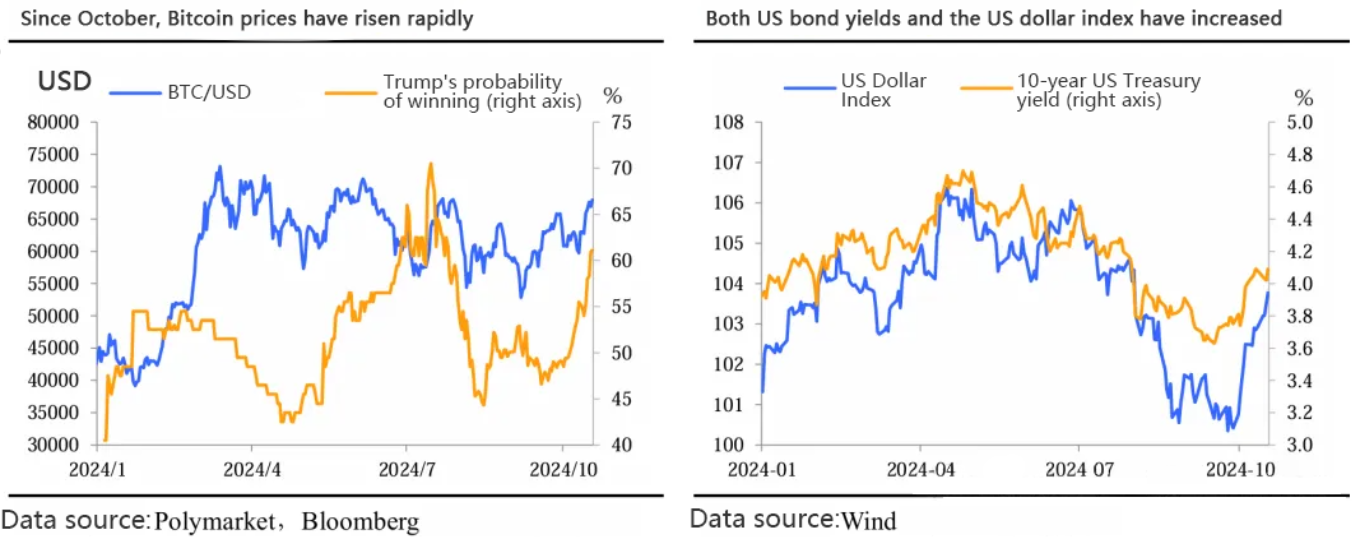
Currently, Trump's probability of winning is significantly higher than Harris's. Trump's probability of winning has risen sharply to 61%, 12 percentage points ahead of Harris, according to Polymarket data. This trend reflects the market's optimism for Trump.
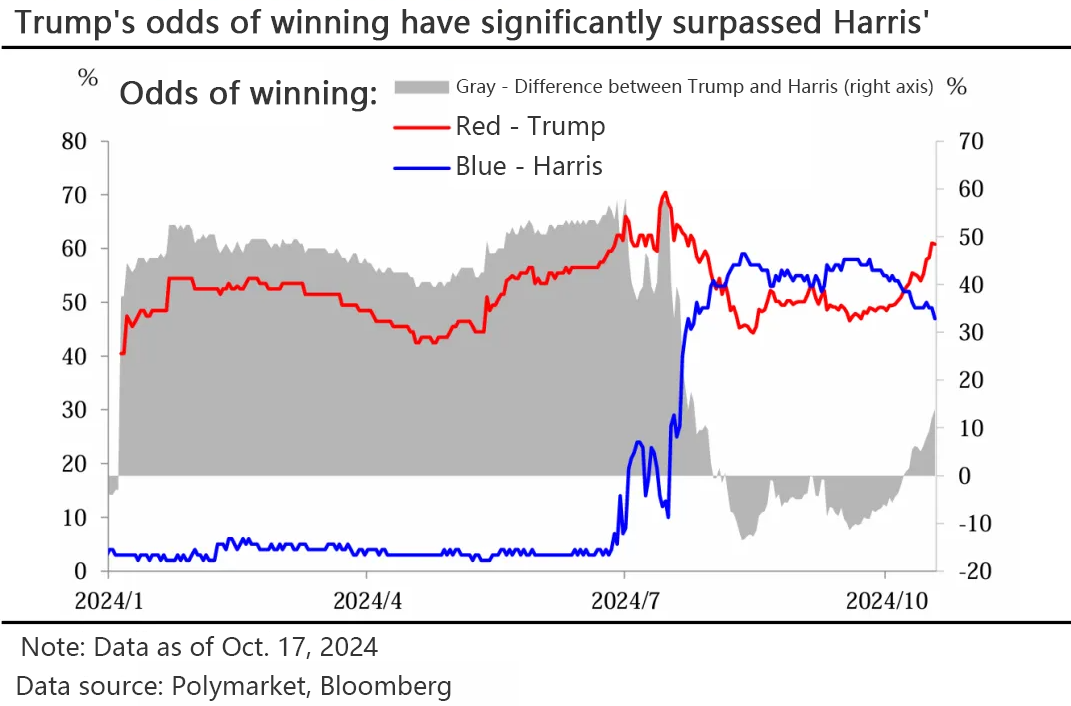
In key swing states, Trump's approval rating also showed a trend of comprehensively surpassing Harris. Historically, support in swing states has often determined the final outcome of an election. Data as of October 17 show that Trump has taken the lead in many key swing states, including Arizona, North Carolina, and Georgia.
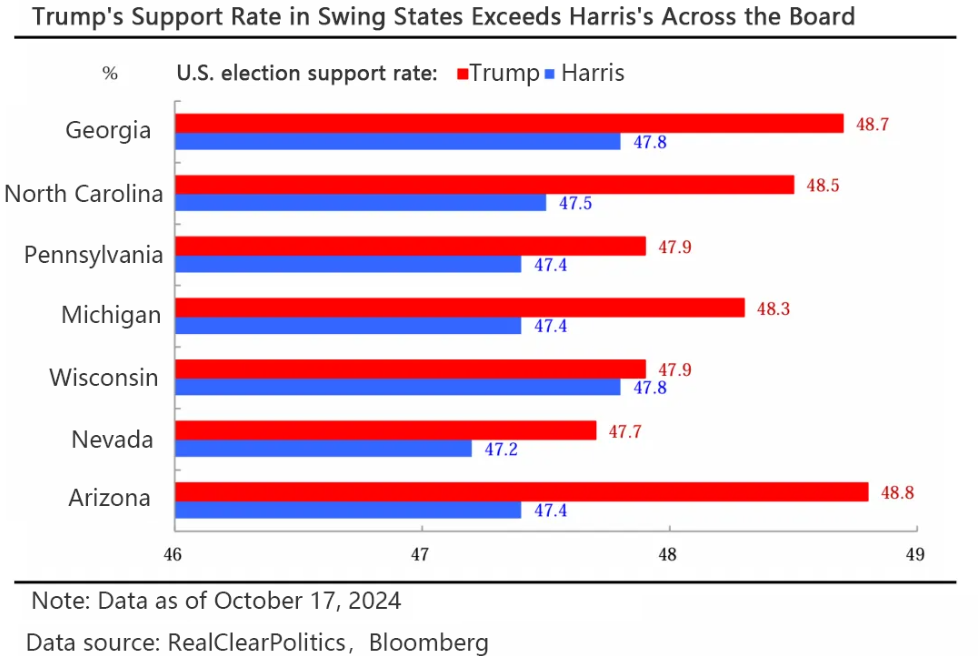
In addition, he also achieved overtakes over Harris in Nevada, Wisconsin, Michigan and Pennsylvania. The lead in Michigan is particularly significant, reaching 0.9 percentage points. These changes have increased Trump's chances of winning a second term.
3. The Influence of Various Parties on Assets
Overall, we can observe an interesting phenomenon from historical data: every three weeks before an election, the market often begins to anticipate the victory of the Republican presidential candidate, and performs more strongly under this expectation. In comparison, the market performance during the Democratic presidential candidate's administration was slightly worse.
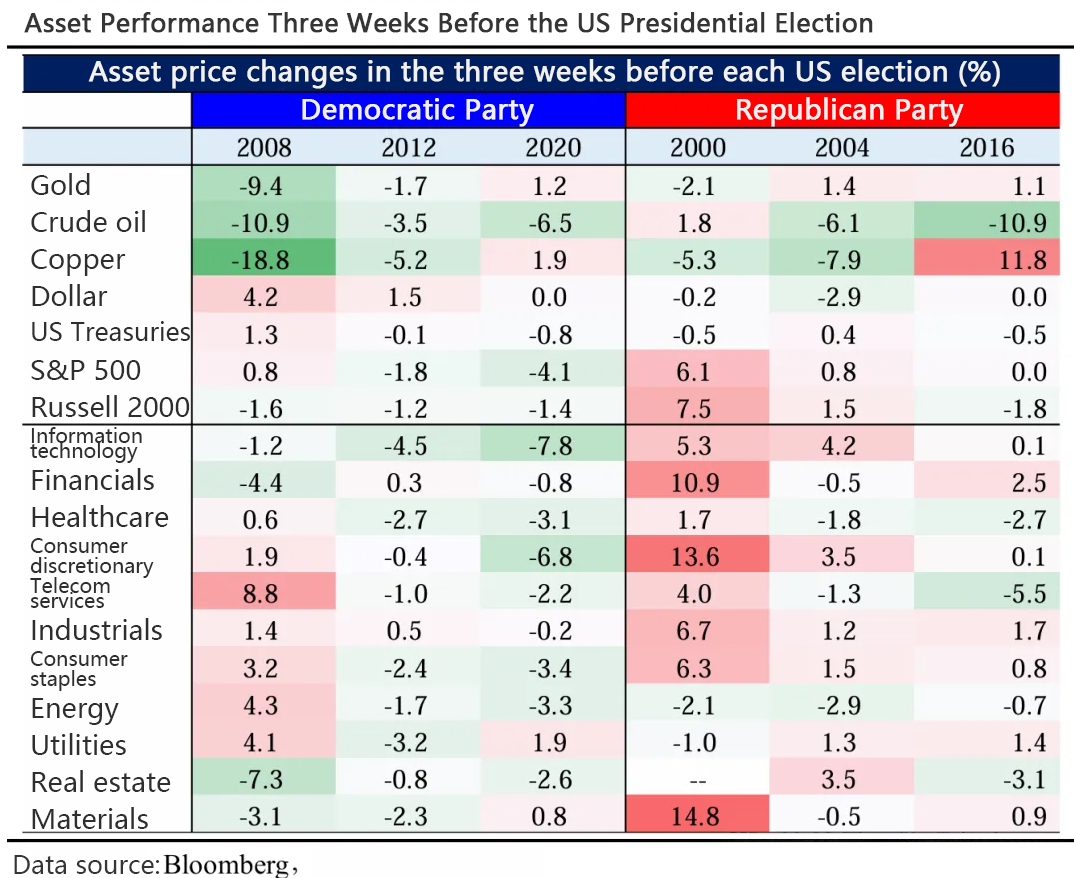
However, the role of Congress cannot be underestimated in whether the president's policies can be smoothly promoted and finally implemented. In the process of policy formulation and implementation, Congress's influence and decision-making power often play a decisive role in the final effectiveness of the policy.
Therefore, when evaluating policy expectations, investors should also pay close attention to developments in Congress, in addition to paying attention to the campaign promises of presidential candidates, to obtain more comprehensive market insights.
4. What Investment Changes Will Be Brought After the Election?
Based on betting market odds, we carefully analyzed four possible election outcomes and predicted their potential impact on asset prices: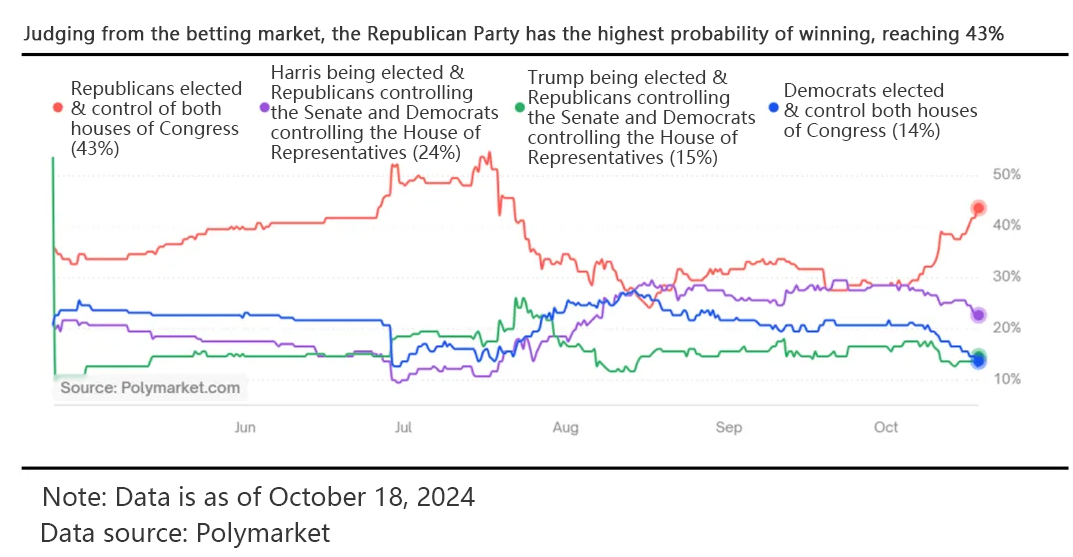
Scenario 1: The Republican Party wins a landslide (probability 43%)
In this case, Trump will smoothly implement his policies, including deep tax cuts and deregulation. These measures will be positive for U.S. stocks. At the same time, the U.S. Treasury market may face selling pressure due to policy resonance, such as increased tariffs and tightened immigration policies, which may bring upward momentum to the U.S. dollar.
Scenario 2: Trump is elected, but Congress is divided (probability 15%)
Trump will face a Democratic-controlled House of Representatives, which will limit his ability to implement policies. Therefore, the rise in U.S. stocks may be more modest. The U.S. dollar and gold are likely to perform relatively flat, while the U.S. Treasury market is relatively less stressed.
Scenario 3: The Democratic Party takes full power (probability 14%)
If Harris is elected, she may raise corporate and wealthy taxes, which will put pressure on U.S. stocks. The U.S. dollar is likely to weaken amid the risk of a recession. However, the upward pressure on U.S. bond interest rates will be less than if Trump is elected because Harris's fiscal policy is relatively dovish.
Scenario 4: Harris is elected, but Congress is divided (24% probability)
In this case, Harris's policy implementation will be limited, especially the tax increase policy. This may cause short-term pressure on U.S. stocks, but it also provides the possibility of structural investment opportunities. Other assets may perform relatively neutrally.
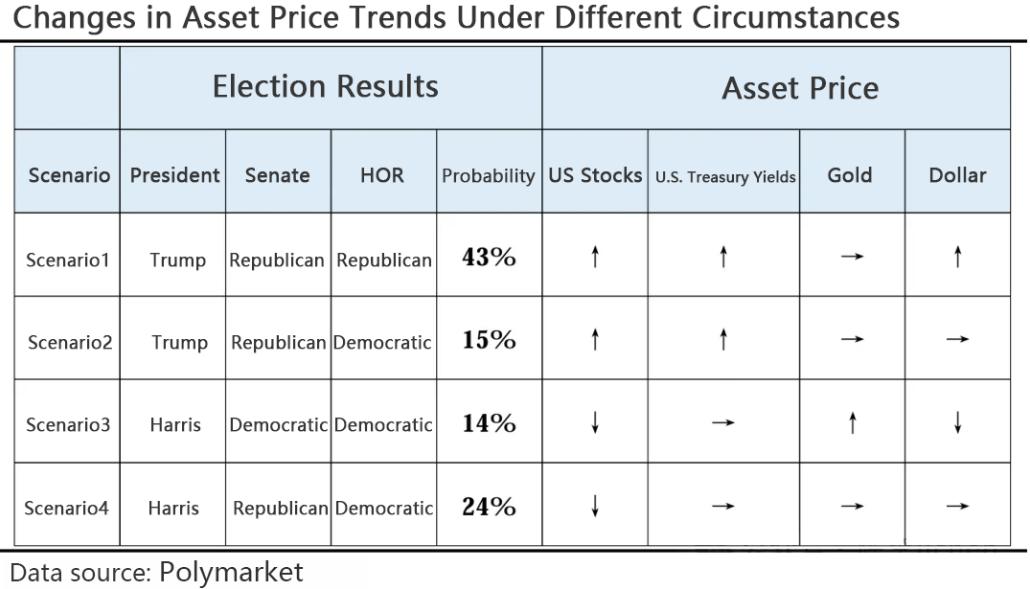
The current market tends to believe that the Republican Party is most likely to win overall. However, market volatility also requires attention to two key factors:
1. The impact of mail-in ballots
The number of mail-in ballots has increased as the pandemic continues. This could lead to a delay in the announcement of election results, affecting market expectations.
2. Risk of constitutional crisis
As seen in 2016 and 2020, election results can be surprising even when the polls are ahead. Any sign of a constitutional crisis could exacerbate market volatility and lead to confusing trading signals.


Trending Articles
- Who Is Andrew Tate and Why Is He Famous? 10 Things to Know the Controversial Influencer
Discover who is Andrew Tate and why he's making waves in the digital sphere. Uncover 10 intriguing facts about this controversial influencer, his journey, and his impact on the online world.
2024-03-01 TOPONE Markets Analyst - Andrew Tate Net Worth 2024: Is the Internet's Most Controversial Man Worth $800 Million?
Explore the enigmatic Andrew Tate's net worth and delve into the controversies surrounding the internet's most polarizing figure. Is he truly worth $800 million? Uncover the truth behind his wealth and reputation here.
2024-02-23 TOPONE Markets Analyst - 20 Strongest Currencies in the World in 2024
Want to know the strongest currencies in the world in 2024? Here are the list for you!
2024-01-30 TOPONE Markets Analyst - Falling Wedge Pattern: The Ultimate Guide
A falling wedge is a bullish pattern characterized by a wide top and shrinking bottom. It is an extremely bullish pattern in a trading market.
2023-09-25 TOPONE Markets Analyst

 Bonus!

Bonus rebate to help investors grow in the trading world!