English






Crude Oil Becomes Most Valuable Commodity After US Debt Ceiling Lifted
Why crude oil can rise among many investment products, and how can we complete the investment that maximizes returns, an article covers it all!

 10261
10261Why crude oil will become a commodity chased by the investment market
As of June 5 (Monday), the price of US oil was at $74.276/barrel, an increase of $7.144/barrel, or 10.64%, from the price of $67.132/barrel on June 1.
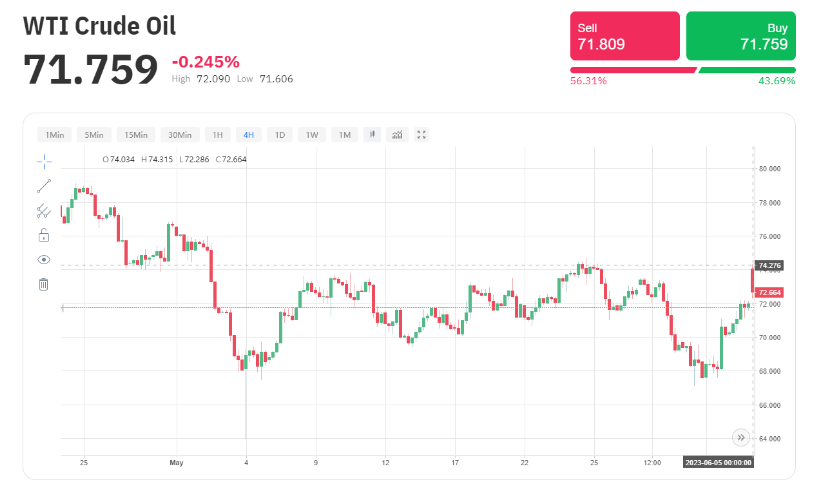
The logic of crude oil price drop before the debt crisis
Anticipation of debt crisis triggers recession fearsDebt crises are often closely associated with economic instability and recession. When a debt crisis occurs, credit liquidity decreases, corporate and individual borrowing capacity is restricted, investment and consumption activities weaken, and economic growth slows down or even appears negative, causing oil prices to fall.
The debt crisis is expected to trigger a supply-demand imbalance crisisRecessions lead to lower demand, especially for commodities like oil. Companies reduce production and operations, and consumers reduce energy use, resulting in lower demand for crude oil. At the same time, demand for alternative energy sources, such as renewable energy, may be relatively low due to a slowing economy, thus reducing the need for alternatives to crude oil.
The debt crisis is expected to trigger a recession in global tradeDebt crises typically lead to weaker global trade activity. Due to economic instability and recession, orders from multinational companies and international trade volumes may decline, which reduces transportation demand.
Crude oil is an important source of energy for the transportation business, and a drop in demand will put pressure on crude oil prices.
Debt crisis is expected to trigger a decline in capital liquidityUncertainty stemming from the debt crisis could lead capital to flee riskier markets, with investors seeking safe-haven assets. That could lead to turmoil in financial markets, with stock markets falling and crude oil generally considered a risky asset. When investors flee risky assets, they may sell crude oil futures contracts or other financial products related to crude oil, causing crude oil prices to fall.Therefore, before the maturity of U.S. debt, the expectation of U.S. debt will lead to a decline in crude oil, which is a performance in line with market expectations.
The Debt Ceiling Crisis Undoes the Logic of Rising Crude Oil Prices
The end of the crisis brings expectations of economic recovery After the debt crisis is lifted, there will be a wave of recovery expectations for the US economy. Economic recovery means increased demand, and crude oil, as an important part of energy, will play an important role in economic recovery. As economic activity increases, so does demand for crude oil, making crude a focus for investors.
The end of the crisis brings inflation expectationsAfter the debt crisis is lifted, the government usually takes some measures to stimulate economic growth, such as loosening monetary policy or increasing fiscal expenditure. Such a move is completely opposite to the current policy of raising interest rates in the United States, because after the crisis is resolved, the U.S. government will stop raising interest rates with a high probability, which will lead to an increase in inflation expectations, because the money supply will increase, and consumption and investment activities will intensify. Crude oil is a commodity whose price is often closely related to inflation. Therefore, investors will tend to invest funds in the crude oil market to hedge against inflation risks, leading to a rise in crude oil.
The focus of events has shifted from the debt issue to the war issueThe crude oil market is vulnerable to geopolitical events such as wars, political tensions, natural disasters, etc. After the debt crisis is lifted, some geopolitical and war issues will again occupy the forefront of hot issues, which will also directly affect the market's choice of investment products. As long as the war continues, investors' confidence in the crude oil market will continue to increase. With attention, crude oil will rely on its investment enthusiasm, and the price will rise.Therefore, the above factors can explain the main reason why crude oil prices will rebound in retaliation after the debt problem is resolved.
Crude oil future trend interpretation and strategy formulation
Recently, the crude oil market has been affected by Saudi Arabia's commitment to cut production.
They said that they will further cut production by 1 million barrels per day starting in July in response to the current macroeconomic headwinds that are suppressing the market.
This pledge to cut production is seen as a signal of tighter supply, which we believe sets a floor for oil prices at $70 a barrel.However, it is important to note that Saudi Arabia's production cuts will not immediately lead to a sharp increase in oil prices, because the reduction of inventories will take time.
Supply is expected to tighten sharply in the second half of the year, which increases the possibility of a strong rebound in crude oil prices to a certain extent.In addition, Saudi Arabia will also raise the official selling price of Arabian Light crude oil to Asian customers in July to a six-month high, which, together with the support of geopolitical tensions, will keep the bullish view on oil prices.
It is important to note that the U.S. is likely to work with oil producers and consumers to ensure lower oil prices, which may limit the short-term rise in oil prices.
Therefore, it is necessary to pay close attention to whether the United States will further lower oil prices.
Combined with the debt crisis relief event, the high probability of crude oil will continue to trend upward, but the actual trend, we still need to continue to conduct further analysis of the current crude oil K-line.
Technical Analysis
Yesterday (June 5) the crude oil market opened high and moved low, and a long Yin line was formed at the close. It can be seen that the oil price is still under the pressure of the 74.70 high point pressure level, and there is no breakthrough trend.
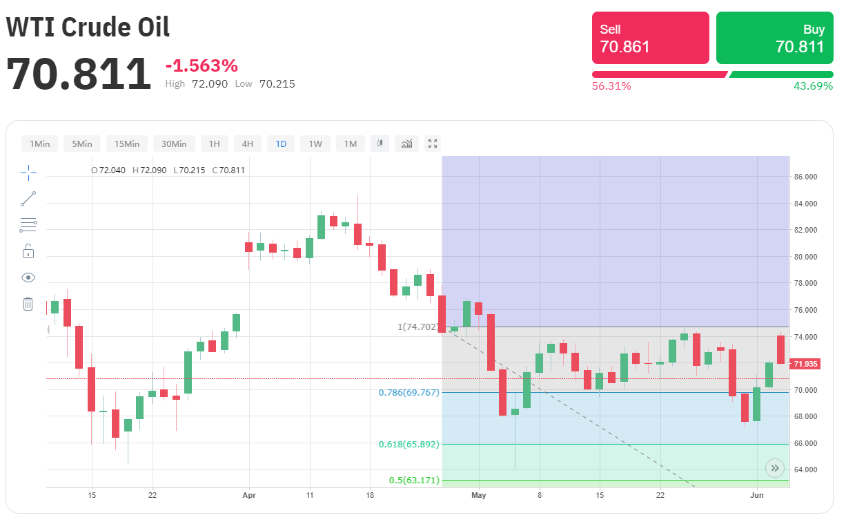
From the daily chart, the current crude oil price is in a contracting range, and a breakthrough is needed to determine the further direction of the trend. The lower support range is relatively stable between 69.761-69.913. The upper resistance level is at 74.70, which needs a breakthrough to open up space.
Therefore, in the short term, the daily chart shows contraction and volatility, and we need to wait for the continuation of the breakthrough signal.
On the 4-hour chart, there are shrinkage shocks in the local contraction range, and the lower support is relatively stable between 72.289-71.678, but the upper part has not yet broken through 74.70, so the current space is limited.
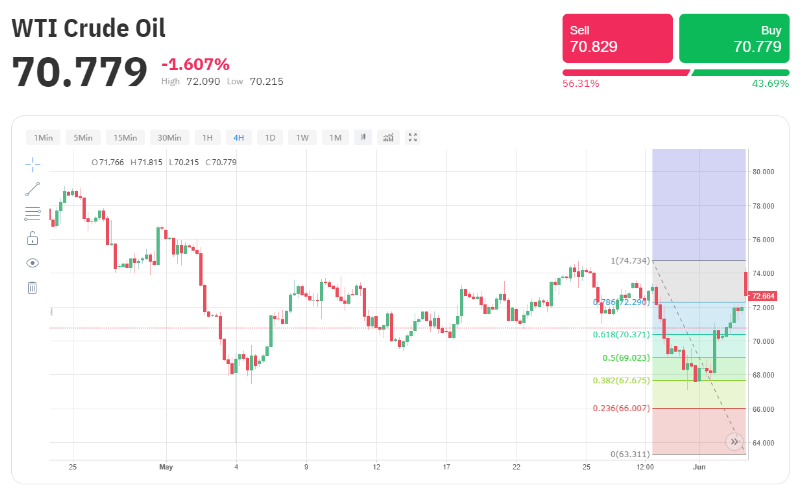
In terms of short-term operations, it is recommended to mainly focus on [calling back to do long], supplemented by shorting at high rebounds. Pay attention to the space between the upper resistance level of 74.343-74.420 and the lower support level of 72.289-71.678. On the whole, crude oil may still go through a period of consolidation and correction in the short term, and we just need to seize the opportunity and [go long on dips].
Why CFD investment can maximize the income of crude oil
If we adopt the trading strategy of long crude oil according to the investment suggestions formulated above, which investment method will be more convenient to operate, with lower risks and higher yields?
Compare the transaction convenience of different investment products
The following is a comparison table of transaction convenience of products that can invest in crude oil:
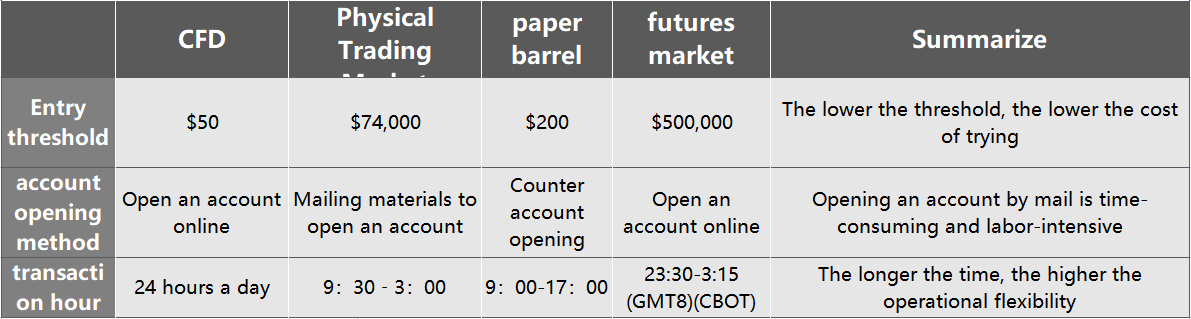
For transaction convenience, we need to consider the deposit threshold, account opening method and transaction time.
1.The impact of deposit threshold on transaction convenience
The entry threshold determines how much money we can use to try crude oil investment and trading. The lower the entry threshold, the higher the convenience.
2. The impact of account opening methods on transaction convenience
The way of opening an account determines the time and energy we spend when trying to invest in crude oil. The less time and energy is spent, the higher the convenience. Opening an account online is better than opening an account by mail, and opening an account by mail is better than opening an account over the counter.
3. The impact of transaction time on transaction convenience
The trading time is related to whether we can allocate investment time according to our own conditions and environment. The longer the time, the more flexible and the more convenient investment.Comprehensive consideration, the ranking of transaction convenience is:
CFD > paper barrel > physical transaction > futures market
Compare the risk rate of different investment products
The following is a risk assessment comparison table for products that can invest in crude oil:
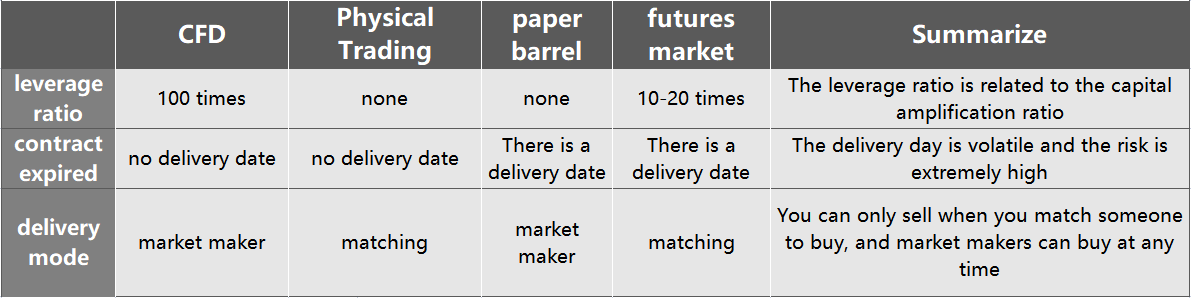
Trading risk We need to consider the leverage ratio, whether there is a contract expiration date and the delivery mode.
1. The influence of the leverage ratio on the risk rate
The higher the leverage ratio, the greater the risk.
2. The impact of contract expiration on the risk rate
Whether the contract expires or not affects the price stability of the product. Generally, the price of a product with a delivery date will fluctuate greatly, and the risk factor will also increase.
3. The impact of the delivery mode on the risk rate
The matching trading model considers the heat of the market. Once the market heat is low, there will be situations where you cannot buy or sell. Therefore, the matching trading model has a higher risk rate than the market maker model.
Comprehensive consideration, the ranking of risk rate is:
physical transaction > crude oil passbook > contract for difference > futures market
Compare the returns of different investment products
The following is a comparison table of income models of products that can invest in crude oil:
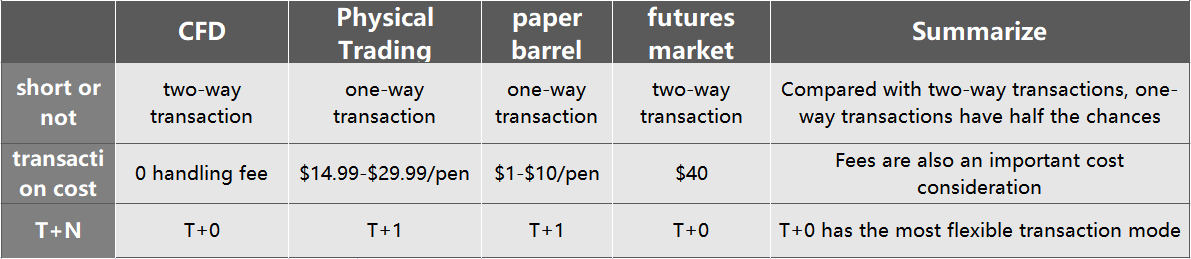
We need to consider whether two-way transactions, transaction cost control and transaction time intervals are required for the rate of return.
1. Whether two-way trading can affect the rate of return
Two-way trading can effectively use every market and opportunity. The market does not need to be limited to rising and falling, which doubles the profit opportunities. Therefore, the profit opportunities of products with two-way trading are higher than those of one-way trading products.
2. The impact of transaction cost control on the rate of return
In addition to calculating profit and profit, investment also needs to add investment cost. Handling fee, as the cost of investment, becomes one of the conditions for increasing profit under the same conditions. The lower the handling fee, the higher the cost. income.
3. The impact of trading time interval on the rate of return
The trading time interval is related to our control over emergencies. Once there is a big positive or negative news, whether we can operate immediately. This requires the support of the T+0 model, and T+1 is compared to T+0. With a waiting period of one day, the rate of return will also be greatly reduced.
Comprehensive consideration, the income model ranking is:
CFD>futures market>crude oil passbook>physical transaction
Example:
Let's compare it with the known market of crude oil
Cost: $100000,
Points: short the price of $72.644/barrel on May 30 to $67.132/barrel on June 1.
The price of $67.132/barrel on June 1 is long to $74.276/barrel on June 5.
Using 4 different products to operate respectively, the yields obtained are:
1. Physical transaction
Short order profit: Cannot short, the profit is 0
Profit from multiple orders: (74.276 (closing price) - 67.132 (opening price)) X1489 (barrels of crude oil) - 20 (handling fee) X5 (days) = $10537.416
The total profit is: 0 (short order profit) + 10537.416 (long order profit) = $10537.416
Total profit: 10537.416 (total profit) / 100000 (cost) X 100% = 10.53%
2. Passbook for crude oil
Short order profit: Cannot short, the profit is 0
Profit from multiple orders: (74.276 (closing price) - 67.132 (opening price)) X1489 (barrels of crude oil) - 10 (handling fee) X5 (days) = $10587.416
The total profit is: 0 (short order profit) + 10587.416 (long order profit) = $10587.416
Total profit: 10587.416 (total profit) / 100000 (cost) X 100% = 10.58%
3. Futures market
Short order profit: (72.644 (opening price) -67.132 (closing price)) X1376 (barrels of crude oil) X20 (leverage multiple) -40 (handling fee) X3 (days) = $151570.24
Profit from multiple orders: (74.276 (closing price) -67.132 (opening price)) X1489 (barrels of crude oil) X20 (leverage multiple) -40 (handling fee) X5 (number of days) = $212548.32
The total profit is: 151570.24 (short order profit) + 212548.32 (long order profit) = $364118.56
Total profit: 364118.56 (total profit) / 100000 (cost) X 100% = 364.11%
4. CFD
Short order profit: (72.644 (opening price) -67.132 (closing price)) X1376 (barrels of crude oil) X100 (leverage multiple) -0 (handling fee) X3 (days) = $758451.2
Profit from multiple orders: (74.276 (closing price) - 67.132 (opening price)) X1489 (barrels of crude oil) X100 (leverage multiple) - 0 (handling fee) X5 (number of days) = $1063741.6
The total profit is: 758451.2 (short order profit) + 1063741.6 (long order profit) = $1822192.8
Total profit: 1822192.8 (total profit) / 100000 (cost) X 100% = 1822.19%
Summarize
From the analysis of the full text, we understand the reasons for the recent hot market of crude oil, and also disassemble the factors affecting the impact of US debt on crude oil. At the same time, we also made strategic arrangements for the trend of crude oil in the later period. The product that maximizes the return of crude oil, of course, we must always believe in one sentence, the return is directly proportional to the risk, how to amplify the return in a risk-controllable market is the main function and purpose of our article.


Trending Articles

 Bonus!

Bonus rebate to help investors grow in the trading world!