English






US non-farm payrolls data hit 818,000, the largest downward revision in 15 years! Is it a risk or an opportunity?
The US non-farm payrolls have been revised significantly, and the Federal Reserve is about to cut interest rates. How will the economy develop in the future? What investment opportunities will it bring us?

 11382
11382


Introduction
The U.S. Bureau of Labor Statistics disclosed in its latest announcement that it had made a preliminary revision to the non-farm payrolls data for the past 12 months ending March 2024. The results showed that the number of employed people was 818,000 less than the initial estimate, and this revision was in line with the previous forecast range of economists.
The downward revision of the data suggests that the growth momentum of the U.S. job market may not be as strong as previously reported. This may have an impact on the Federal Reserve's interest rate decision next month, increasing the possibility that it will consider a rate cut.
Before this adjustment, data showed that there was a net increase of 2.9 million jobs during the reporting period, an average increase of 242,000 per month. After the revision, the average monthly employment growth rate dropped to 174,000. Although this figure has slowed down from the recovery of the labor market after the epidemic, it still reflects that the U.S. economy is at a relatively healthy level. As usual, the final revised data will be released early next year.
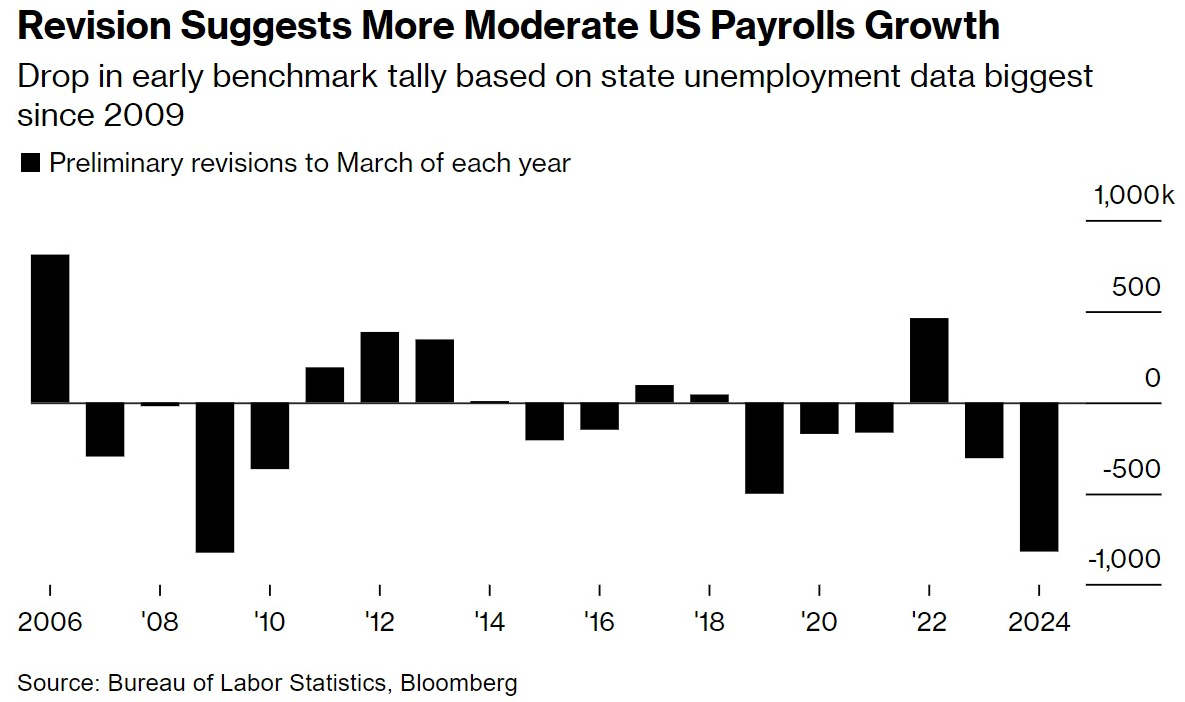
The highest level of initial benchmark data decline since 2009
Why such a massive downward correction?
1. Signs of a labor market slowdown earlier than expected
Revised data suggest that the labor market began to slow much earlier than initially thought. Until earlier this month, markets and economists had been concerned about the release of the July jobs report. Alarm bells were sounded after a weak jobs report and a fourth straight month of increases in the unemployment rate. But other indicators, such as unemployment claims and job openings, suggested a more modest slowdown.
Benchmark revisions are made every year, but this year markets and Fed watchers are paying special attention to them. They look for any signs that the labor market may be cooling faster than initially reported.
Multiple economists said the initial jobs data could be affected by a variety of factors, including adjustments for business creation and closures and how illegal immigrant workers are counted.
2. Significant Decline in Professional and Business Services
Professional and business services accounted for nearly half of the downward revisions. Other industries also declined, including leisure and hospitality, manufacturing and retail.
Economist Anna Wong: We think these revisions suggest that the labor market was operating more sluggishly than most people thought for most of last year. Notably, the downward revisions were mostly due to white-collar industries—such as professional and business services—that tend not to attract large numbers of undocumented workers. This should ease concerns that the benchmark series underestimates undocumented workers.
The Bureau of Labor Statistics compiles its monthly employment report based on two surveys. Wednesday's revisions involve payrolls (collected through a survey of businesses) and do not affect the unemployment rate (derived from a survey of households).
The Bureau of Labor Statistics conducts this annual survey, comparing March employment numbers to a more accurate but less timely source of data, the Quarterly Census of Employment and Wages (QCEW). The data is based on state unemployment insurance tax records and covers almost all U.S. jobs.
The QCEW data, also released on Wednesday, showed a 1.3% increase in employment in the year ending March 2024. In contrast, the annual growth rate, measured by initial monthly payroll data, was 1.9%.

As can be seen in the chart, non-farm payrolls gradually increased from 157.856 million people in January to 158.723 million people in July, but fell to 158.445 million people in August. Although this decline is not particularly large, combined with the full-year growth rate, the downward adjustment in August has attracted great attention from the market. This trend may indicate that the economy is experiencing some degree of slowdown.
Will the massive downward revision affect the September non-farm data?
The downward revision of the non-farm payrolls data in August has exacerbated market concerns about the slowdown in US economic growth. Against this backdrop, investors and economists have begun to speculate whether the Federal Reserve will consider entering the interest rate cut channel to cope with the risk of an economic downturn.

First, the downward revision of the data this time shows that the new employment in the labor market is weaker than expected, but it still has a certain resilience and continues to weaken overall. This trend may be reflected in the data in September. If the labor market continues to show signs of slowing down, the non-farm data in September may also be negatively affected.
In addition, the minutes of the July FOMC meeting of the FED mentioned that if the economic data continues to meet expectations, it is appropriate to relax monetary policy in September. This means that if the non-farm data in September show a further slowdown in the labor market, the Federal Reserve may consider cutting interest rates to stimulate economic activity and support the stability of the job market.
At the same time, the market's expectations for the Federal Reserve's interest rate cut in September are relatively clear, which may have a certain psychological impact on the non-farm data in September. If the market generally expects a rate cut, investors and companies may take a more cautious attitude before the data is released, which may also affect the performance of non-farm data to a certain extent.
So, in general, the downward revision of the non-farm data in August may exacerbate market concerns about the slowdown in US economic growth, which will have a certain negative impact on the non-farm data in September.
The Fed's potential interest rate cuts and market expectations may also affect the performance of the non-farm data in September to a certain extent. However, the specific extent of the impact needs to be further analyzed based on the actual published data and market reactions.
What investment products have opportunities for early layout?
US dollar
If the non-farm data in September is adjusted down, the market will increase concerns about the slowdown in US economic growth, which may have a negative impact on the US dollar index.

If the market expects that the Federal Reserve will consider cutting interest rates to stimulate the economy, the US dollar may be further under pressure. At present, the US dollar index has fallen to a seven-month low after Powell's speech. Therefore, we should try to short the US dollar as the primary direction and reduce the number of long positions.
US stocks
At the same time, if the non-farm data in September is weak, it is likely to boost US stocks in the short term because the market expects that the Federal Reserve may cut interest rates to support the economy.
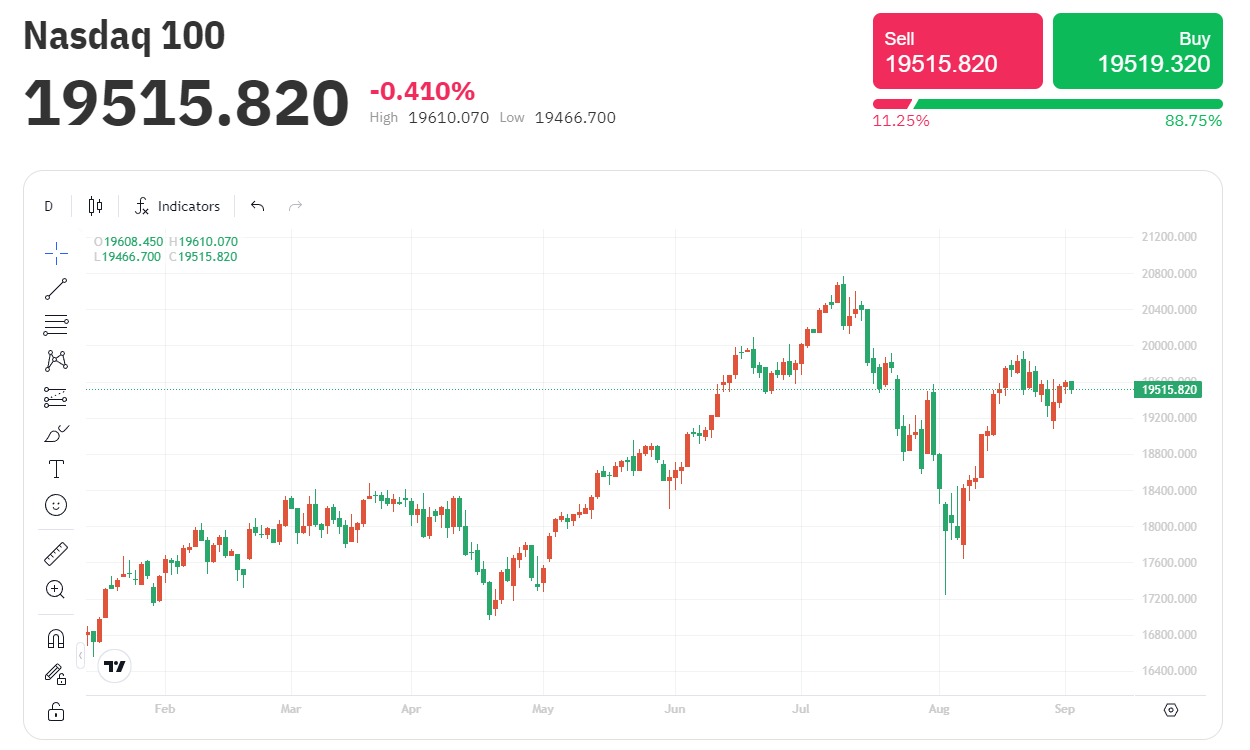
The reason is that interest rate cuts usually reduce corporate borrowing costs and increase consumers and companies' willingness to spend, thereby stimulating economic growth. However, if concerns about economic slowdown persist, it will put pressure on the stock market in the long run. Therefore, we should pay attention to industries that perform well in a low-interest rate environment, such as technology stocks and consumer stocks. NVDA is recommended here.
Gold
As for gold, the non-farm data in September is likely to enhance the attractiveness of gold as a safe-haven asset.
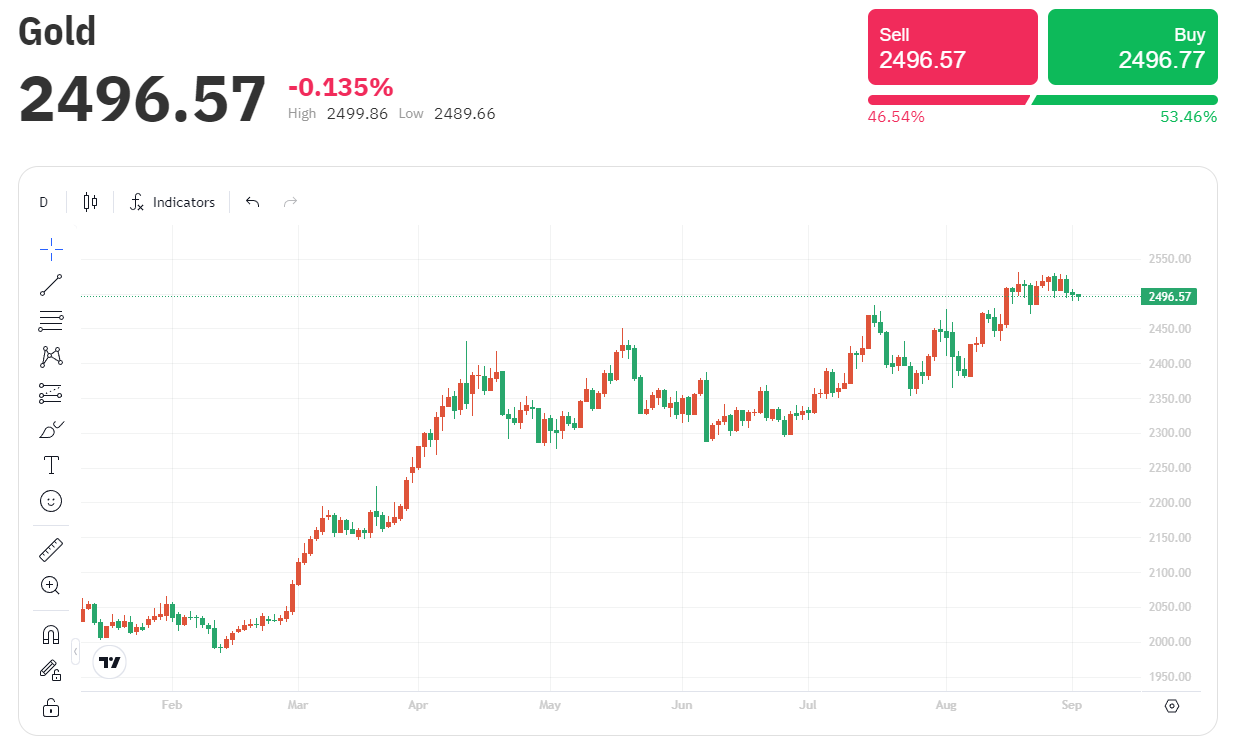
In the face of increasing economic uncertainty, most investors tend to seek safe-haven assets such as gold to protect their wealth. In addition, if the Fed cuts interest rates, real interest rates may fall, which generally increases the attractiveness of gold because gold does not generate interest and has a lower opportunity cost. So we can see that the scale of global gold ETFs has hit new highs, which also shows that investors' demand for gold is gradually increasing.
Crude oil
Finally, crude oil, the non-agricultural data in September is likely to have a complex impact on the crude oil market.

On the one hand, the slowdown in economic growth may reduce the demand for crude oil, thereby putting pressure on oil prices. On the other hand, if the market expects the Fed to stimulate the economy by cutting interest rates, then increased economic activity may increase demand for crude oil. OPEC+'s decision to cut production may also have an impact on crude oil prices and support oil prices. Coupled with the expansion of the current war situation, it will further magnify the important attributes of crude oil as a strategic material, thereby pushing up crude oil prices.


Trending Articles
- Who Is Andrew Tate and Why Is He Famous? 10 Things to Know the Controversial Influencer
Discover who is Andrew Tate and why he's making waves in the digital sphere. Uncover 10 intriguing facts about this controversial influencer, his journey, and his impact on the online world.
2024-03-01 TOPONE Markets Analyst - Andrew Tate Net Worth 2024: Is the Internet's Most Controversial Man Worth $800 Million?
Explore the enigmatic Andrew Tate's net worth and delve into the controversies surrounding the internet's most polarizing figure. Is he truly worth $800 million? Uncover the truth behind his wealth and reputation here.
2024-02-23 TOPONE Markets Analyst - 20 Strongest Currencies in the World in 2024
Want to know the strongest currencies in the world in 2024? Here are the list for you!
2024-01-30 TOPONE Markets Analyst - Falling Wedge Pattern: The Ultimate Guide
A falling wedge is a bullish pattern characterized by a wide top and shrinking bottom. It is an extremely bullish pattern in a trading market.
2023-09-25 TOPONE Markets Analyst

 Bonus!

Bonus rebate to help investors grow in the trading world!