English





What Is an ETF? Everything You Need to Know
Although exchange-traded funds are adaptable, flexible, and often have minimal internal costs, they are not suitable for everyone.Look into if ETFs are a suitable fit for you.

 2830
2830
The management costs of exchange-traded funds (ETFs) are often moderately low, and ETFs are typically more tax advantageous than mutual funds.
Intro
Because it is exchanged on an exchange like stocks are, an ETF is also known as an exchange-traded fund. As shares of an ETF are purchased and sold on the market throughout the trading day, the price will fluctuate. Contrary to mutual funds, which only trade once daily after the markets close and are not traded on an exchange, this is the case. In comparison to mutual funds, ETFs are typically cheaper and more liquid.
Unlike stocks, which only hold one underlying asset, ETFs have a variety of underlying assets. ETFs are frequently used for diversification because they contain a variety of assets. Thus, various investments, including stocks, commodities, bonds, or a combination of investments, can be found in ETFs. An ETF may own hundreds or thousands of equities from different industries or be confined to a single sector or industry. While some funds primarily concentrate on U.S. offers, others have a worldwide perspective. For instance, different banks' equities throughout the industry would be included in banking-focused ETFs.
An ETF is marketable security, which means that its share price enables day-to-day buying and selling on exchanges and short sales. Except where subsequent regulations have adjusted their regulatory requirements, most ETFs in the United States are organized as open-ended funds and are therefore governed by the Investment Company Act of 1940. Open-end funds allow an unlimited number of participants to participate.
What is an ETF?
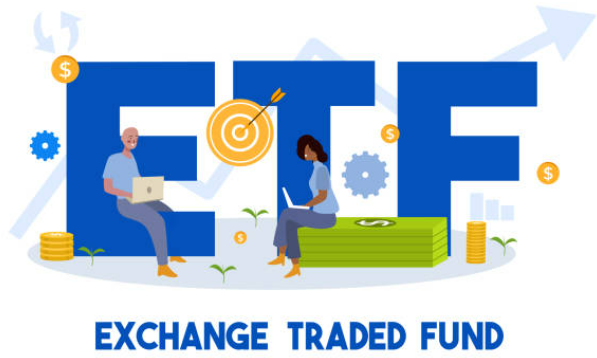
A pooled investment security called an exchange-traded fund (ETF) functions very similarly to a mutual fund. ETFs often follow a certain sector, index, commodity, or another asset, but unlike mutual funds, Like regular stocks, they can be bought or sold on a stock exchange. Anything from the price of a single commodity to a sizable and varied group of securities can be tracked by an ETF. ETFs may even be designed to follow particular investment strategies.
The first ETF was the SPDR S&P 500 ETF (SPY), a duplicate of the S&P 500 Index that is still frequently traded today.
How do ETFs work?
Exchange-traded funds, or ETFs, are precisely what their name suggests: funds that trade on exchanges and often track a certain index. When you purchase an ETF, you receive a collection of assets that you can buy and sell during trading hours, potentially reducing your risk and exposure and assisting with portfolio diversification.
ETFs can be bought and traded on a stock exchange just like regular stocks.
ETFs are exchanged, and their prices fluctuate throughout the day, just like stocks do.
Similar to mutual funds, ETFs are collections of tens, hundreds, or even thousands of equities or bonds.
What types of ETFs are there?
Investors can choose from a range of ETFs that can be used to manage risk in their portfolios, generate income, engage in speculation and price appreciation, and generate income.
Here is a list of some of the ETFs that are currently available.
Passive and Active ETFs
ETFs can be classified as passively managed or actively managed. The goal of passive ETFs is to mimic the performance of a more extensive index, whether it be a more specialized sector or trend or a more diversified index like the S&P 500. Gold mining stocks illustrate the latter category: as of February 18, 2022, there are roughly eight ETFs that concentrate on businesses involved in gold mining, omitting inverse, leveraged, and funds with little assets under management (AUM).
Typically, actively managed ETFs do not aim to track an index of assets but rather have portfolio managers choose which securities to hold. Despite being more expensive for investors, these products have advantages over passive ETFs. Below, we look at actively managed ETFs.
Bond ETFs
Bond ETFs are designed to give investors consistent income. Their income distribution is based on how well the underlying bonds perform. Government bonds, corporate bonds, and municipal bonds—also known as state and local bonds—might be among them. Bond ETFs lack a maturity date like their underlying assets do. They typically trade above or below the price of the underlying bond.
Stock ETFs
Stock (equity) ETFs are made up of a collection of equities that track a certain sector or industry. A stock ETF, for instance, might follow equities in the automobile industry or overseas. The goal is to provide a single industry with both strong performers and new entrants with growth potential a varied exposure. Stock ETFs feature lower costs than stock mutual funds and don't require actual ownership of any securities.
Industry/Sector ETFs
Funds that concentrate on a particular industry or sector are known as industry or sector ETFs. For instance, an ETF for the energy sector will include businesses engaged in that industry. Industry ETFs are designed to give investors exposure to an industry's potential growth by monitoring the activity of its constituent companies. One such is the recent inflow of capital into the technology sector. ETFs do not entail direct ownership of shares. Thus the downside of erratic stock performance is likewise limited in them. During economic cycles, industry ETFs is also utilized to cycle in and out of sectors.
Commodity ETFs
As their name suggests, ETFs invest in commodities, such as gold or crude oil. The advantages of commodity ETFs are numerous. They first diversify a portfolio, which makes it simpler to hedging downturns. Commodity ETFs, for instance, can provide a buffer during a stock market downturn. Second, investing in a commodity ETF is less expensive than buying the commodity outright. It is so that the former does not require spending money on storage and insurance.
Currency ETFs
The performance of currency pairings, which include both domestic and foreign currencies, is tracked through currency exchange-traded funds (ETFs). ETFs that invest in currencies have many uses. They can be used to make currency price predictions based on a nation's political and economic trends. Importers and exporters also use them to diversify their portfolios or as a safety net against foreign market volatility. Some of them are additionally employed as inflation hedges. Even an ETF is available for bitcoin.
Inverse ETFs
By shorting equities, inverse ETFs try to profit from stock falls. Shorting is the practice of selling stock in anticipation of a decrease in value and buying it back at a loss. An inverse ETF uses derivatives to short a stock. In essence, they are wagers against the market. An inverse ETF appreciates proportionately as the market falls. Investors need to be aware that many inverse exchange-traded funds (ETFs) are actually exchange-traded notes (ETNs), not real ETFs. Although it trades like a stock and is backed by an issuer like a bank, an ETN is a bond. To determine whether an ETN is a good fit for your portfolio, be sure to consult with your broker.
Leveraged ETFs
A leveraged ETF aims to return a number of times (such as two or three times) the return of the underlying investments. For instance, a 2x leveraged S&P 500 ETF will yield a return of 2% if the S&P 500 increases by 1%. (If the index falls by 1 percent, the ETF will lose 2 percent ). These products use derivatives like options or futures contracts to increase their returns. Leveraged inverse ETFs are another option; they aim to generate an inverse multiplied return.
Why Invest in ETFs?
ETF investing can be the best choice for you if you're searching for a cheap, tax-efficient approach to access various asset classes. Here are a few of the factors that make ETFs so popular among investors:
Diversification
You can access various asset classes with ETFs, such as domestic and foreign equities, bonds, and commodities.
Lower cost
Operating expense ratios (OERs) for ETFs are often lower than those for actively managed mutual funds.
Trading flexibility
To satisfy a range of investment objectives, ETFs combine the traceability of individual assets with the diversification of mutual funds.
Tax efficiency
For a variety of reasons, ETFs are frequently thought to be more tax-efficient than actively managed mutual funds.
Advantages of ETFs and disadvantages of ETFs
Because investing in it would be costly to purchase each stock in an ETF portfolio separately, ETFs provide reduced average costs. Because investors make so few trades, they only need to complete one transaction to buy and one to sell, resulting in lower broker commissions. For every trade, brokers often charge a commission. To further cut costs for investors, some brokers even provide no-commission trading on a few inexpensive ETFs.

The expense ratio of an ETF represents the cost of running and running the fund. Because they follow an index, ETFs often have low expenses. A passively managed fund with a lower time commitment might contain all 500 equities from the S&P if an ETF tracks the S&P 500 Index, for instance. But not all ETFs follow an index passively, and as a result, some may have a higher expense ratio.
Pros
• Availability of several stocks in diverse industries
• Lower broker commissions and lower expense ratios
• Risk reduction via diversification
• Some ETFs concentrate on specific industries.
Cons
• Fees for actively managed ETFs are higher.
• Industry-specific ETFs prevent diversification.
• Low liquidity makes transactions difficult.
How much do ETFs cost?
Investors often pay the administrative and overhead charges associated with ETFs. These expenses also referred to as the "expense ratio," normally make up a modest portion of an investment. ETFs are among the most economical investment vehicles due to decreasing expense ratios generally brought about by the expansion of the ETF industry. However, depending on the type of ETF and its investment approach, expense ratios might fluctuate widely.
Although many ETFs can be affordable, you should know the costs, as with any investment. The following are the fees most frequently related to ETFs:
Trade commissions
The costs your brokerage firm assesses each time you buy or sell an ETF that is listed can range from $0 to $20 per online trade1, depending on the volume of trades. Online transactions at Schwab cost nothing for each trade.
Operating expense ratio (OER)
the ongoing management fee levied by the sponsor of an ETF. For passively managed ETFs, the industry's asset-weighted average** OER is 0.19 percent. 3, although this can vary substantially. For cap-weighted Schwab ETFs, the asset-weighted average OER is just 0.05 percent.
Bid/Ask spreads and premiums.
Bid/Ask spreads and fluctuations in discounts and premiums to an ETF's net asset value are two more misunderstood and sometimes ignored trading charges (NAV).
ETFs and Taxes
Because most purchases and sales are made through exchanges, and the ETF sponsor does not have to redeem shares each time an investor wants to sell or issue new shares each time an investor wants to buy, an ETF is more tax-efficient than a mutual fund. A fund's shares can be redeemed and result in tax liability, so listing the shares on an exchange can reduce tax obligations. When an investor sells shares in a mutual fund, they must sell them back to the fund and suffer a tax penalty, which the fund's shareholders must cover.
Both have benefits, but there are other factors to consider, just like with any investing strategy.
ETF Examples
Here are some examples of popular ETFs available right now. While some ETFs focus on particular industries, others track stock indices to build broader portfolios.
The SPDR S&P 500 (SPY): Also known as the "Spider," this ETF tracks the S&P 500 Index and is the oldest and best-known.
The Russell 2000 small-cap index is tracked by the iShares Russell 2000 (IWM).
The technology stock-heavy Nasdaq 100 Index is tracked by the Invesco QQQ (QQQ) ("cubes").
The Dow Jones Industrial Average's 30 constituent stocks are represented by the SPDR Dow Jones Industrial Average (DIA), or "diamonds."
Individual industries and sectors are tracked by sector exchange-traded funds (ETFs), including oil (OIH), energy (XLE), financial services (XLF), and real estate investment trusts (IYR), and biotechnology (BBH).
Commodity exchange-traded funds (ETFs) represent the markets for commodities such as gold (GLD), silver (SLV), crude oil (USO), and natural gas (UNG).
Country ETFs follow the major stock indices of other nations, but they are traded in the US and are priced in USD. Brazil (EWZ), China (MCHI), Japan (EWJ), and Israel are among examples (EIS). Others follow a broad range of overseas markets, including those that follow developed market economies (DMEs) and emerging market economies (EMEs) (EFA).
ETFs vs. Mutual Funds vs. Stocks
In an environment where broker costs and policies are constantly changing, comparing features for ETFs, mutual funds, and stocks can be difficult. You can buy and sell the majority of stocks, ETFs, and mutual funds without paying a commission. Although they have been on a long-term downward trend, management fees are what set funds and ETFs apart from stocks. 1 ETFs often charge lower average fees than mutual funds do. 5 Here is a comparison of some other likenesses and distinctions.
Exchange-Traded Funds
The index funds that follow a portfolio of securities include exchange-traded funds (ETFs).
ETF prices might fluctuate in relation to the fund's net asset value (NAV) at a premium or a discount.
Like stocks, ETFs are traded in the markets during regular business hours.
Due to the lack of marketing fees, some ETFs can be acquired commission-free and are less expensive than mutual funds.
ETFs do not actually own the stocks they hold.
By tracking various businesses within a given sector or industry in a single fund, ETFs help to diversify risk.
Trading in ETFs takes place in kind. Thus they cannot be redeemed for cash.
Of the three forms of financial instruments, ETFs are the most tax-efficient since share transactions are viewed as in-kind payouts.
Mutual Funds
Bonds, securities, and other investment vehicles that produce returns are all bundled together in mutual funds.
Prices for mutual funds are based on the total fund's net asset value.
Mutual fund redemption is only possible at the close of a trading day.
Although some mutual funds do not impose load fees, most do because they also charge marketing and administration costs.
The fund owns the securities in a mutual fund's basket.
By building a portfolio that includes a variety of asset types and security instruments, mutual funds diversify risk.
Shares of mutual funds may be exchanged for cash at the fund's current net asset value.
Tax advantages are provided by mutual funds when cash is returned, or specific tax-exempt bonds are included in their portfolio.
Stocks
Securities that offer performance-based returns include stocks.
Stock returns are determined by their real market performance.
During standard trading hours, stocks are exchanged.
On some platforms, commission-free stock purchases are possible, and there are often no fees after the initial purchase.
Stocks entail actual possession of the security.
The performance of a stock is where risk is concentrated.
Cash is used to buy and sell stocks.
Stocks are taxed at either ordinary income tax rates or capital gains rates.
Bottom Line
Using a broker is the most typical method for individual investors to purchase and sell ETFs. Investors can trade ETFs manually or passively using brokerage accounts, such as a Robo-advisor. If an investor opts for a more active strategy, they will need to look through the expanding ETF market for funds to purchase, keeping in mind that certain ETFs are made for long-term investments while others are made to be bought and sold quickly.


Trending Articles

 Bonus!
Bonus rebate to help investors grow in the trading world!