English






What Does Fill the Gap Mean in Stocks?
Do you know what a gap means in stock and why stock gaps need to be filled? This article will find answers to all of your questions about gap filling.

 1864
1864Significant price swings in assets can provide traders with opportunities when they turn into opportunities in volatile markets. Therefore, the chart contains gaps where the stock price (financial instrument) fluctuates sharply without additional trading.
Because of this, the asset's chart shows a space between its regular price pattern and the current price. Traders can take advantage of these voids for profit by interpreting them correctly. Using the information in this article, you will learn what filling the gap means in stocks, how to take advantage of them to make money, and how to use them when trading.
What is a gap?
Technical or fundamental factors lead to inconsistencies. An imbalance between demand and supply most commonly causes a gap. At the open, the price can go up if aggressive buying or the price can go down if selling exceeds supply at the prior closing price.
It is also possible for divergences to occur when overnight sentiment changes, such as hitting a new high. A new high then drive a stock higher when it opens—the overnight sentiment changes when there is big news after hours. In addition, fill the gap stocks can form if a prominent investor (smart money) tries to break through a support or resistance level.
Trading gapping stocks successfully requires a disciplined set of entry and exit rules to minimize risk and signal trades. Moreover, trading strategies for range trading that you can implement to weekly and end-of-day and intraday gaps. Finally, holes mechanics are essential for long-term investors to understand, as 'short' signals can serve as exit signals.
There are several gap trading strategies, each of which has a long and short trading signal. Dividend trading entails establishing the stock price's range one hour after the market opens. To trigger trades before the first hour, an adapted trading way, to be discussed later, can be used with any of the eight major strategies. However, it includes a higher level of risk. To exit a long position, you calculate and set an 8% trailing stop, and to exit a short position, a 4% trailing stop. In the case of short positions, the trailing stop is an exit threshold that moves along with the rising or falling price.
What is a gap fill?
It means that the price has returned to its original pre-gap level when someone says the gap has closed. It can happen for numerous reasons, including:
Irrational exuberance: A spike in valuation may have been excessively optimistic or pessimistic, leading to a correction.
Technical resistance: A price movement that increases or decreases quickly leaves no support or resistance in its wake.
Price Pattern: Based on the pattern of prices in the market, we can classify gaps and make predictions about their filling. The exhaustion gaps are usually the ones to be filled because they indicate the end of a trend. On the other hand, breakaway and continuation gaps are far less likely to be filled since they confirm a trend's direction.
A gap filled after it occurs on the same trading day is fading. For instance, a company that announces outstanding earnings per share for the current quarter then jumps up at the open (meaning it opened much higher than its previous close).
Let's imagine that people begin selling as the day progresses because they see some weakness in the cash flow statement. At some point, the price will get back to yesterday's close, and the gap will narrow. The strategy is often used during earnings periods or during other times when the stock market is experiencing irrational exuberance.
Different types of gaps
The different types of it differ fundamentally in their characteristics: Common, Breakaway, Runaway, and Exhaustion Gaps.
Breakaway: They occur at the end of a trend and signal the start of a new one.
Common: Prices in these areas have gapped, but nothing else has changed.
Continuation: They result from a sudden surge in supply and demand during price patterns.
Exhaustion: They occur near the end of a pattern and warn that the price is trying to make the last push.

Visual representation of types of gap
This type generally occurs without a significant event preceding it. As a result, you can quickly fill the most common gaps (usually in a few days) compared to other openings. Usually, an expected average trading volume accompanying common spaces can also operate as "area gaps" or "trading gaps."
Breakaway occurs when the price breaches above a support or resistance level, like those created during a range. Breakaway cracks occur when prices break out of existing trading ranges.
Breakaway can also emerge from other types of chart patterns, including triangles, wedges, cup-and-handles, rounded bottoms or tops, or head-and-shoulders patterns.
Generally seen on charts, a runaway gap appears when trading activity skips consecutive price points due to strong investor interest. Between the beginning and end of the runaway gap, there was no exchange of ownership in the security.
Usually, on a daily chart, an exhaustion gap is characterized by a break lower in price that follows a rapid run-up in a stock price for a few weeks. The signal usually occurs when a stock is in the decline of demand, and dramatic changes in buying and selling occur. This implies that a recent upward trend is on the verge of ending.
Traders face different consequences for different types of gaps. For example, trading volume usually rises sharply when a reversal or breakaway opening occurs; standard and runaway openings, on the other hand, do not. Furthermore, most gaps appear when an event or news such as an earnings announcement or analyst upgrade/downgrade occurs.
There are more commonly occurring gaps, and there is no particular reason why they appear. Also, the most common gaps tend to disappear, while the other two may signal a reversal of a trend.
Example of a gap
Let's examine a trading system designed specifically for the forex market to tie these concepts together. Based on gaps, this system predicts retracements to the introductory price. Here is how it works:
Trading with the overall price trend (check hourly charts).
A significant gap must occur on the 30-minute charts above or below a critical resistance level.
To reach the initial resistance level, the price must retrace. After that, the price will have returned to the previous resistance turned support, thus closing the gap.
Until there is a candle signifying the price continuation in the gap, the price must remain in that direction. That ensures that the support remains intact.
Amidst the forex market hours (it is open 24 hours a day, 5:00 pm EST to 4:00 pm EST), one discrepancies is apparent in charts as large candles. Often, large candles form after the release of a report that causes sharp price changes with little to no liquidity. As a result, a chart in the forex market will only show fluctuations after the weekend when the market opens.
In the following example, you may see the system in action:
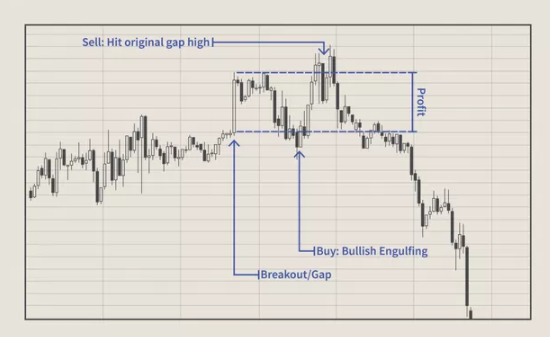
Fill the gap in stock trading.
In this GBP/USD chart, you can see a large candlestick identified by the left arrow, indicating a gap. The price does not look like a regular void, but the lack of liquidity is why. You can see these areas provide substantial levels of support and resistance.
The figure shows that the price gapped up above some consolidation resistance, retraced, filled the gap, and subsequently resumed its upward movement before decelerating. Below the opening, we can observe little support (where we can buy) until the prior permission (where we can sell). Traders could also short the currency to identify a top on their way down to this point.
Limitations of Gaps
Even though gaps are easy to spot, there are limitations. Identifying the different types of holes in one's knowledge is a glaring flaw. The misinterpretation of an opening could lead to a devastating mistake, resulting in missing out on an opportunity to either buy or sell, impacting one's profits and losses heavily.
What is a gap fill in equities?
What does it show that a gap has closed on a stock chart? Price action has filled a gap on a chart when it moves back through an open area where there were no transactions. After the price gap closes, the price must retrace to the previous day's closing price. Technically, a price fills once it reaches before the gap day. A partial gap fill occurs when the price moves inside the gap area but doesn't fill it.
When voids appear on the chart, they can signal momentum, trend continuation, or reversal.
The gap from a price base to all-time highs is a new and very positive momentum signal to the upside.
A gap from a price base down to a new all-time low can signal a substantial momentum downturn.
When price moves in a trend, a gap in the direction of the current move can indicate a continuation of the current trend.
When a gap appears against the direction of a current price trend, it may indicate that the trend is about to reverse.
If a gap in the opening price fails to close in the first hour of trading, the rest of the day inclines to follow the gap.
The market eventually fills in gaps. However, this may require a strong move or trend and can take some time to change direction.
In general, the path of least resistance follows the direction of the gap in the price action. This is because few technical signals are more powerful than a price gap. A more significant gap translates into a stronger signal.

Filling of gap
What Does It Mean To Fill A Gap In Stocks?
Fillings usually occur by one of three factors:
Support and resistance– The asset's price pushes back from the resistance of technical analysis.
Over Optimism/Pessimism– There is a correction after a period of irrational optimism.
Exhaustion Gaps: This price pattern typically gets filled because it signals the end of a trend. However, the other types of gaps typically indicate the continuation of a trend.
Trading gap-fill stocks are one of the best methods to profit during earnings season when bad or good results can cause overreactions.
The sellers couldn't sell during a downward gap. Likewise, buyers could not buy during a downward opening. As soon as buyers begin purchasing at what they consider a local low, stocks move quickly since no sellers are in the gap to create a headwind.
Stocks that are in the process of rising will promptly go through a hole and reach the point where the opening began. This is where sellers who got caught up in the drop can sell, and the chart of the stock levels out and goes back to being more typical. A gap-up works the same way.
Do All Gaps Need To Be Filled?
A few assumptions also apply when it comes to gap trading. One of the most impressive aspects is that most gaps have already closed. Can this be confirmed?
Gaps that occur overnight often remain unfilled. S&P indices, for example, have historically been more likely to fill the order within a trading day than not.
As a general explanation for why these gaps fill more often than not, market tendencies are dominantly those of mean reversion. It is similar to auto-correlation or self-similarity, which produces sustained trends). If a market tends to fill gaps by retreading old ground, it is statistically likely to do so frequently.
How do trade gap-fill stocks?
Gapping can take two forms in the stock market: partial and complete. The term partial gapping refers to when a share's opening price is raised or lowered than the previous day's close, within the normal range.
And the term full gapping refers to when a share's opening price means the price is outside the typical scope. We can see that the market was particularly volatile overnight with a wide gap. The market sentiment has also changed for this particular share.
Gaps in a chart happen because of the imbalance between supply and demand. It forces its price out of its support and resistance levels overnight. Occasionally, these gaps are filled back up to their original levels. A weak earnings report or misunderstood price rally could explain this as excessive optimism or a more thorough examination of the earnings report. They may then decide to sell their shares, restoring the claim's value to its original level.
How to find gap-up stocks?
The price chart of a gap-up stock is relatively easy to identify. A gap between candlesticks indicates a market gap, and a green candlestick indicates a stock that has moved higher. The prices are rising, which either signals a new trend or a harmless anomaly. This example illustrates an external event leading to a jump in an asset's cost when a green candle follows an ample space in the price chart.

Gap-up trade set up
How to find gap-down stocks?
A gap-down stock follows the same structure as a gap-up stock but reversible direction. Below you can see a price chart that shows two rapid drops in price within 30 minutes; whenever there is a blank gap in the market, a red candlestick signals that the price has declined outside of the support and resistance levels. While the price starts in an uptrend, this market gap soon reverses, and the stock enters a downward trend.

Gap-down trade set up
Gap trading rules help design trading strategies when identifying buying and selling opportunities. Remember that not every opportunity represents a low-risk and high-reward trade. Nevertheless, we can use market activity to make predictions to identify low-risk and high-reward businesses.
Gap Fill Stocks Strategies
Several different strategies use Gap-fill stocks, which are more popular than others.
Assuming a potential gap:
Traders may buy or sell when technical or fundamental factors suggest there will be a fluctuation on the following trading day—as an example, selling after hours following a surprise negative earnings release in the hope of a hole forming the next day.
Trading highly liquid or illiquid positions- taking positions when the market begins to move, assuming that the gap will continue.
For instance, a void has formed upwards with minimal liquidity, and there is little resistance above. A trader who opens a position on the assumed opening at the start of a price movement would trail.
Filing/Fading:
Where you notice gaps forming, but they hit a brick wall (either the top or bottom) due to weakening or a technical analyst play. In the above example, traders may short the stock before an announcement to cause the upward hole to fade.
Post fill buy/sell:
When a trader follows the gap-filling process, the price will reach the prior support area or resistance area before the hole, and they will buy or sell in the opposite direction.
The Bottom line
There is a gap in the market if the price jumps from one price level to another without affecting prices. It is common for holes to form overnight following the market's re-opening. However, there is the potential for gaps to develop intraday on illiquid markets.
The filling of spaces depends on several factors. However, most gaps do not seem to be filled, at least within one day of their occurrence.
In addition, positive gaps are more likely to generate positive moves than negative gaps. You can use this information in your trading!


Trending Articles
- 25 Richest People in the World in 2023
Compared with last year, these 25 richest people are $200 billion poorer than last year, but still worth $2.1 trillion.
2024-01-30 TOPONE Markets Analyst - Best Stocks for Covered Calls in 2024
A covered call strategy deploys by traders who wish to hold the stock in the future and minimize the risk by selling its call option. This guide will help you to find out the best stocks for covered calls.
2024-01-20 TOPONE Markets Analyst - 20 Most Recognized Brands in the World in 2024
The financial success of a corporation is frequently determined by its brand. Here, we'll walk you through the world's top 20 most recognizable businesses and how you can invest in their stock.
2024-01-05 TOPONE Markets Analyst - 10 Biggest Short Squeezes in History
Short Squeeze plays a vital role in short-term traders who randomly decide to reduce losses and leave their positions.
2023-10-20 TOPONE Markets Analyst

 Bonus!

Bonus rebate to help investors grow in the trading world!