English






The Key Factors Affecting This Week's Non-farm Payrolls: Is it the 2.6% PCE or the Reversal to 48.5 PMI?
PCE and PMI, which one has a greater impact on non-agricultural data? This article will provide you with in-depth analysis and strategies to help you capture potential investment opportunities.

 8098
8098
Non-agricultural Data is about to Be Released; PCE Price Index Tumbles Ahead
On the closing day of June, the US dollar index rose and fell. According to the latest data released by the US Department of Commerce, the month-on-month growth of the PCE price index in May fell from 0.3% in April to 0%, the lowest level since November 2023. The year-on-year growth rate also fell slightly from 2.7% last month to 2.6%, both of which were in line with market expectations.
What is more worthy of our attention is that the year-on-year growth rate of the core PCE price index in May hit a new low since March 2021. After excluding food and energy price fluctuations, it fell from 2.8% in April to 2.6%, which is also in line with market expectations.

After the data was released, the Chicago Mercantile Exchange's Federal Reserve Observation Tool showed that the market expected the Federal Reserve to cut interest rates by 25 basis points in September to 61%, while the possibility of further cuts in December was 44.7%.
Affected by this, the US dollar index gapped down, but then rebounded quickly. However, the US dollar index has recently gapped down again, showing that the influence of PCE data is still not to be underestimated. In the short term, the US dollar index may continue its weak trend.
If the non-farm data shows strong job growth, it is usually regarded as a sign of economic health. It may increase consumer confidence and consumer spending, which may push up the PCE price index. But on the contrary, the sluggish PCE price index reflects the uncertainty of non-farm data from the side, resulting in a decline in consumer spending data.
PMI Data Continues to Diverge; Non-farm Payrolls Bear Downward Pressure on Inflation
The June ISM Manufacturing PMI data released by the Institute for Supply Management (ISM) on July 1 revealed the continued weakness of the US manufacturing industry. Although the new order index has rebounded, overall manufacturing activity has been in a state of contraction for three consecutive months, indicating that the road to recovery is full of challenges.

The downward trend of the price index has continued since April, and it hit the largest drop in nearly a year in June, indicating that inflationary pressure has eased.
With the end of the second quarter, the recovery of the US manufacturing industry seems to be faltering. As a key area in the US job market, the performance of the manufacturing industry directly affects the employment situation. The continued rise in prices has led to increased labor costs, squeezed corporate profits, and weakened competitiveness accordingly.
In an environment of high interest rates, corporate liquidity may also face challenges. This may force companies to reduce the size of their workforce, which will have a negative impact on non-agricultural employment data.
The downturn in the manufacturing industry not only reflects the complexity of economic recovery, but also reminds policymakers to pay close attention to its chain reaction to the job market and take timely measures to support stable economic growth.
Three Key Points Affecting Non-agricultural Data
To understand which factor is the key to non-farm payrolls, we must first distinguish the scope, timeliness, and purpose of these data.
From the perspective of the scope of influence
First, let's explore from the perspective of the scope of influence.
The PCE price index is an indicator of changes in the prices of goods and services purchased by American consumers, and is also one of the main inflation indicators closely watched by the Federal Reserve.
The rise in the PCE price index usually represents increased inflationary pressure, which is directly related to the Federal Reserve's monetary policy decisions, including whether interest rates need to be adjusted. In other words, changes in the PCE price index may directly trigger the Federal Reserve's interest rate cuts.
In contrast, the PMI index is based on a monthly survey of corporate purchasing managers, which comprehensively reflects the industrial conditions in multiple aspects such as production, new orders, inventory, employment, and supplier delivery times. One is a data focused on the consumer level, and the other is a vane of industrial activity. Obviously, the PCE price index covers a wider range.
From the perspective of timeliness
The PCE price index may only reflect fluctuations in consumer demand in the short term, while the PMI index provides continuous dynamic information such as corporate orders, inventory and employment over a period of time. The decline in the PMI index may indicate a tightening of the job market, which has a longer-term indicative significance.
From the perspective of goal achievement
One of the important tasks of the Federal Reserve this year is to determine the appropriate monetary policy, especially the timing and magnitude of interest rate cuts that the market generally pays attention to. When formulating these policies, the Federal Reserve will consider a variety of economic indicators, among which non-agricultural employment data is one of the key references.
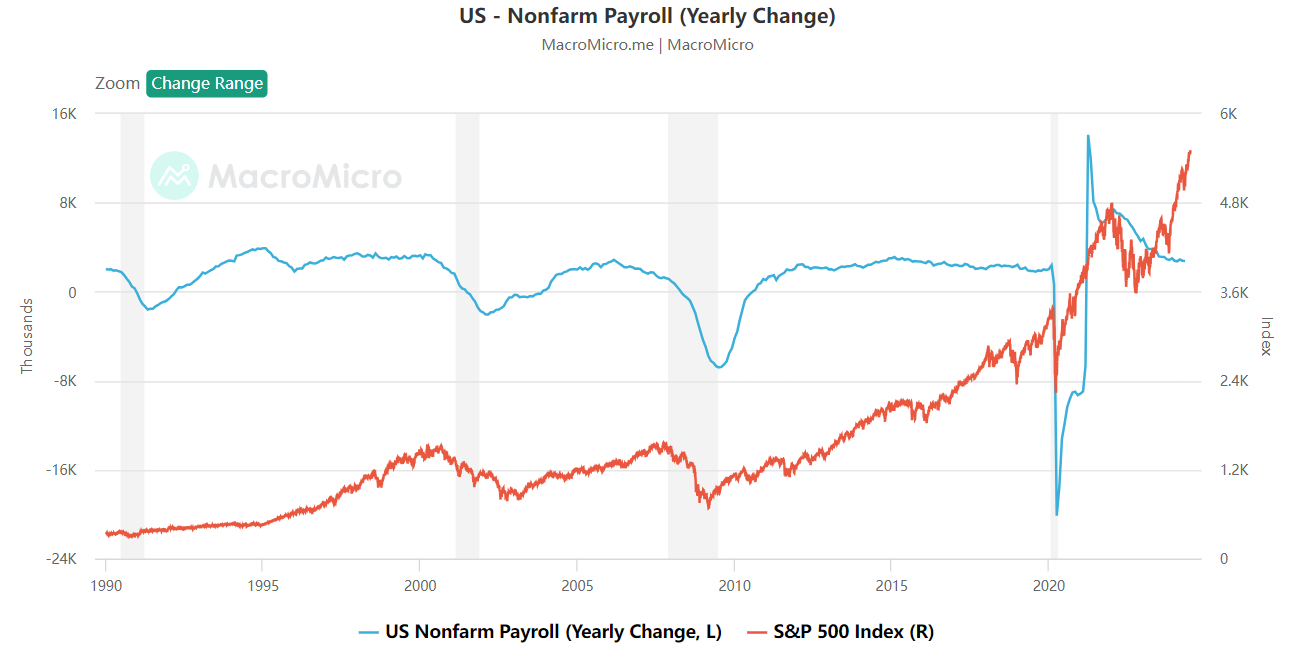
As mentioned above, the PCE price index has a direct impact on the policy inclination of the Federal Reserve. It can be said that the PCE price index and non-agricultural employment data appear to be quite consistent in the direction of policy formulation. Therefore, the impact of the PCE price index on non-agricultural employment data is more direct and obvious, while the PMI index plays a more important role in the factors behind the changes in non-agricultural employment data.
What Impact Does The Non-farm Payrolls Have on The Market?
Non-farm payrolls data has a profound impact on the market, especially the three major asset classes of the US dollar, gold and crude oil. Therefore, the following combines the current technical patterns and trends of the three major assets to provide investors with operational judgments.
US Dollar Index

From last week's trading, it can be observed that the US dollar index is currently closing in a small cross star pattern. Its relative strength index (RSI) is stable above the 50 level, showing that the market is slightly strong in the shock. However, the index failed to break through the previous high last Friday. Today's opening gap fell and broke through the support of the 10-day moving average, showing a weakening of short-term momentum.
Operational Advice: On the 4-hour chart, the index has fallen below the lower edge of the downward channel. If it further falls below the key support level of 105.50, the market may further fall to the range of 105.00 to 105.20. Combined with the non-farm time period last Friday, the channel time should continue until Friday daytime.
Gold Index

The gold market showed a slight shock trend last week. The price is still hovering around the 5-week and 10-week moving averages, indicating that this range-bound fluctuation pattern may continue in the short term. Gold closed with a doji last Friday, indicating that buying and selling forces are relatively balanced.The 5-day and 10-day moving averages remain stable. The daily relative strength index (RSI) still fluctuates around the 50-level line, suggesting that the short-term market momentum is relatively even. For investors who adopt a conservative strategy, now may be a time to wait and see.
Operational Advice: If the gold price can find support around $2,310/ounce and fall steadily, this may be an opportunity to consider establishing a long position. The specific time of the outbreak should be around 18-19 o'clock on Friday.
Crude oil index

In the context of the weekly chart for U.S. crude oil, a positive 'Three White Soldiers' candlestick pattern has emerged, successfully breaking through and stabilizing above the middle Bollinger Band. This indicates that market momentum is building up, suggesting potential for further upside in the near-term trend.Last Friday, crude oil prices continued their upward momentum and hit a new high. The 5-day and 10-day moving averages formed a bullish "golden cross" signal, indicating that the short-term trend remains strong.
Operational Advice: In such a market environment, traders can consider maintaining a low-buy high-sell strategy. If crude oil prices can remain above $81/barrel, it will provide further confidence and operating space for bulls. Of course, like the US dollar index, the time point for breaking through $81/barrel should be during the non-agricultural period.


Trending Articles
- Who Is Andrew Tate and Why Is He Famous? 10 Things to Know the Controversial Influencer
Discover who is Andrew Tate and why he's making waves in the digital sphere. Uncover 10 intriguing facts about this controversial influencer, his journey, and his impact on the online world.
2024-03-01 TOPONE Markets Analyst - Andrew Tate Net Worth 2024: Is the Internet's Most Controversial Man Worth $800 Million?
Explore the enigmatic Andrew Tate's net worth and delve into the controversies surrounding the internet's most polarizing figure. Is he truly worth $800 million? Uncover the truth behind his wealth and reputation here.
2024-02-23 TOPONE Markets Analyst - 20 Strongest Currencies in the World in 2024
Want to know the strongest currencies in the world in 2024? Here are the list for you!
2024-01-30 TOPONE Markets Analyst - Falling Wedge Pattern: The Ultimate Guide
A falling wedge is a bullish pattern characterized by a wide top and shrinking bottom. It is an extremely bullish pattern in a trading market.
2023-09-25 TOPONE Markets Analyst

 Bonus!

Bonus rebate to help investors grow in the trading world!