English






Retracement vs. Reversal in Forex Trading: A Complete Guide
Do you want to learn the difference between Retracement and Reversal in Forex trading? In this guide, we have provided both details with their comparison.

 1096
1096Traders must be familiar with retracement and reversal to execute their trades successfully. Traders can take advantage of retracement and reversal in different ways and must understand what they mean to take full advantage. The term retracement refers to an asset that moves contrary to its trend. This section includes several twists that must be understood carefully. The topic today will be retracement and reversal trends.
Those of you who trade following strategies have probably wondered at one point or another if a pullback you're watching is retracement or reversal. With a solid understanding of the retracements and reversals argument, you can hold onto winning trades longer and quit losing trades earlier.
What is a Retracement?
It is common to hear about Forex retracements, especially when you trade them. Even though Fibonacci retracements are often used in conjunction with the word "retracement," it is a broader, more general term. Quite often, people refer to retracements without referring to Fibonacci levels.
In the simplest sense, retracements are temporary reversals in price within a major trend. The word "within" is crucial here. That's what distinguishes a reversal from a retracement. In technical analysis, reversals mean that a trend has ended, a new one is beginning, or a consolidation period is beginning. Retracements are merely a temporary interruption of the trend.
The market always moves according to this general pattern when examining forex charts. Retracements are common among most trends in most periods, even within extremely strong trends. It is likely to take two steps forward, one step back, and taking two steps forward, one step back.
There are retracements in bullish and bearish trending markets. The Fibonacci retracement occurs when the Fibonacci number is reached. It is common to pause around Fibonacci support and resistance levels. Their behavior is based on the expectation and expectations of traders.
Even though retracements are often mistaken for reversals, they signify a continuing trend. Trying to find a great trade context can be very helpful - especially if they are Fibonacci retracements. Traders tend to wait for retracements before entering into a trade at the onset of a trend. So, why wait?
Once the price turns around, you will not be able to distinguish between a retracement and a reversal if you enter before the retracement. Waiting until after a retracement, though, will not only save you from getting fooled out by false trends but will also give you a better chance of getting into a trend as the retracement level then acts as support or resistance in your favor.
What is a Reversal?
The reversal of an asset is a change in price direction. Prices can be reversed upwards or downwards. Following an uptrend, the market would revert to the downside. A reversal following a downtrend would be upwards. It is uncommon for reversals based on a few periods/bars on a chart rather than overall price direction.
The use of certain indicators, such as moving averages, oscillators, or channels, may spot trend reversals. Breakout might serve as a comparison of trend reversals.
The reversal characteristics often occur in intraday trading and happen fairly quickly, but it can also take a lot of time to occur. Therefore, different traders utilize various to determine when they are likely to revert.
Long-term investors who monitor daily or weekly charts for reversals aren't concerned about intraday reversals on a five-minute chart. However, a day trader needs to pay attention to the five-minute reversal.
Downtrends are characterized by lower swing highs and lower swing lows, reversing an uptrend's higher swing highs into a series of lower swing highs and lower swing lows. Conversely, a downtrend reverses when an uptrend is established, consisting of higher highs and higher lows.
Indicators can help traders identify trends and reversals, depending on their preferences. However, price action alone can show trends and reversals. Trends and reversals may be detected with moving averages. For example, an upward trend can be sensed when the price is above a rising moving average, but a drop below that moving average could signal a price reversal.
What is the difference between a Retracement and a Reversal?
It can often be difficult for traders to identify retracements and reversals. It is important to keep in mind that retracements occur when the share price pulls back in a short period. In addition, it's important to remember that retracements don't break support or resistance levels. Retracements also don't interrupt uptrends or downtrends. To better understand retracements and major reversals, use a demo account.
We call a price reversal if the price breaks the support or resistance lines or the uptrend or downtrend lines. If you want to make a profitable trade, you must identify these differences. You should never mix the two concepts because they play different roles in the forex market.
Factor | Retracement | Reversal |
Volume | A retail trader's profit-taking (small block trades) | Selling institutionally (large block trades) |
Money Flow | Demand for buying during a decline | Buying interest is very low |
Chart Patterns | There are few retracement patterns - usually confined to candles | Chart patterns - usually reversal patterns (double tops). |
Short Interest | Interest rates remain unchanged | Short-term interest rates increasing |
Time Frame | One to two weeks' duration, short-term reversal | An extended reversal lasting more than a couple of weeks |
Fundamentals | Fundamentals remain the same | Changes in fundamentals or speculations about them |
Recent Activity | After a large gain, this usually occurs | Even during otherwise routine trading hours, it can occur |
Candlesticks | The "indecision" candle has tops and bottoms that are typically long (spinning tops) | A reverse candle might encompass an engulfing pattern, soldiers, or a similar pattern. |
When you examine the table above, keep in mind that short interest is delayed when reported, so you may not be able to foretell it specifically.
In summarizing the above chart, retracements display plenty of indecision, but reversals show an abundance of authority. A pullback may be accompanied by low volume, but on a reversal, it may spike. Normally, the first is passive; the second is aggressive.
Higher lows and higher highs characterize the retracement pattern of an uptrend. In contrast, a reversal pattern is often contrary to this, such as the double top pattern - two similar highs followed by a new low - or the head and shoulder pattern - a low high followed by a low.
Retracements often result in less confidence in short-term movements reflected by candlesticks. In contrast, when an uptrend reverses, the candles tend to be very long, packed with movement and momentum.
Investors and traders usually have to make a tough choice when a price retraces. Three options are available to them.
The retracement may turn into a larger trend reversal if the sell-off proves to be a large reversal.
In the event of a price recovery, it makes no sense to sell and re-buy, which will waste commissions and spreads and may lead to missed opportunities if the price recovers sharply.
The potential for a missed opportunity arises if the price recovers if you sell permanently.
If you correctly identify the movement as either a retracement or a reversal, it is possible to prevent losses, minimize costs, and maximize gains.
How to identify if a pullback is a Retracement or a Reversal?
Additionally, we have explained what retracements are and reversals; we need to discuss whether a pullback is merely a retracement or a reversal.
Identifying these differences enables you to become an efficient trader who shortens losses while allowing winners to run.
The ultimate goal of forex trading
We know how to identify retracements and reversals and explore tools and strategies to help you perform this task.
Simple technical analysis
A simple technical analysis can be used to determine whether a pullback is just a retracement or a move in the opposite direction.
The humble trend line is a useful technical tool. Below is an example on the EUR/USD 4 hourly chart:
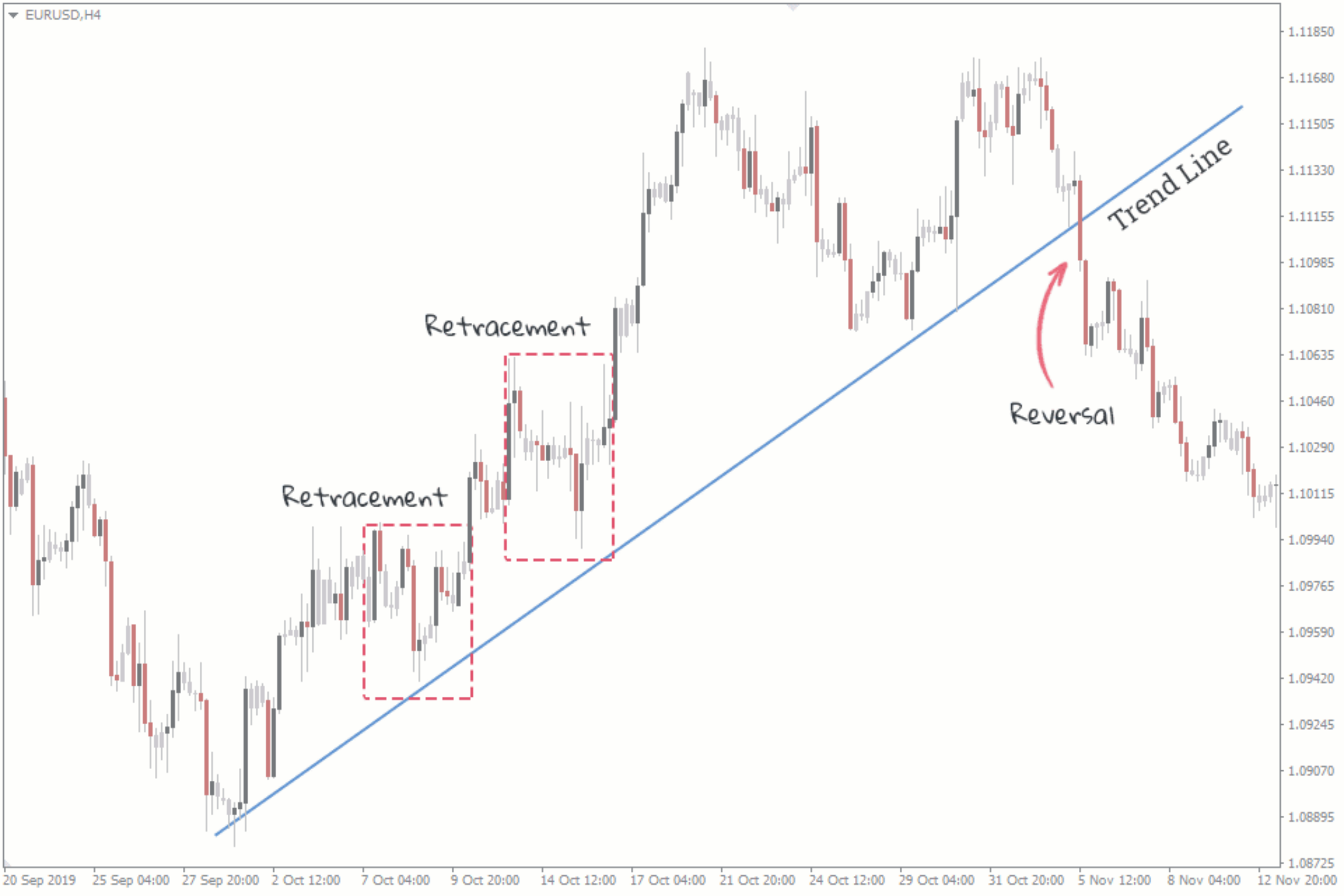
Here you can see the price trend is bullish overall.
If the price pulls back to the trendline that still holds as support, it would be more probable to view the move as a retracement.
It is also a signal to close out long positions when price hits trend line support, as this is a reversal more likely than a continuation.
Why bother yourself with plotting trend lines?
Bull/Bear sentiment
Using profit and positioning ratio indicators is the next featured strategy you can use to figure out whether a pullback is merely a retracement or a full reversal.
Look at the EUR/USD hourly chart below with the attached positioning indicator for MetaTrader 4:

A bullish trend was observed in this case before the price reversed course.
During the pullback, you can see that SSI data spiked, which could have been interpreted as an indication of a possible reversal.
Order book analysis
As our third method to identify retracements or reversals, it is recommended that you conduct some sentiment analysis via the Order Book indicator.
This indicator analyzes order book data from our list of brokers, enabling it to provide an even more precise prediction of a reversal than a simple trend line.
View the following EUR/USD hourly chart to see the indicator in action:

A bearish reversal was caught right at the top by observing a bull trap in the order book at the recent high.
It is a strong signal that a change in trend is about to occur.
Profit ratio
The final indicator we will discuss is the Profit Ratio indicator for MT4.
Check out the following hourly chart for GBP/USD when the indicator is applied:

As you can see, the current pullback is slightly below the top, indicating a bullish trend.
By indicating when the end of a counter-trend move may be near, the profit ratio indicator offers insight into whether a move is retracing.
Therefore, it is likely that this pullback was a retracement and not a full reversal, as the price continues in the direction of the overall trend.
How to determine scope?
Retracements can be identified, and their scope can be determined once you have the know-how.
To determine the scope of retracement, Fibonacci Retracements are excellent tools. If you're familiar with charting software, you can make use of the Fibonacci retracement tool to draw a line between the upper and bottom of the most recent price swing.
A common retracement interval is between 23% and 78% of the initial impulse wave. That doesn't mean the stock drops 23 percent. Therefore, it means that the stock price drops 23% of the distance between the two points measured by the retracements tool. In the case of measuring the retracements of an upward move from 10 to 15, you might find that the tool shows you $13.45 as the first retracement level if you employ a Fibonacci retracement tool. It's because a 23% retracement is calculated by multiplying the difference by .23:$5.00 x .23 = $1.15. 23% would be $1.15 lower than the high so that the tool would mark $13.85 as the retracement level.
The trend remains based on $15 being the new high and $10 being the recent low. As long as the price keeps rising above $10, there is still an uptrend if it rallies and makes a new high. However, it might be time to get out when it falls below $15 again and doesn't rise above it.
Fibonacci retracement
A pivot point level is also commonly used to establish whether or not a retracement should be undertaken. Should the price continue past the pivot point support and resistance levels, the price will often reverse near these levels, indicating a strong stalling, and reversing indicates the opposite. Day traders typically use pivot points to indicate where support and resistance will be on the next trading day based on yesterday's prices.
If major trendlines break on high volume point to the reversal of the trend, then a reversal is likely to occur. Candlestick patterns and charts are often combined with trendlines to confirm reversal patterns.
This is illustrated in the following chart. There is a downtrend, but the price rallies above the trendline. Earlier that day, there was already a higher low made. A small price bounce during the retracement period follows a breakout, but the price surges upward on strong volume. Instead of retracing a downtrend, the wave up has reversed the trend, and now it is heading upwards again.
How to deal with false signals?
Reversals are an inevitable part of the financial markets. There will always be some reversal in price at some point, and there will be multiple-up sticks and down sticks over time.
If reversals are ignored, one may take on greater risks than anticipated. For example, an investor may believe that a stock that has risen from $4 to $5 is well-positioned to increase value. Initially, the stock rose, but now it is declining, dropping to $4, $3, and then $2.
It appeared as if a reversal was imminent long before the stock dropped to $2. These signs were probably already apparent when the stock reached $4. As a result, the trader could have earned profits or avoided losing positions by watching for reversals.
Reversals are sometimes ambiguous, so it's hard to determine if they are reversals or pullbacks. However, suppose it is obvious that a reversal is underway. In that case, the price may already have traveled a considerable distance, resulting in a substantial loss or erosion of profit for the trader.
Trend traders usually exit while the price is still moving their way. By doing so, they don't need to concern themselves with whether the move is a pullback or a reversal.
False signals are also an unfortunate reality. If an indicator shows a reversal or price action does, the price will resume moving in the previous trending direction.
Even retracements meeting all criteria may suddenly reverse without prior warning. You can protect yourself by placing stop-loss orders in the event of a reversal.
Exiting during a retracement is ideal for lowering your risk of losing money while still exiting rapidly during a reversal. Unfortunately, learning to step back takes practice, and being right all the time is impossible.
Occasionally, what appears to be a reversal is a retracement, and oppositely, what appears to be a retracement is a reversal.
Final thoughts
The retracement and reversal of the price play a crucial role in the market, helping traders to make profits. Then you can make decent profits if they can recognize the retracement and reversal perfectly.
By correctly identifying when the retracement or reversal movement occurs, you can reduce your cost, limit your losses, and preserve your gains. Try to briefly understand the retracement and reversal to place an effective trade in the market without making any losses. Professional traders always focus on these concepts before executing a higher trade on the market.


Trending Articles
- Who Is Andrew Tate and Why Is He Famous? 10 Things to Know the Controversial Influencer
Discover who is Andrew Tate and why he's making waves in the digital sphere. Uncover 10 intriguing facts about this controversial influencer, his journey, and his impact on the online world.
2024-03-01 TOPONE Markets Analyst - Andrew Tate Net Worth 2024: Is the Internet's Most Controversial Man Worth $800 Million?
Explore the enigmatic Andrew Tate's net worth and delve into the controversies surrounding the internet's most polarizing figure. Is he truly worth $800 million? Uncover the truth behind his wealth and reputation here.
2024-02-23 TOPONE Markets Analyst - 20 Strongest Currencies in the World in 2024
Want to know the strongest currencies in the world in 2024? Here are the list for you!
2024-01-30 TOPONE Markets Analyst - Falling Wedge Pattern: The Ultimate Guide
A falling wedge is a bullish pattern characterized by a wide top and shrinking bottom. It is an extremely bullish pattern in a trading market.
2023-09-25 TOPONE Markets Analyst

 Bonus!

Bonus rebate to help investors grow in the trading world!