English






2023 Yen Investment Strategy - Understand the Past And Present of the Japanese Currency Exchange Rate
In 2023, for many investors, seizing the investment opportunity of the Japanese yen has become the focus. But before investing, it is particularly important to understand the exchange rate history of the Japanese currency, as it can provide us with a deeper understanding of market trends. This article is to help investors reveal the secrets of the Japanese currency exchange rate

 13569
13569


Japan has always been the preferred country for Taiwanese people to travel, and Taiwanese people should not be unfamiliar with exchanging Japanese currency!
From the perspective of the global financial community, the Japanese dollar has always been a safe haven currency for global investors, and short selling for Japanese yen and long borrowing for Japanese yen can be said to be commonly used tactics by investment seniors.
But these situations have undergone significant changes since former Japanese Prime Minister Shinzo Abe launched the three arrows.
Within 10 years, the exchange rate will depreciate from 75 yen to 115 yen to exchange for one dollar!
In 2022, it will directly depreciate to 150 yen within one year to exchange for 1 US dollar.
What are the main factors that affect the yen exchange rate and how to invest in the yen to bring maximum returns? It is something that everyone wants to know whether the sharp drop in the yen can be bought or sold at a stop loss!
This article will explain the past and present of the Japanese yen to everyone, and predict and analyze its future trend. The dry goods are full, and I hope everyone must see the end!
History of Japan's Exchange Rate Development (1985 2011): The Last Carnival and Endless Depression
To talk about the history of exchange rates, it is necessary to understand the political relations of various countries. Only by understanding this can we understand that there may be an invisible hand behind the central bank to manipulate the direction of many things.
Although Japan's rapid rise after World War II is believed to be supported by the United States, an important driving force is actually Japan's aristocratic system, which has lasted for thousands of years.
This system not only gave birth to many financial groups in Japan, but also allowed them to control Japan's parliament. This is also why Japan's economy is different from other Asian countries.
Everyone knows that the cause of Japan's financial foam was the Plaza Accord in 1985.
Due to the severe domestic economic recession caused by the oil crisis in the United States, the then President of the United States joined forces with several other leaders to force Japan to sign the Plaza Accord and sell the US dollar in the international market.
This action led to a significant appreciation of the Japanese currency in a short period of time, with the currency doubling in strength within two years.
The relatively expensive yen has deprived Japan of its price advantage in exporting goods, and the country has started to lower interest rates to avoid layoffs for businesses. In addition, due to the fact that Japan's politics and commerce are mostly controlled by several major financial conglomerates, in order to make the people dependent on the enterprise and loyal, Japan hardly layoffs.
Therefore, the enterprise lending after the interest rate reduction is almost a bad way of "saving the poor without saving the emergency". At this time, Japan's domestic finance also fell into an unprecedented foam due to excessive lending.
Usually, in order to avoid such high inflation, the government should raise interest rates to curb inflation.
But at this moment, the newly recovered United States did not allow interest rate hikes, and for this reason, the Louvre Agreement was also issued. In addition, domestic financial groups also believed that raising interest rates would directly kill struggling enterprises, causing a large number of unemployment and shaking the foundation of the country.
After that, even these Japanese enterprises were unable to sustain themselves under low interest loans, and the problem completely exploded. Unemployment rates rose, housing prices plummeted, and inflation problems were directly deflated before they were solved.
For this reason, Japan had to continue to lower interest rates and print a large amount of money.
But the Japanese people have accumulated deep resentment towards the collusion of government consortia and the situation of being sold out by the United States to the outside world, so they began to put it on display, and after that, it will be a lost 30 years.
The yen exchange rate is completely not controlled by the Bank of Japan, but has become a foreign withdrawal machine.
Anyway, Japan's interest rate policy has been lowered and cannot be lowered. The exchange rate mainly comes from the inflow and outflow of international funds. When the global economy is poor, people will switch to yen as a safe haven, and the yen exchange rate will rise.
When the global economy is in good shape, people will go to Japan to borrow money and exchange it for foreign exchange investment, which also causes Japan's exchange rate to show a different trend from other global economies.
Generally speaking, countries experience a rise in exchange rates during good times and a decline in exchange rates during bad times, but Japan has the opposite trend.
History of Japan's Exchange Rate Development (2011-2021): Abe's Three Arrows
In order to improve Japan's weak and sluggish situation, then Prime Minister Abe launched three arrows. Since interest rates are not very flexible, it is necessary to increase QE interest rates.
By trying to gradually weaken the Japanese currency and increase its competitiveness in export earnings, this approach has also led to a depreciation of the Japanese yen from 75 to around 110 within 10 years. The main reason for the slow decline in the later period is that the global market has also begun to experience QE.
But a stable exchange rate also allows speculators to see opportunities for 'arbitrage'. After all, the Japanese yen has a low interest rate, and there is no exchange risk of borrowing to invest in US dollars to earn a spread.
Therefore, many international funds have begun to do such operations, which has also laid the foundation for the sharp decline of the Japanese yen in 2022.
History of Japan's Exchange Rate Development (2022-2023/7): Black Swan's Frequent 2022
Due to the outbreak of the Ukraine Russia War in 2022, which accelerated inflation, the United States adopted aggressive interest rate hikes and collected funds through QT, prompting many investors to take advantage of the opportunity to arbitrage.
In this way, the funds borrowed from Japanese yen suddenly flooded into a massive amount, directly causing the exchange rate to crash from 115 to 150 in just one year.
Although depreciation is what the Japanese government wants to see, the rapid depreciation has caused a complete loss of international funds.
Although the decline began to slow down after the peak of inflation in the United States and slowly began to rebound, many countries also believe that the value of the yen is no longer maintained due to this situation.
As soon as there was a rebound, many countries began to sell off their foreign exchange reserves in the yen. This wave of selling has caused the yen, which has rebounded to half, to start falling again. Therefore, the current situation of the yen falling back to 143 yen to exchange for the US dollar.
Analysis of the Future Trend of Japan's Exchange Rate
As mentioned earlier about the history of the Japanese yen exchange rate, we can see that the three main factors that affect Japan's exchange rate are:
Bank of Japan attitude
International arbitrage funds
Central bank reserves of various countries
Due to the large amount of QE in recent years, the Bank of Japan has reached a point where bond interest rates account for a large amount of tax revenue, making it difficult to raise interest rates. Therefore, overall, it will continue to be loose.
As international arbitrage funds move towards the end with the US interest rate hike, the spread gradually narrows. However, the recent downgrade of the US has caused some volatility in US bonds, which may attract short-term speculative buyers.
However, in the long run, Powell predicts that interest rate cuts will begin next year, and the spread will narrow early. This portion of arbitrage funds is likely to take the opportunity to sell and repay money early.
Although central banks around the world have reduced the foreign exchange reserves of the Japanese yen, this adjustment is currently nearing its end.
In addition, Japan's stock market has reached a new high this year, and the overall domestic economy has also won a wave of people after the epidemic, showing a trend of improvement. Therefore, I believe that long-term buying points for Japanese yen investment have emerged.
Japanese yen investment advice
At present, the domestic bearish situation of the Japanese yen no longer exists, after all, there is no way to lower interest rates at present, and it is unlikely that the United States will continue to raise interest rates significantly.
In the future, whether Japan cannot resist raising interest rates due to high domestic inflation or the United States cutting interest rates, it represents a narrowing of interest rate spreads, with a bullish yen rising, and overseas factors also selling out all the profits. Therefore, it is recommended to buy long.
However, in the short term, it is still affected by the 8/1 credit rating company FITCH's lowering of the credit rating of US treasury bond bonds (AAA → AA+). Therefore, it is recommended to observe whether it falls below 145. If it is held, you can directly go long. If not, you can wait until it bounces below 140 before entering the market.
I think if the United States starts to cut interest rates, the yen is likely to return to around 120, but 110 or even lower is the result of the US also lowering interest rates to 0% and crazy QE, which is not very foreseeable.
Therefore, if starting to long the Japanese yen, it is recommended to stop interest rates between 120 and 13 to avoid spending a lot of time and costs later without corresponding benefits.
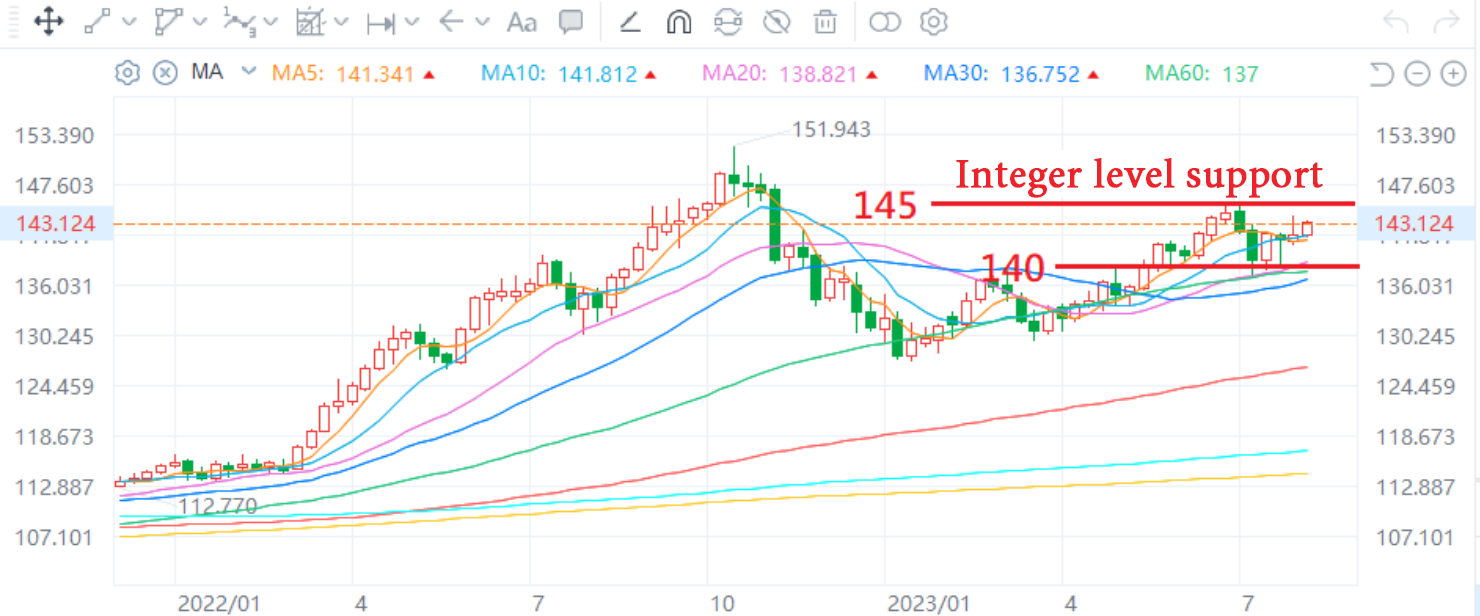
Introduction to Japanese yen investment tools
Taiwanese people generally have the following methods for investing in Japanese yen.
Go directly to the bank to exchange cash.
This method is more suitable for people who really want to travel to Japan for physical consumption. Due to the difference in exchange rate between buying and selling cash in banks compared to online banking, and some may also charge handling fees, this method is not suitable for those who want to earn exchange rate differences.
Online exchange
It can be exchanged through online banking, free of handling fees, with a small difference in buying and selling exchange rates and no time limit. It can be processed 24 hours a day.
This operation method is very safe and suitable for conservative investors or investors with large funds.
Foreign exchange margin trading
Due to the relatively low volatility of exchange rates compared to stock prices or cryptocurrencies themselves, some trading platforms also offer foreign exchange margin trading systems to allow investors to leverage and amplify returns.
Many foreign exchange traders even amplify exchange rate fluctuations by 50 to 100 times, allowing them to earn huge profits through small funds, but the risk also increases accordingly, Moreover, leverage has borrowing costs and is not suitable for long-term holding and short-term operation, making it more suitable for experienced investors to use.
The advantages of trading USD and JPY on the TOPONE Markets foreign exchange contract for differences platform:
Trading 24 hours a day, allowing you to trade US dollars and Japanese currency anytime, anywhere
The minimum tradable amount is 0.1 hands, and the margin is only $20
Up to 1000x leverage available
Zero commission, transaction fees with only a very low spread
Account balance negative protection
Effective risk management
Novice suggests registering a simulation account first, receiving a $100, 000 simulation deposit, and conducting simulation transactions:
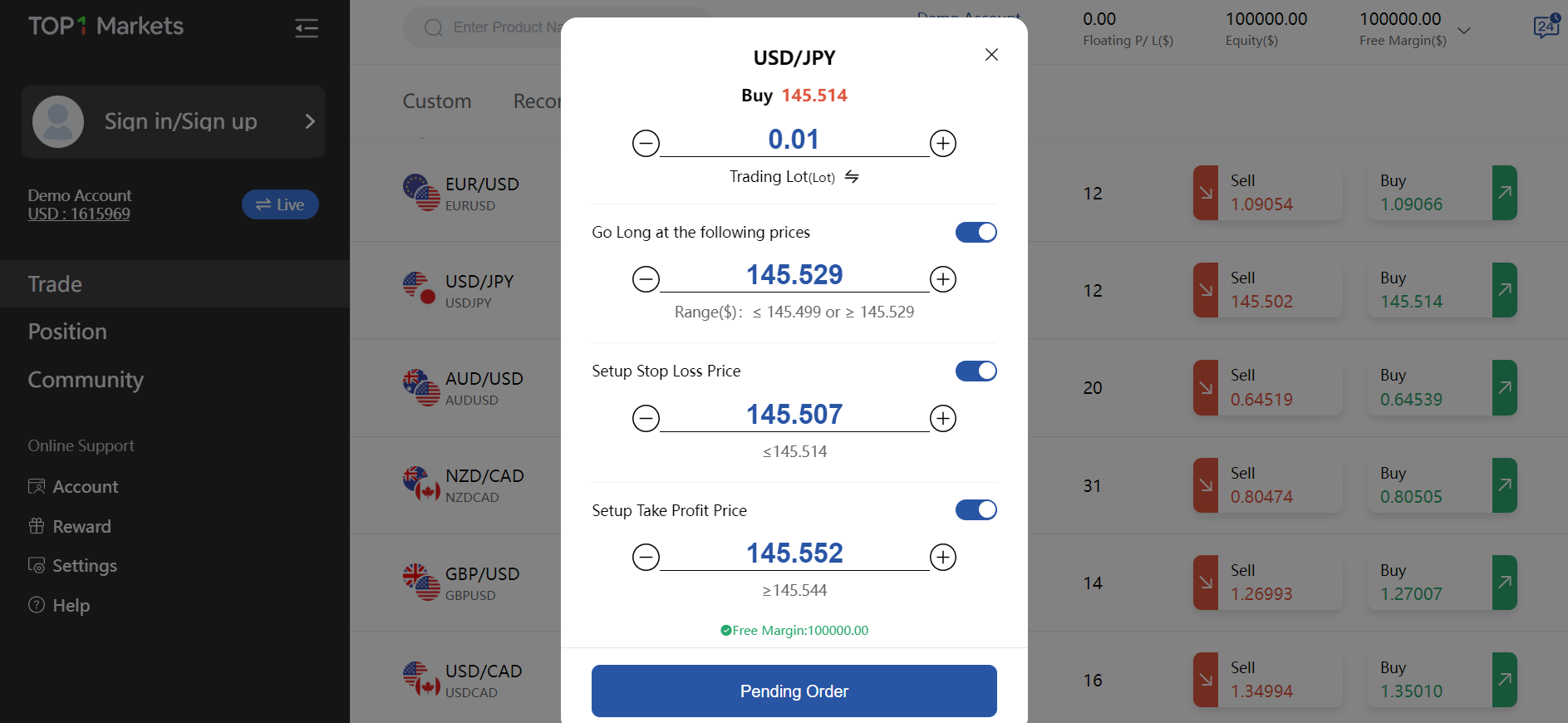
Trade on the TOPONE Markets Forex CFD platform trading USDJPY
Log in to the webpage version of the TOPONE Markets trading platform or mobile program TOPONE Markets APP
Register for a free TOPONE Markets account and receive a $100000 platform simulation fee
Free experience of simulated trading, including over 100 global financial products such as foreign exchange, cryptocurrency, gold, crude oil, indices, stocks, etc
Conclusion
Under the stimulation of sustained low interest rates and QE, Japan has experienced a long period of inflation domestically, and many negative factors from overseas have also been exhausted.
Inflation Rate in Japan:
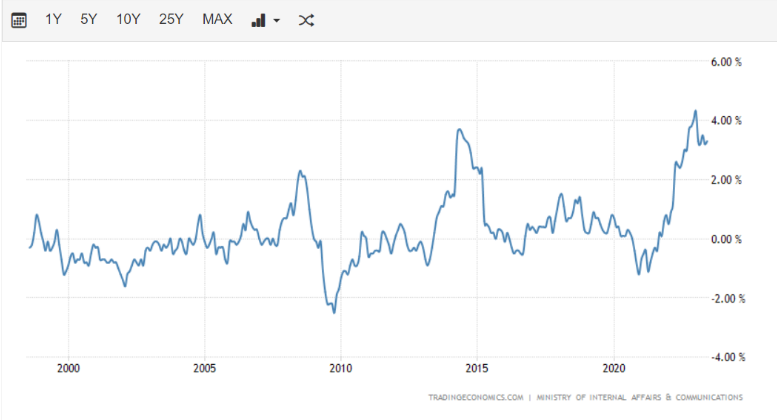
Data source: TradingEconomics
At present, investing in Japanese yen has a greater return than risk in the long run. Therefore, it is recommended that everyone can put Japanese yen into their own asset allocation. After all, even if the investment does not make a profit, traveling abroad to buy something to reward themselves is still very worthwhile. After all, all investments are aimed at enabling us to live a better life!


Trending Articles
- Who Is Andrew Tate and Why Is He Famous? 10 Things to Know the Controversial Influencer
Discover who is Andrew Tate and why he's making waves in the digital sphere. Uncover 10 intriguing facts about this controversial influencer, his journey, and his impact on the online world.
2024-03-01 TOPONE Markets Analyst - Andrew Tate Net Worth 2024: Is the Internet's Most Controversial Man Worth $800 Million?
Explore the enigmatic Andrew Tate's net worth and delve into the controversies surrounding the internet's most polarizing figure. Is he truly worth $800 million? Uncover the truth behind his wealth and reputation here.
2024-02-23 TOPONE Markets Analyst - 20 Strongest Currencies in the World in 2024
Want to know the strongest currencies in the world in 2024? Here are the list for you!
2024-01-30 TOPONE Markets Analyst - Falling Wedge Pattern: The Ultimate Guide
A falling wedge is a bullish pattern characterized by a wide top and shrinking bottom. It is an extremely bullish pattern in a trading market.
2023-09-25 TOPONE Markets Analyst

 Bonus!

Bonus rebate to help investors grow in the trading world!