English






Triple Bottom Pattern: The Ultimate Guide
Would you like to learn more about the Triple Bottom pattern, how it forms, and how to trade it? Throughout this article, you will learn more about this pattern.

 1682
1682Technically, the triple bottom is a bullish formation indicating an optimistic outlook for the stock, commodity, or index. The move signals a positive sentiment among market players and reflects a reversal to the upside, mainly driven by substantial volumes.
Essentially, a triple bottom shows the price holding a downward trend around three different but nearby levels. Bulls are taking control of the price movement and not allowing the stock price to fall further at these three different levels.
During the bottom of a downtrend, there arises a bullish reversal pattern called the triple bottom. In three consecutive attempts, the sellers have failed to break the support in this candlestick pattern, suggesting a sudden change in the trend direction.
This article will review the triple bottom chart formation structure and learn from it. Also, you will find tips about how to make a profit using a simple triple bottom trading strategy.
What is the triple bottom pattern?
Technical analysis utilizes the triple bottom chart pattern. Three equal low points come before a break above the resistance level in this pattern.
Typically, this pattern occurs when bears control trading during a prolonged downtrend. The first bottom could be interpreted as simply price movement, whereas the second bottom suggests that bulls are gaining momentum and preparing to reverse. It's evident by the third bottom that solid support has been established. Whenever the price breaks through resistance levels, bears might capitulate.
The triple bottom is formed by candlesticks that form three levels of support or valleys of equal or close to equal heights. The third valley is not strong enough to support the first two valleys, leading to a triple bottom breakout when it forms. Bearish trends create these patterns, which are bullish reversals.
The technical trader constantly looks for patterns to use as an entry and exit point. It is comprised of three matching bottoms that are followed by a breakout above resistance.
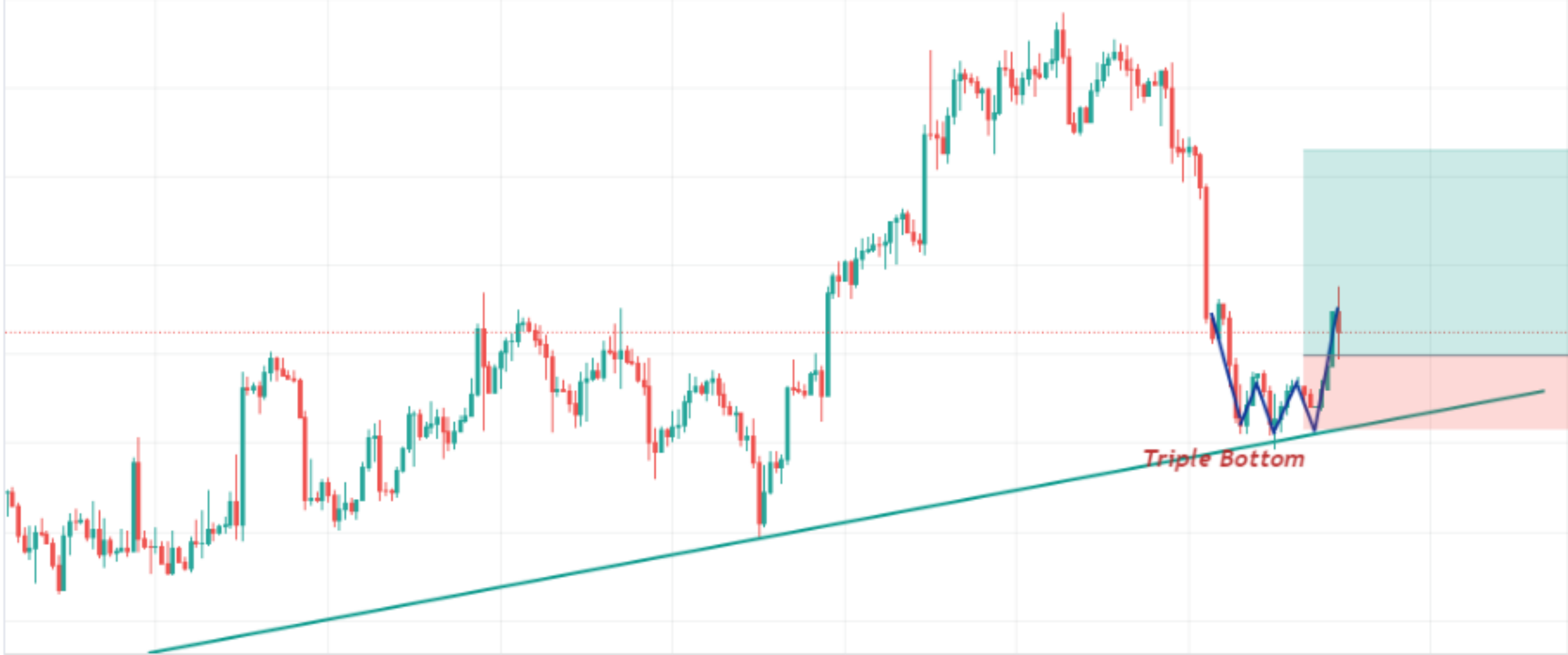
Triple bottom structure
There are several candlesticks in this structure. Candlesticks can each tell a story independently, but they create a larger picture when they are grouped. A pattern emerges when buyers and sellers engage in a tug of war. There has been a long-standing push and pull between the two.
With a pattern like this, it is reasonable to assume that the third bounce indicates demand for the stock at this level, and the fact that it was able to hold it three times raises the possibility that prices will continue to increase. Usually, high prices mean many buyers at those prices, causing the stock to hold up.
Breakout expectation
A breakout in a triple bottom usually leads to at least a measured move higher. Therefore, you can use this pattern to project the price to the upside by measuring the height of the trading range during the triple bottom and adding it to the resistance level once it has been penetrated.
To qualify for the triple bottom, some rules typically apply:
Before the pattern forms, there must be a current downtrend.
The three lows are recommended to be spaced out in price and almost equal. Even though two prices don't have to be equal, a trend line should be horizontal if they are close to the same value.
The price should break through the last resistance as the volume will drop throughout the pattern to indicate the bears are losing momentum.

Components of the triple bottom
Threelows: These are also known as the three troughs, and they act as an essential feature to mark important points. There is nothing wrong with lows being not equal, as long as they are in the same range.
Volume: Usually, this decreases as the pattern emerges. Sometimes, it increases, especially near the lows. You will see the volume increase at the resistance breakout once the third low is achieved.
Price target: The distance between the lows and the resistance breakout can be included in the resistance breakout. A pattern whose development is prolonged will ultimately lead to a breakout.
Resistance break: This marks the peak point on the pattern.
Broken resistance: The broken resistance is the same as the potential support.
Formation of the triple bottom pattern
This pattern is one of the most reliable reversal patterns. Downtrends usually lead to this pattern. These bottoms have almost the same heights and form a regular pattern.
Bottom one: The bottom one is formed in continuation of the downward trend. Several new lows are being formed, followed by a pullback (10-20%) till the neckline (resistance).
Bottom two: A further decline from the neckline brings about a second low or pull back (10-20%) before moving up again to the neckline.
Bottom three: A third bottom forms when price moves towards resistance three times before giving a breakout away.
Neckline resistance: The line runs from the first bottom to the third. This serves as significant resistance to the pattern.

Understanding the triple bottom chart pattern:
When traders believe that the price will drop further, a triple bottom chart pattern is formed, resulting in a new look (bottom 1), but a failure to continue so results in a pullback due to the strong support basics. A second pullback occurs when the sellers attempt to lower the price but cannot get enough momentum to lower it further. Finally, the formation of a third bottom is characterized by similar sentiments on the sellers' part. All these attempts resulted in sellers losing their faith, buyers overtaking sellers and causing the price to rise and the trend to reverse.
Duration: These patterns form over a period ranging from minutes to months. When a breakout occurs, the greater the reliability of a pattern with a longer duration.
Shape: The triple bottom should theoretically be symmetrical, which means that all three bottoms should have the same height and be spaced nearly equally apart. However, the three lows may not necessarily be the same height as they can also be pointed or round in shape, and the neckline can slope upwards or downwards.
Breakout: This is essential for this pattern to be confirmed. For the triple bottom pattern to be valid, the price must close below the neckline support or the confirmation point; the lowest low in the pattern and higher volume are usually observed. Therefore, a triple bottom pattern may not form unless the price closes below the confirmation point.
After a breakout, one can usually observe a pullback which supports the pattern formation. Important to remember, however, is that the pullback is to see your neckline, which later becomes your support. A stop loss is always highly recommended during a pullback.
Volume: Volume is a crucial factor in confirming patterns. Triple bottom chart patterns lead to a decrease in volume. The first bottom generally has a higher volume than the second and third bottoms.
When volume decreases, sellers lose interest, indicating that pattern formation is possible. As the breakout approaches, the volume increases, which further confirms the reliability of the pattern. This means that buyers are taking over from sellers.
Price target: A rough estimate can be determined by measuring the vertical distance between the highest bottom (support) and the neckline resistance. There should be consideration of other technical indicators as well.
What does the triple bottom pattern represent?
Triple bottom patterns are bullish reversal patterns. Consequently, you can expect a breakout above the patterns' high once you notice the triple bottom chart pattern.
If the pattern's confirmation occurs, this represents a chance for long-term holders to add to their bullish position. Conversely, the triple bottom pattern can serve as an exit signal for traders who wish to short the market.
To determine the reliability of the triple bottom, we must compare the actual pattern to the ideal. The results are reliable if the actual market closely mimics the idealized pattern.
Chart patterns with triple bottom occur typically after a prolonged downtrend when bears control the market. A first bottom may reflect normal price movement, but a second bottom indicates gaining momentum and a possibility of reversal for the bulls. The third bottom indicates strong support in place, which may lead to bears capitulating when the price breaks through resistance levels.
Triple bottoms are typically qualified by applying the following rules:
This pattern should occur in the context of an existing downtrend.
Ideally, the three lows should be approximately equal in price and separate from each other. For a trendline to be horizontal, the price may not be identical, but it should be reasonably close to the same price.
The price should break the final resistance with a decrease in volume, indicating the bears are losing strength. The volume should also increase as the bulls gain strength after the pattern has ended.
Example of a triple bottom pattern
The trading channel for Atom is ascending with higher highs and higher lows. From May-August, Atom formed a triple bottom, and its price increased 150% after escaping the support zone between 16-17.
The price of Atom has moved between 18-44 since September and formed a triple bottom or triple top pattern, both reversal patterns. The May-August period saw a 130% price difference between support and resistance zones, and September-January observed the same price variation.

If the price breaks above 45, you should take a long position and expect a price increase between 100 and 150% (80-100 USD).
First TP 55
Second TP 75
Third TP 100
It is plausible that we will see a new higher low around 25-26 USD, which is also a reasonable price level to open a long position.
Generally speaking, Atom outperforms Bitcoin, and the price of Atom could increase by two to three times if the Bitcoin price increases.
How to trade with the triple bottom pattern?
A double bottom reversal price target is usually the distance between the lows and the breakout point added to the breakout point. As an example, if the lows is $10.00 and the breakout occurs at $12.00, the price target would be (12 - 10 = 2 + 12 = 14) $14.00. It is typical to place stop-loss stops just above the breakout point or below the lows of a triple bottom formation.
A triple bottom chart pattern is similar to a double bottom chart pattern and may look like an ascending or descending triangle. Therefore, it is always good to use other technical indicators and chart patterns to confirm a triple bottom.
Traders might observe that an oversold relative strength index (RSI) forms before a triple bottom forms or look for a break to verify that it's a triple bottom instead of a descending triangle or another bearish pattern. This is a bullish reversal pattern.
This chart pattern already shows us that these are bullish reversal patterns. There has been a break in the downtrend, and the asset is trading at a strong support level.
A downtrend that reaches its third low will continue to go up, and traders will be under more pressure to sell the stock. Consequently, the stock price will get back to its original low. To rise, buyers will start moving back into the asset.
In the circumstance above, if the price falls for the third time and is at a new low, then the chart pattern will have completed itself once it has risen above the resistance level.
The pattern begins to take shape after confirmation.
The trader should set the trade trigger at the resistance line if the triple bottom has been confirmed. Then, traders can assess the potential breakout target, allowing them to open long positions.
Trading at this point provides traders the opportunity to benefit from the downtrend by purchasing the underlying security. In closing the pattern, the price will rise, causing more selling pressure within the market. The sale of the security is an excellent opportunity for short-term traders to make a profit.
When it comes to triple bottoms, the best exit point is determined by adding the width of the respective formation to the high or low point. However, it would help tighten your stops once you have reached the target to reap the most significant profits.
What happens after a triple bottom pattern?
Expect a bullish price reversal once the triple bottom three lower lows have been formed. The high point of the triple bottom pattern is the first thing to identify when the breakout higher is confirmed.
Placing vertical lines at the first and third bottoms of the pattern is the easiest way to identify the high point. Next, identify the point at which the high price (or peak) is located between those two vertical lines. For example, between the three bottoms in the chart below, the highest price is $42,396. A horizontal line extending to the right is present on this high point.

Bullish traders will be alerted that a reversal is underway once this high price point balances- and shortly, prices will likely rise even higher. Even though this confirmation method isn't 100 percent foolproof, it does provide traders with a level of reliability they can rely on to make more accurate predictions.
Increasing volume on the uptrend or expanding ranges of the bullish candles can also help support the case of a bullish break.
To succeed, a bullish breakout does not have to fulfill all of these conditions. In any case, their presence confirms the likelihood of a breakout following.
What is the difference between the tripe bottom and triple top patterns?
A triple top alternates with a triple bottom. The triple top is essentially the opposite of a bullish trend reversal, where the price action bumps three times off resistance, posting three roughly equal highs before plunging through resistance.
Nevertheless, these patterns correspond to the same market phenomenon - a prolonged battle between bulls and bears to control the market, where one side eventually wins. If no winner emerges, the bottom or top of a triple bottom or top will be an extended range.
Limitations of the Triple Bottom Patterns
Whenever you trade chart patterns with probability, you will always face uncertainty. However, triple bottoms are easily recognizable once the trading opportunity has passed, as with most patterns.
By definition, a triple bottom can become a double bottom if the double bottom fails, and vice versa. Although a triple bottom does have its limitations, the most common one is that its placement of target and stop-loss does not offer significant risk and reward.
Traders can increase their profit potential by dropping their stop losses inside the pattern before the breakout and trailing them upwards as the breakout occurs. The problem is more likely to be stopped out of the range and lose a small amount of money.
Final thoughts
A triple top pattern is a reversal chart pattern, as are triple bottom patterns.
A triple top is a chart pattern that indicates a bearish reversal after an upward trend.
A triple bottom pattern is a bullish reversal pattern that appears after a downward trend in chart patterns.
Trading these patterns is governed by specific rules.


Trending Articles
- Who Is Andrew Tate and Why Is He Famous? 10 Things to Know the Controversial Influencer
Discover who is Andrew Tate and why he's making waves in the digital sphere. Uncover 10 intriguing facts about this controversial influencer, his journey, and his impact on the online world.
2024-03-01 TOPONE Markets Analyst - Andrew Tate Net Worth 2024: Is the Internet's Most Controversial Man Worth $800 Million?
Explore the enigmatic Andrew Tate's net worth and delve into the controversies surrounding the internet's most polarizing figure. Is he truly worth $800 million? Uncover the truth behind his wealth and reputation here.
2024-02-23 TOPONE Markets Analyst - 20 Strongest Currencies in the World in 2024
Want to know the strongest currencies in the world in 2024? Here are the list for you!
2024-01-30 TOPONE Markets Analyst - Falling Wedge Pattern: The Ultimate Guide
A falling wedge is a bullish pattern characterized by a wide top and shrinking bottom. It is an extremely bullish pattern in a trading market.
2023-09-25 TOPONE Markets Analyst

 Bonus!

Bonus rebate to help investors grow in the trading world!