English






Supertrend Indicator: A Complete Guide
The Supertrend indicator works as a trend following overlay in which it displays the current trend direction. It is an excellent tool to use in the trending market.

 2743
2743Choosing the right indicators for intraday trades is a common problem. You are likely to identify trades using technical analysis as an intraday trader based on various parameters.
Despite its simplicity, our first thought regarding an intraday trading indicator is the Supertrend indicator. The software can provide you with accurate buy or sell signals in trending markets along with the best super trend strategy for intraday trading.
Let's dive into the discussion below, where we will discuss what the Supertrend indicator is and how it works in your trading process.
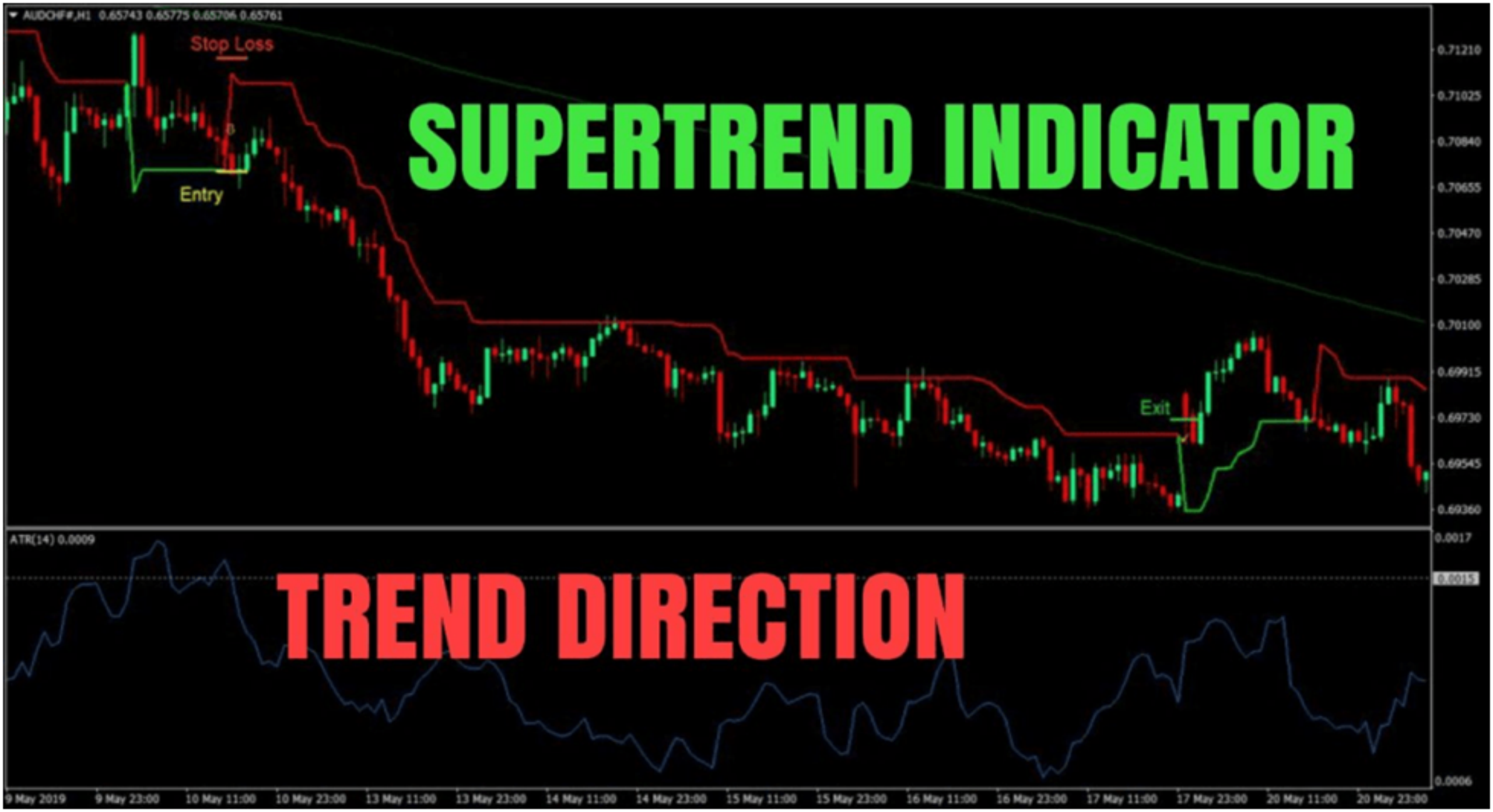
Supertrend indicator on the chart
What is the Supertrend Indicator?
Developed - as explained above - by Olivier Sebam to assist traders in identifying trends and knowing when to buy or sell financial assets, the Supertrend is an unpopular technical indicator. Neither TradingView nor MetaTrader includes the indicator as a default. Custom Supertrend indicators are available in the market.
The super trend indicator is easily visible on a chart with two colors. These colors are typically red and green by default, but they can be changed. For example, a green bar indicates to buy an asset, whereas a red bar indicates to sell an asset.
All timelines work well with the supertrend indicator. Short-term charts such as 5-minute charts can be used, and longer-term charts like daily and weekly charts.
Features of Supertrend Indicator
You'll see a continuous green and red line on a stock chart when plotting the Supertrend Indicator. When the stock price turns higher than the indicator value, an arrow signal indicates a buy.
It also shows you a crossover of the price over the indicator and changes the indicator's color to green. Once you receive a sell signal, you can close your long position. An arrow with a downward pointing and a red color indicates a sell signal.
As soon as you see a sell signal, you can exit your position or create a new short position as you would expect the stock price to go down further.
Stop-Loss can also be used with the indicator line in either direction. If you have a long position, you should set your Stop-Loss at the green indicator.
Hence, you should put your stop loss at the red Supertrend indicator line if your position is on the short side. There is nothing wrong with using Stop-Loss signals for supertrend signals. However, the Stop-Loss feature allows you to cut your losses and so it is a good idea to always use it without thinking about it too much.
How does the Supertrend Indicator work?
It is based upon two fundamental dynamics- the period and the multiplier. Therefore, it is important to understand ATR or average true range. ATR determines volatility in a market by decompressing price ranges for a given period.
These values (current high minus current low), the intrinsic value (value inherent in the difference between current high and the previous close), and the current low minus previous close make up a true-range indicator.
The ATR is calculated by first finding the TR value series, then dividing the above by n, the number of periods represented by the ATR. The result is the moving average of the TR values.
When the above information is put into the formula for ATR, it looks like this:
TR=Max [(current high –current low), Abs (current high – previous close), Abs(current low – previous close)]
ATR= (1/n)
TRi stands for the true range
n is the number of trading days or periods
To understand the workings of this indicator, we need to use this formula. You can select Periods (the number of days for the ATR) and the multiplier from the super-trend indicator on most trading terminals.
Multipliers are values based on which ATR is multipliedATR is typically multiplied by three for ten periods.
The shorter the n value, the more signals it can produce and the more responsive to price changes, with a longer value of n, fewer noise signals, and fewer signals to act on.

Supertrend indicator calculation
How to use the Supertrend Indicator?
The steps for using this Supertrend are as follows:
To trade a particular stock, open its chart.
Set the time interval for intraday trading at 10 minutes. Various charting programs can be used for that.
Insert a supertrend indicator. You can also set it to 10 and 3, and you can even insert your settings.
Once you have your settings, you can start tracking.
Stocks can also be bought and sold by following the arrows.
Technical analysis can also be performed using Supertrend. On confirmation of a trend, it signals going long or short.
You can use the indicator on your chart by setting a time interval of 10 minutes for intraday trading and then opening the chart of the stock you want to follow. You can use any good charting software. Set the settings to 10 and 3 for the supertrend indicator.
The settings can also be customized. Once you see a positive signal, you can begin tracking it. The charts show pictures once the indicator is plotted. You can buy or sell stocks according to the arrows.
A sell signal is generated when the indicator value is below the price. The red color is displayed. It is capable of detecting intraday trends quickly.
In any case, the default values of 10 and 3 should be adequate while you are using them. However, it is possible to generate incorrect signals if you reduce the parameter.
How do you read the Supertrend indicator?
Indicators indicate a buy or sell signal by plotting above or below the closing price. If you should be buying, the indicator changes color. The indicator turns green if it moves below the closing price, giving an entry point or points for buying.
Trend indicators, such as Super Trend, perform well in trending markets (both uptrends and downtrends).
Technical indicators cannot be 100% accurate, nor can Super Trend. Also, it generates false signals during sideways markets, though it does so less frequently than other indicators.
A 'Supertrend' also acts as strong support or resistance and as a trailing stop loss for existing trades and acts like any other indicator when used with other indicators such as MACD, Parabolic SAR, RSI, etc.
What is the best way to use Supertrend for intraday trading?
Open a price chart with 10-minute intervals for intraday trading and use the Supertrend indicator.
The Supertrend indicator consists of a line that flips from one side of the candlestick to the other when applied to the chart. You can begin tracking for good signals to you once the green and red lines are drawn.
Green lines represent trailing stop losses for long positions, and red lines indicate trailing stop losses for short positions.
An asset's price will become greater than the indicator when it reaches the line or the color changes from red to green. Alternatively, it is time to sell when the green color turns red and the asset price drops below the indicator value.
The Supertrend predicts no direction. Instead, it helps traders determine whether to remain in a position once the trend is identified and whether or not to initiate a position once the trend is identified.

Identifying trend with Supertrend
What are the parameters for the Supertrend Indicator?
By default, the whole period is set to 10 and 3. If those figures change, their effects will be felt on the Supertrend indicator.
No trading indicator has the best setting. Further, the more settings you change, the more likely you will create an over-optimized trading system.
The following points should be noted;
The indicator will be more reactive to price changes with smaller settings, resulting in more signals.
With higher settings, fewer trading signals will be generated because the noise from the market will be removed.
Formula to calculate Supertrend Indicator
With the following formula, you can calculate the SuperTrend indicator:
Up = (high + low / 22 + multiplier x ATR
Down = (high + low) / 2 – multiplier x ATR
Average true range calculation:
[(Prior ATR x 13) + Current TR] / 14
14 is nothing but a period according to this definition. The ATR of the period is thus calculated as the last ATR x 13. Next, divide the most recent TR value by the duration after adding the most recent TR value.
Finally, you should know that the ATR plays an important role when calculating technical indicators.
How to identify buy and sell signals with Supertrend Indicators?
Using the Supertrend indicator is the most important part for intraday traders. A green signal indicates a buy, while a red signal indicates a sell. Here's how to determine a buy signal and a sell signal
Buy signal
You will usually get a buy or sell signal when you plot any Chart with a Supertrend Indicator. A red line will appear above the price line if the supertrend signal is a 'SELL.' Whenever the price crosses above this red line, the supertrend generates a buy signal. Red indicates a buy signal when the super trend generates one.
This line is moving downward and is now a green line below the price. Supertrend buy signals are typically indicated by a green arrow on the candlestick. If you received a buy signal, stocks could be purchased with stop losses as low as the previous candle.
What if the previous candle low was very far from the buy signal level, like 5% or 10%? It would be wise to ignore supertrend signals in such cases. A stop loss should be reasonable only if the previous candle were within the 1-2% range.
Sell Signal
The supertrend line becomes red after the price crosses the green line (sell signal). After the price crosses the red line, the supertrend line goes above the price line.
It is also applicable to set a 1-2% stop loss range. A stop loss of 5%-10% should be avoided.
What are the Supertrend trading strategies?
Supertrend and Moving Average Crossover
Based on the crossover of 5-20 EMAs, this strategy involves Super Trend. It is a buy signal when the Super Trend turns green (i.e., Super Trend is below the price) and the five-day moving average is above the twenty-day moving average. Conversely, a sell signal is generated whenever the Super Trend is red (i.e., above the price) and the 20 EMA is above the 5 EMA.
Linear Regression
SuperTrend does not predict trends. However, if the trend is established, it encourages you to take a position and hold it until it continues. In this case, the Linear Regression is used to determine stock price.
Linear regression projects a line based on least square fitting that reflects the general trend of a sample of data. When the Linear Regression Indicator is up, traders go long, and when the indicator is down, they go short.
Its Linear Regression line indicates where the price should be expected, allowing it to respond more quickly than a moving average.
When should the Supertrend Indicator be used?
Swing Traders and Position Holders use longer timeframes to identify absolute trade signals after confirming trends, eliminating short-term volatility. For example, using a 15-minute chart as the smallest time frame is possible.
In addition, you can use this indicator on multiple timeframes, placing it on a long-term timeframe, then going down to a short-term time frame where it can be used as an entry and exit signal.
What is the best way to prevent Supertrend false signals?
By the way, using smaller parameters may give you an advantage over using the default Supertrend parameters of 10,3. Since smaller parameters can permit you to enter and exit more quickly, we can eliminate extra false signals using RSI (7) followed by Supertrend(5,1.5).
How do I find it?
The Supertrend is an indicator built into some trading platforms, such as the MT5.
Some older editions of MT4 do not include the indicator when you install them, only if your broker does. However, you can download the indicator online and include it on your trading platform if it does not already have it.
In addition to creating a version for MT4, Ninja Trader has made versions for eTrader, Trade Station, and others.
You can search for it online.
Is it yet possible to improve the accuracy of the SuperTrend signal?
RSI and ADX indicators can be used to complement the signal provided by the Supertrend indicator. For example, the Adx indicates trend strength and ADS > 30 indicates a strong trend.
Similarly, the RSI identifies overbought and oversold conditions. The RSI > 80 indicates overbought conditions, while RSI * 20 indicates oversold conditions.
Pros and cons of Supertrend Indicator
Pros:
There is always a tendency for it to send out the correct signals.
There is a high likelihood that the indicator will send signals at a definite time.
It provides quick technical analysis for intraday traders.
Additionally, it assists intraday traders in making better decisions.
Cons:
The indicator covers not all situations.
In an ideal world, it would only work in a trending market.
In some cases, the two parameters used by the indicator are not enough to correctly forecast market direction.
FAQs
What is the accuracy of Supertrend?
Some indicators may give false signals, and no indicator will give 100% accurate results. For example, super trends are better than other indicators because they provide fewer false signals. You must, however, conduct a proper backtest before making any calculations.
Supertrend indicator: how to use it?
By going into the Add Indicators section, you can add supertrend to your charts. Once it is applied, you will see buy and sell signals. Combined with ADX, it provides better results.
What is the formula for calculating Supertrend?
To offset the indicator from the normal price, the SuperTrend indicator uses the ATR. The stock price changes in the other direction when the upper or lower offset line of the SuperTrend is reached. By default, the 14-period ATR is used in the calculation.
How does Supertrend trading work?
Supertrend strategies attempt to maximize profits from small price breakouts. This trading strategy involves buying when we receive a supertrend buy signal and selling when we receive a supertrend sell signal. The system works best when stock prices are going up rather than down.
Bottom line
In light of all the information we have learned about the SuperTrend Indicator, we can conclude that it is only suitable for use when the market is trending and that there are clear uptrends and downtrends in terms of price movement.
Traders who can identify a Supertrend that has formed might be able to stay with it for weeks, months, or even years.
In addition to assisting traders in generating a few profits, Supertrend can make them endure extreme pullbacks as well. Therefore, risk management is paramount, which is why you should only trade with money you can afford to lose.
Sideways markets don't seem to be profitable for the indicator since they may also give false signals, which may lead to bad trades in the end.
Combining it with other indicators, such as moving averages, is highly recommended to use this indicator practically.


Trending Articles
- Who Is Andrew Tate and Why Is He Famous? 10 Things to Know the Controversial Influencer
Discover who is Andrew Tate and why he's making waves in the digital sphere. Uncover 10 intriguing facts about this controversial influencer, his journey, and his impact on the online world.
2024-03-01 TOPONE Markets Analyst - Andrew Tate Net Worth 2024: Is the Internet's Most Controversial Man Worth $800 Million?
Explore the enigmatic Andrew Tate's net worth and delve into the controversies surrounding the internet's most polarizing figure. Is he truly worth $800 million? Uncover the truth behind his wealth and reputation here.
2024-02-23 TOPONE Markets Analyst - 20 Strongest Currencies in the World in 2024
Want to know the strongest currencies in the world in 2024? Here are the list for you!
2024-01-30 TOPONE Markets Analyst - Falling Wedge Pattern: The Ultimate Guide
A falling wedge is a bullish pattern characterized by a wide top and shrinking bottom. It is an extremely bullish pattern in a trading market.
2023-09-25 TOPONE Markets Analyst

 Bonus!

Bonus rebate to help investors grow in the trading world!