English





Leading vs. Lagging Indicators: What’s The Difference?
Business leaders can use a leading indicator to guide them in achieving desired results, while a lagging indicator measures current production and performance. Dynamic indicators are difficult to measure while lagging indicators are simple to measure but difficult to change.
 1584
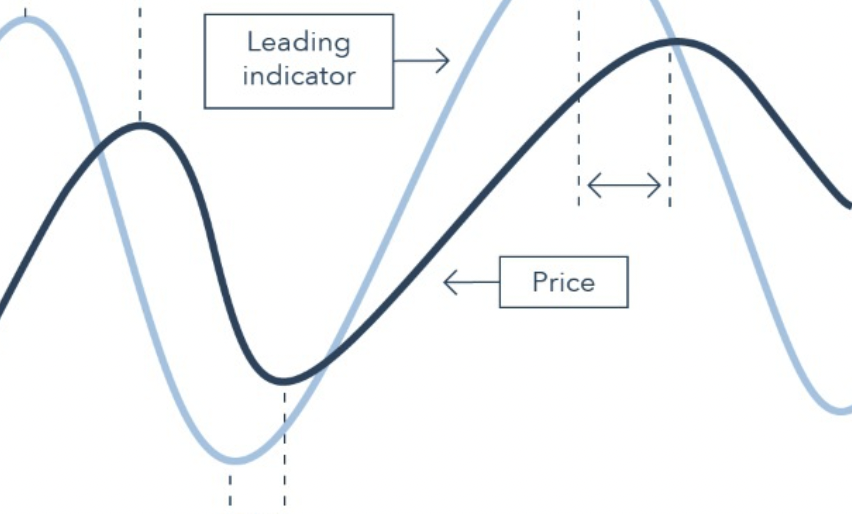
1584The lagging indicators use past price data to provide entry and exit signals, while the leading indicators use past price data to provide indications of future price movements.
Introduction
When you trade stocks, you buy and sell frequently in a bid to time the market. Traders aim to profit from short-term market events by selling or purchasing stocks at a discount. It is rare for traders to buy and sell multiple times, called day trading.
Stock traders devote several hours to following the market, doing extensive research. Using the technical analysis of stocks, they find trading opportunities and trends by charting a stock's movements. Many online brokers can find stock trading information like analyst reports, stock research, and charting tools.
In order to follow the action effectively, it is crucial to use the right technical indicators. The type of opportunities you will find in your nightly research will affect how you interpret trends on positions and in the broad averages. You'll build a strong base for speculative success if you pick wisely. Predators will line up ready to pick your pockets everywhere you go when you make a poor choice. Almost all technical indicators can be classified into five categories. It is possible to further subdivide each category into leading vs lagging indicators. If you are going to adjust an indicator one at a time, you should start with the most popular numbers to see if the output helps or hurts your performance. With this method, you will quickly understand the needs of your level.
What are the leading indicators?
Inputs are sometimes described as leading indicators. The indicators specify what actions you need to take to achieve your objectives. "Leaders" are those who successfully meet business objectives, which is why they are called "leaders".
As a result, leading indicators provide benchmarks that indicate whether or not overall KPIs and objectives are being met. Here are some leading indicators for a company that offers enterprise business software with an annual subscription fee:
The customers percentage who sign up for a two-year contract
Renewing software before midterm alerts or at midterm
A customer base that purchases software add-ons
The best indicator is known as a technical indicator that forecasts future price movements using past price data. With leading indicators, traders can anticipate a future price movement, which allows them to enter trades when the move is just beginning potentially. In some cases, leading indicators can lead to the market moving in the opposite direction, as traders anticipate a move before it occurs. Thus, it isn't unusual to see false breakouts or signs of trend reversals that just turn out to be minor retracements.
The following are examples of common leading indicators:
Donchian channels
Support and resistance levels
Fibonacci retracements
Client Sentiment (IG Client Sentiment)
Advantages
Establish favorable entry points for possible moves.
The use of leading indicators assists traders as they identify key levels that can lead to higher probability trades.
Limitations
Prices are not guaranteed to move in the direction predicted. Investors must use their own judgment when using these indicators.
Often, leading indicators can provide insights into advanced techniques like Elliott Wave Theory, which new traders may find intimidating.
What are lagging indicators?
Unlike leading indicators, lagging indicators measure current performance and provide information on achieving desired results. Lagging indicators are simple to measure but difficult to change while leading indicators are dynamic but difficult to measure. A lagging indicator and an output metric are opposites, so they are sometimes compared.If you ask what’s the difference between leading and lagging indicators, then the lagging indicators, measure what has already happened to gain insight into future success. Examples include:
Expenses
Profit
Customer participation
Revenue
Renewal rates
Traders use lagging indicators to analyze the market based on the previous price action average. The name of these indicators suggests that they lag the market. As a result, traders helps witness a move before the indicator confirms it, which could cause them to lose several pips initially. Many consider this to be a necessary expense to verify if the move gathers momentum. Many traders consider this a missed opportunity since they fail to enter a trade at the beginning of a move.
Indicators that lag include:
Simple Moving Averages (SMA)
Stochastic Oscillator
Relative Strength Index (RSI)
Moving Average Convergence Divergence (MACD)
Advantages
Enhances trading conviction - confirms recent price movement
Reduces the risk of false breakouts or failed moves
Limitations
The lagging indicator sacrifices potential pips while traders wait for confirmation.
Traders should be aware that lagging indicators do not understand key levels.
How to use leading indicators
Taking measurements of leading indicators is more challenging than taking measurements of lagging indicators. These indicators are abstract, so they are more challenging to measure. As previously mentioned, leading indicators are how your business is doing. You might miss an important segment of your market if you use lagging metrics, such as revenue because they are purchasing from a location where you do not have a presence.
Indicators of leadership play a key role here. If you track purchases outside of specific zip codes or regions, you can learn where your company could establish a new foothold. Looking at overall revenue alone won't provide this information. A leading indicator would be appropriate when you are considering future growth and success.
Leading indicators are not guaranteed to be accurate. Several leading indicators provide insight into an economy's future, along with other types of data. There is often a trade-off between accuracy, precision, and lead time in predicting future events using leading indicators. Theory suggests that a leading indicator should be able to forecast economic trends or business performance changes with high accuracy, over a long time horizon, and with a narrow estimation range, but in practice, they all vary.
Understanding of leading indicator
On the other hand, a leading indicator can provide highly accurate and precise information about an economy or market that is turning or changing. You can use these indicators to uncover trends that could impact your business or investments, but they may not arrive in time for you to take full advantage of them.
Even though both types of leading indicators may be useful on their own, neither type is comprehensive enough to maximize performance. Therefore, it is possible to predict future trends by using a variety of leading indicators that are more or less precise, precise, and forward-looking.
How to use lagging indicators
The term 'lagging indicator' refers to observable or measurable factors that change after changing economic, financial, or business variables. Leading indicators confirm trends and predictions of trends. For gauging the general economy, business operations, and strategy, and as signals to buy and sell assets on the financial market, lagging indicators can be extremely useful.
Understanding of leading indicator
A lagging indicator signals a financial shift after it has been apparent for some time. In this way, lagging indicators are a confirmatory measure of long-term trends, not a predictor. It is helpful since many leading indicators are volatile, and short-term fluctuations can obscure essential turning points.
An event that triggers a lag indicator, and, therefore, a lag indicator is self-explanatory. When you use lagging indicators to determine, in retrospect, who attended and what was produced, or how attendees received it, you're assessing the outcome of an event, product release, sales training program, and what have you.
Combining lag indicators with leading indicators is the best way to determine trends and if outcomes were achieved. Insight can be gained by comparing leading, and lagging indicators made simple with the right technology infrastructure.
Example of leading indicators
When considering leading indicators, determine what you can do, or Indicators can also be leading or lagging depending on the viewpoint. A signed contract, for instance, could be a leading indicator for the finance department but a lagging indicator for sales. Despite being harder to measure, leading indicators provide valuable insight into the future. A number of key performance indicators for future growth are derived from lagging indicators.
You can find your leading indicators by following these steps:
1. Determine the business objectives and results you want to achieve
Begin by identifying your goals and your strategy. Financial performance and customer or market performance are usually measured as outcomes such as increasing profits, improving customer satisfaction, or increasing market share.
2. Identify the results and goals you want to achieve
When you know what you want to accomplish, you must have measures in place to monitor your progress. For this, you must define your goal's outcome or a lagging indicator. A good example would be net profits margins or market share.
3. Determine what drives value
To achieve your goals or achieve your desired results, you need to determine what activities or conditions you need to meet. What can I do in order to reach my goals and achieve my results? Which activities are most likely to drive success? Does the market need to be in the right place?
4. Which leading indicators will you use?
The purpose of this step is to identify how your value drivers might be measured in order to create your leading indicator. A metric can be a measure of the activities you need to do to achieve your goals and results, or it can be a signal or measure. Consumer behavior and market trends are examples of conditions.
Additional leading metrics that may indicate that a retreat of this nature is taking place include:
What are the most likely places for sales growth? These factors indicate what new regional or industry markets you can corner after the retreat based on attendance and other factors.
In new markets, what sales goals can we predict for individuals? Since you expect to grow in certain areas, this percentage indicates how much growth to anticipate
Can we expect a large number of attendees next year? Leading indicators, such as future attendance percent, can be developed using lagging indicators, such as total attendance.
Example of lagging indicators
Because they measure what already happened, lagging indicators can be of use to businesses. By measuring performance through indicators, we can better understand performance and identify ways to improve it in the future. There are two types of hands you will need to do this correctly.
Furthermore, some indicators can lead and lag at the same time. The HR department may consider it a lagging indicator (e.g., have they put the right systems and processes in place to hire the right people? ). However, it's a leading indicator for the company since it should translate into better business outcomes.
In order to assist my clients in defining their strategy, I create what is known as a "plan on a page". It divides the company strategy into several key areas or "panels" - finance, customer, and resources - and outlines their goals. To create a detailed picture of performance, you need to look at outcomes (and the actions/inputs required to achieve those outcomes).
Since lagging indicators are easy to measure, some enterprise organizations put too much emphasis on them. As such, leading indicators don't get much attention.
Both should be deployed. Using the examples below, you can see how lagging indicators are used in practice and how they interact with leading indicators. For example, you have just organized a corporate retreat, and you are evaluating its success. Here are some lagging indicators to use:
The retreat was attended by how many people? By knowing this, you can estimate general interest.
What was the cost of the retreat? Calculating the return on investment will be easier with this information.
Workshops were offered to how many attendees? The number of attendees tells you how engaging your programming was.
How many people attended which workshops? By looking at this indicator, we can infer the most interesting parts of the program.
It is possible to confirm a change in the economy by looking at the lagging indicators.
Economic Lagging Indicators
Every month, the U.S. Conference Board publishes a lagging indicator index in addition to its leading indicator index. The consumer price index for services, the average unemployment duration, and average prime rates charged by banks can be used as lagging indicators. Indicators are used for forecasting and making predictions differ from leading indicators.
Business Lagging Indicators
An example of a lag indicator is sales, client satisfaction, or revenue churn, which measures business performance after the event has occurred. Indirectly influencing them is hard or impossible.
Companies may also monitor leading indicators that measure internal performance, such as customer satisfaction or employee engagement, which can directly influence and result in lagging indicators. Businesses can measure, track, and compare various performance indicators using business intelligence tools such as dashboards.
Technical Lagging Indicators
The second type of lagging indicator occurs when a technical indicator lags behind the current price of an asset, which occurs after a specific price movement has occurred. Crossovers of moving averages are examples of lagging technical indicators.
In contrast to other lagging indicators that compare different economic variables to each other, technical indicators compare the value of a given variable to its own moving average over a given period or to other historical characteristics. An increase in momentum is considered a confirmation by technical traders when a short-term average crosses above a long-term average.
How to fetch the most out of leading and lagging indicators?
By measuring performance through indicators, we can better understand performance and identify ways to improve it in the future. There are leading vs lagging indicators. You will need to do this correctly.
Furthermore, some indicators can define the difference between leading and lagging indicators. It could be considered a lagging indicator for HR (for example, have HR put the right systems and processes into place to hire the right people? ). However, it is a leading indicator for the company as a whole, since it should translate to better business performance in the future.
To define a client's strategy, I help them create a "plan on a page". A company strategy is broken down into several "panels" - such as a finance panel, a customer panel, and a resources panel - and each panel's desired outcomes are outlined. Identifying the right combination of leading and lagging indicators can help you create a clear picture of performance by focusing on outcomes (and the actions that will be taken to achieve those outcomes).
Final thoughts
In short, if you rely only on lagging indicators without using leading indicators, your KPI results will be incomplete. Lag indicators are an important component for creating leading indicators, but they are not the whole story. To arrive at accurate and achievable KPIs, these metrics need to work together.


Trending Articles
- Who Is Andrew Tate and Why Is He Famous? 10 Things to Know the Controversial Influencer
Discover who is Andrew Tate and why he's making waves in the digital sphere. Uncover 10 intriguing facts about this controversial influencer, his journey, and his impact on the online world.
2024-03-01 TOPONE Markets Analyst - Andrew Tate Net Worth 2024: Is the Internet's Most Controversial Man Worth $800 Million?
Explore the enigmatic Andrew Tate's net worth and delve into the controversies surrounding the internet's most polarizing figure. Is he truly worth $800 million? Uncover the truth behind his wealth and reputation here.
2024-02-23 TOPONE Markets Analyst - 20 Strongest Currencies in the World in 2024
Want to know the strongest currencies in the world in 2024? Here are the list for you!
2024-01-30 TOPONE Markets Analyst - Falling Wedge Pattern: The Ultimate Guide
A falling wedge is a bullish pattern characterized by a wide top and shrinking bottom. It is an extremely bullish pattern in a trading market.
2023-09-25 TOPONE Markets Analyst

 Bonus!

Bonus rebate to help investors grow in the trading world!