English






Dividend vs. Growth Stocks: What are the Differences?
The main difference between dividend and growth stocks is how you emphasize the return on each asset and long-term growth for every share.

 2798
2798Investors use many criteria to select stocks. For example, some will monitor specific industries, while others will invest based on price changes and new trends. The current strategy is to focus your business on dividends and growth stocks.
With dividend stocks, you try to make money from a few consistent dividend payments with time. You want to make money at increasing prices and subsequent capital gains with rising stocks.
Here's a quick guide on the main differences between dividend stocks vs. growth stocks and how to choose the one.

What are dividend stocks?
The main difference between dividend and growth stocks is how you emphasize the return on each asset. It is also based on how the company plans long-term growth for every share.
A dividend stock encourages regular dividend payments instead of the share price of the asset. Being an investor, you plan to make the maximum regular payments.
Finally, if you sell the stock, it's a nice bonus when the price goes up, and you get some money from the sale. However, you can then make the planned returns.
Dividend stocks are defined by the nature of any specific underlying company. Here, the company behind the shares usually uses its income to pay out shareholders. Again, this does not mean that the company uses its profits only to pay shareholders. However, in its business strategy, it emphasizes the payment of dividends.
Most companies prefer to make these payments quarterly.
Why should you choose dividend stocks?
Dividend selection means building an investment portfolio that focuses on dividend-paying assets.
You have to diversify yourself into a few growth assets. But it would help if you are looking for stocks when making maximum investments. Find the one with a consistent history of gaining high returns on dividend payments.
You can even consider choosing funds or individual stocks besides investing in dividend-oriented assets. If you follow this trading strategy, you will also need to decide how to manage the money earned on dividend investments.
Many investors in their portfolios return their dividends, either for money to buy many of the same assets (which themselves formed their investment) or to buy different shares.
What are growth stocks?
Growth stocks are the stocks where you emphasize stock price growth from all other considerations. As an experienced investor, you plan to earn some of your money by simply selling stocks in the coming future. This profit form is known as the "capital gain."
With rising stocks, the holding company often decides to reinvest all the profits in the company itself. This will leave investors with little money, so small dividends will likely be.
However, this reinvestment is likely to increase the company's value over time. This, in turn, will also increase the overall value of any company's stake.

Why choose growth stocks?
Selecting growth stocks means creating a portfolio that focuses on stocks that you expect their value to grow over time. You will need to diversify into some dividend assets, but most of your investments will give weight to companies that invest their profits.
This is a less liquid strategy than investing dividends because your shares do not generate returns as long as you hold them. However, you will witness some returns if you sell a set of shares and collect your deserving capital gains.
Investing in growth means that your cash flow can be more fragmented, which is much more than investing in dividends. This is because your money comes from selling those stocks in individual amounts.
If you follow this strategy, you have to decide what suitable money you plan to earn over each share. Many investors reduce their returns in their portfolios and use the money to buy new stocks or sets of stocks that they hold in anticipation of future profits.
How can growth stocks be identified?
Investing in growth stocks requires a good selection based on specific indicators. For making some high profits, you should make a robust portfolio based on excellent stocks. Make sure you invest in it for a more extended period, i.e., 6-7 years. Some indicators which you need to consider for identifying the growth stocks are:
Earnings per share (EPS)
EPS is one of the essential stock data for new or old investors. It represents the net profit achieved by the company in each segment. EPS will directly show some effect on the market price of various shares.
You can calculate it by dividing the profit after tax by the total number of shares. EPS = Profit after tax (PAT) / No from best shares.
Suppose the company's profit after tax (PAT) is Rs 10 million and the number of shares outstanding is 2 million. This means that the company earns 5 Rs (10/2) per share.
I believe that no other data would directly affect the share price than EPS. Any changes occurring in the EPS will be instantly reflected within the market price of a few shares.
A close relationship was observed between EPS and the market price of the shares. An increase in stock prices accompanied EPS growth. Conversely, a decline in EPS will result in a decline in the share price. EPS has thus become the most monitored financial parameter of companies.
Price / earnings ratio (P / E)
The P / E ratio will display what the price is achieving in the market share compared to the earnings per share (EPS). You can find out if investors consider a stock valuable as described by its returns.
Calculate it by dividing the EPS share price. P / E = market share price / EPS.
If the P / E is assumed to be constant, then a fixed increase in EPS will increase the market price, indicating a higher demand for a particular component directly proportional.
As EPS fell, the market price also began to fall in response. As a result, growth stocks will try to maintain their P / E ratios to keep the market price much higher.

Sales growth
Growth stocks are struggling to sustain sales growth. Sales value plays a significant role in stimulating the development of any organization. Therefore, the increase in sales led to a rise in the company's profit.
Stable earnings growth helps increase earnings per share (EPS), which increases the price of market shares. A higher market price will work well in the long run to increase shareholder wealth.
Profitability
The company's EPS is highly dependent on its profits. However, increasing profits is not as easy as increasing sales. Stable sales growth will accelerate EPS.
This will increase the market price, which will maximize shareholder wealth.
What are the main differences?
Dividend sharing is more widespread in the market than cash investments paid in dividends from shares or investment funds. On the other hand, growth stocks are areas where money remains invested and unavailable at regular intervals.
There is an excessive return on the stock with growth, which is reinvested in the stock itself. While in the case of dividends, investors are provided with a regular return at each interval.
Growth investment returns can only arise if sold or repaid, while dividend shares can generate excess dividend income.
Dividend shares are more closely linked to companies with a steady flow of money and without significant capital expenditures shortly. Shares are rising while there is an opportunity for growth as future forecasts and significant capital expenditures of companies will bring their returns in the longer term.
If an investor is looking for liquidity and money at regular intervals, he should decide to invest in dividends. If, on the other hand, an investor seeks growth and wants to remain invested for a long time, he should choose a growth fund to reap the benefits.
How to choose? Tips to follow
Risks
Growth stocks tend to have a higher risk than dividend stocks. This is partly because you are explicitly looking for consistency in the growth offer.
You want to change the stock price to sell it for more money in the long run, but fluctuations can be reduced in both ways.
Dividend stocks tend to have a lower risk than growth stocks. Dividend companies are likely to be well established, so their payments will be consistent and reliable.
But dividend payments are likely lower than the money you earn in capital gains. By distributing their profits instead of reinvesting them, they reduce their potential share price gains.
You can usually make more money on growth stocks, but there is a higher risk.
Cash flow
Dividend shares are paid out regularly. As mentioned above, most companies pay a quarterly dividend. Most companies also try to make the same dividend payment or at least try to base the dividend payment on a standard formula.
As a result, dividends are a good strategy for investors who need a solid and predictable cash flow.
Growth stocks give you consistent returns. As mentioned above, when you invest in growth stocks, you sell the order. While you can set a target price to sell your shares, the market is unpredictable.
You have no other way of knowing when (or even if) your stock will reach your target price. As a result, growth stocks are a great strategy for investors to keep their money tied to the market in the middle of sales.

Time horizon
Growth investment is likely to be a long-term investment model. Therefore, it is best to hold your stock for many months, if not many years, if they gain value before you sell it.
This can lead to high profits, but you have to plan your portfolio and liquidity around this horizon. Dividend investing is probably a shorter investment model. Because you do not sell shares for a dividend on their long-term capital gains, you can quickly move into these investments and leave them.
Generally, you measure a quarterly dividend investment because it is the time frame you measure your return.
Which option to choose?
Whether you choose dividend or growth funds depends on the investor's time horizon, risk preference, and the type of return he seeks. Investors who want to create wealth in the longer term must invest their income in growth to stay invested and have higher returns.
By investing in the undergrowth, you will not receive any immediate return or payment of any interest.
However, your investment will increase over the years, while on the other hand, it is a dividend investor for classes of investors looking for a steady and steady cash flow over the years.
Difference between dividends vs. growth stocks: comparison table
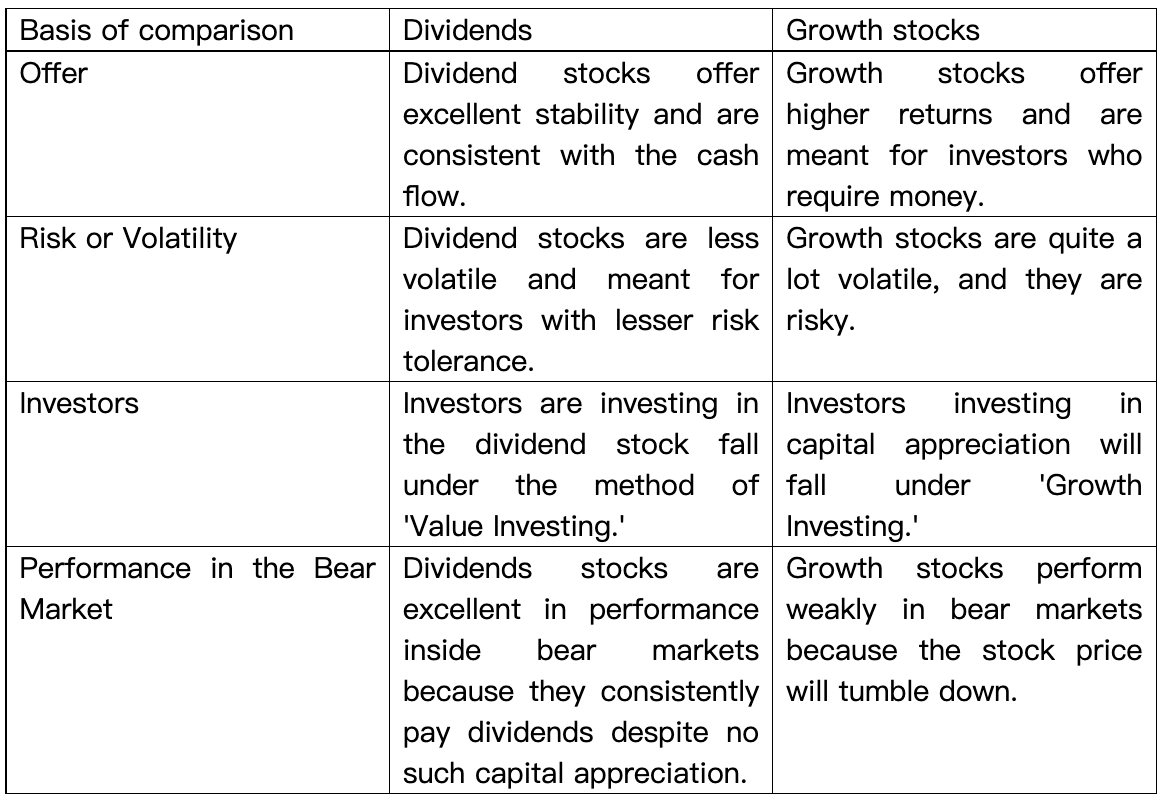
These differences make these companies appealing to investors with different investment objectives because they appeal to different types of investors.
There are three different types of investors: Risk Seeker, Risk Neutrals, and Risk Aversion. Investors seeking growth prefer growth companies, while those seeking dividends prefer dividend stocks.
Investors with a risk-neutral portfolio may invest in both a combination of dividend and growth stocks.
Dividend vs. growth stocks differ based on the management's decisions. Profits made by a company can be returned to investors as dividends or invested back into the business.

Investment tips
One of the most critical issues in investing in stocks is your time frame. Are you looking for short-term income or fixed assets? Do you need liquidity, or can you have your money tied up in the long run? It is good to answer these questions before you start buying real estate.
One of the best ways to resolve any issues that naturally arise when selecting the securities you want to place - and remove from - your portfolio is to consult a financial advisor. Finding one in your area is not at all difficult. The SmartAsset tool will help you find a financial professional in minutes to help you answer questions about time, liquidity, risk, and your overall personal plan. When you are ready, start now.
Furthermore, there are start-up companies that have room for expansion and opportunity. The companies that pay dividends are mature and stable and think that future growth is limited; thus, they prefer to pay the investors rather than search for better investment opportunities.
Related Questions - FAQ
Is growth better than dividends?
The NAV for a growth option is always higher than for a dividend option because the profit reinvested in the growth option may increase in value over time. Due to the compound effect, the overall return on the growth option is usually higher than the dividend option on a sufficiently high investment horizon.
Do you need to invest in growth stocks?
Growth stocks have been going through the market since the financial crisis. Instead of jumping on the bandwagon, investing in companies that match your risk tolerance is better. Rising retail sales can be a shopping opportunity for patient investors.
Are growth stocks high risk?
Investors should consider growth stocks to be high-risk investments in any market environment. They are known to be relatively fast and do not pay dividends, which means that the only way to generate revenue from them is to keep the stocks at a higher price.
How long do you have to hold stocks to earn a dividend?
In short, to be eligible to pay dividends on shares, you must buy the shares (or already have them) at least two days before the record date and have the shares at the end of the sale. It should be one working day before the ex-date.
Are dividends a good investment?
Dividend shares provide investors with a way to get paid during periods of the market when capital gains are difficult to obtain. They offer an excellent gateway against inflation, especially as it grows over time. Unlike other forms of income, they are taxed, such as interest on fixed-income investments.
Bottom line
The choice of stock type depends on investment style, age group, goals, and income. A young investor can invest most of his money in fast-growing stocks because the young investor has a long career and a long period of recovery from market volatility.
It is best to examine the quality of each investment and prevent it from meeting your specific cash income requirements or keeping them for long-term growth.
If you are looking for wealth and have a longer time frame, investing in growth will allow you to enjoy higher returns! But if you are looking for a faster return and a steady flow of money, dividend investing may be the best choice.


Trending Articles
- 25 Richest People in the World in 2023
Compared with last year, these 25 richest people are $200 billion poorer than last year, but still worth $2.1 trillion.
2024-01-30 TOPONE Markets Analyst - Best Stocks for Covered Calls in 2024
A covered call strategy deploys by traders who wish to hold the stock in the future and minimize the risk by selling its call option. This guide will help you to find out the best stocks for covered calls.
2024-01-20 TOPONE Markets Analyst - 20 Most Recognized Brands in the World in 2024
The financial success of a corporation is frequently determined by its brand. Here, we'll walk you through the world's top 20 most recognizable businesses and how you can invest in their stock.
2024-01-05 TOPONE Markets Analyst - 10 Biggest Short Squeezes in History
Short Squeeze plays a vital role in short-term traders who randomly decide to reduce losses and leave their positions.
2023-10-20 TOPONE Markets Analyst

 Bonus!

Bonus rebate to help investors grow in the trading world!