English






Mean Reversion Trading: A Complete Guide
Are you interested in finding the best mean reversion strategy for you? In this article, we examined mean reversion trading with examples and discussed several trading strategies.

 967
967'Mean reversion' is a finance concept suggesting that asset price volatility and historical returns are likely to revert to the average level of the dataset over the long run.
As an example, it may appear in the context of the pace of economic growth, volatility of a stock, a stock's price-to-earnings ratio (P/E ratio), or industry average return.
Almost all trading strategies focus on two common elements in financial markets: mean reversion or momentum.
The main difference between mean reversion and momentum strategies is that mean reversion predicts big moves will partially reverse. In contrast, momentum strategies expect big moves will continue in the same direction.
The mean reversion trading strategy that you'll learn in this guide uses some trading secrets that can help limit the downside. This guide will first introduce you to mean reversion trading and then discuss finding the perfect mean reversion strategy for you.
What is mean reversion trading?
The concept of mean reversion trading assumes that the price of any asset (stock, commodity, FX currency, cryptocurrency) over time will return to the average cost or mean price.
As a result, reversion to the mean appears to be a simple matter of:
The upward trend must include the downward trend."
It is the basis for many trading strategies involving buying and selling classes whose prices have diverged from their historical averages. But, over the long term, the costs will return to their previous average levels and regular patterns.
Among the strategies that utilize mean reversion are:
Reversals
Pullback trading
Retracement
Range trading system
Overbought and oversold strategies
To find profitable mean reversion trading opportunities, you should look for price ranges that occur after severe markups or markdowns. For the sake of this example, you could say that reversion to the mean implies average price trading around the middle of the range.
As its name suggests, mean reversion is the act of playing with the mean, whether the standard is the middle of the range, a moving average, or however you want to describe it.
In those circumstances where there can be a drastic change in the price, reversion to mean trading tends to generate a higher winning ratio.
Using an appropriate time frame, we can calculate extreme price changes.
Furthermore, there is also the possibility that the price might not revert to its mean. This is due to a fundamental change in sentiment in the market as we enter a new era.

But why is this?
Many possible explanations exist in academic literature, but leverage and margin are the most plausible.
There is a high margin requirement when trading stocks.
The margin requirement for a stock trading system typically is at least 25%, making it a capital-intensive activity.
Compared to the futures market, where a contract's maintenance margin is regularly less than 10%, this is a dramatic departure from current practices. Likewise, traders have access to significant leverage in the forex market.
So why is this significant?
Stock positions secured with cash increase your exposure level to individual positions significantly when the value of the positions increases.
A rebalance is necessary, and rebalancing creates selling pressure on the best-performing stocks.
Comparatively, commodities and currencies utilize only a fraction of their cash in highly leveraged portfolios. Thus it is easier to comprehend why trends can occur in these markets with less friction.
Strategies based on mean reversion fade significant divergences from historical prices. It is simpler to buy stocks at 52-week lows, whereas trading pairs based on statistical arbitrage are more complicated.
In the 52-week low strategy, stocks have been oversold and are due to bounce back to some historical mean. This issue is due to the assumption that stocks have fallen too far.
The central assumption behind a pairs-trading strategy is that you will profit when there is a significant deviation from the historical correlation. This can apply to any strategy based on the relationship between two similar stocks or even between two classes of shares of a single stock.
What is the mean reversion formula?
Traders must calculate the mean before they can understand and calculate mean reversion. Generally, the mean is a price average determined from several data points.
Simple moving averages (SMAs) conveniently represent an asset's mean on its trading chart. Likewise, SMAs portray an asset's mean price in its price series. As a result, price usually oscillates around the standard moving average ("SMA") over time, ultimately returning to it.
Various metrics, such as distance (SMA), can be used by traders to indicate when the price might revert to the mean. In addition, some technical indicators, such as Bollinger Bands, regression channels, Keltner channels, and Envelopes, use different formulas to determine when the price is approaching extreme levels and is likely to reverse. In trading, these signals can, however, only serve as indications of the direction of a trade and not a clear sign of its reversal.
This chart illustrates the Euro 50 stock index oscillating around its 50-week simple moving average over five years. But, of course, it applies to shorter periods as well.

What are examples of mean reversion?
The price of an instrument typically returns to its average over time, but it does not necessarily mean that it will drop back to the mean or rise to the mean. This is because the mean cost is moving in addition to the price. This means that even if the price stagnates and doesn't move much, the mean price will be caught up in time. In this sense, mean reversion is also present.
A chart of EUR/USD over a year's worth of daily candlesticks is below. The price is sometimes oscillating around the average. However, sometimes the price accelerates away from the average. After that, the mean (SMA) follows, and they eventually cross again.
Several indicators, including Bollinger Bands, use standard deviation to measure how far away from the mean the price is. Price will likely revert to the mean quickly when standard deviations are farther from the mean, although this may not occur immediately.

What are mean reversion strategies?
Statistical arbitrage strategies seek to exploit the price inequities between securities by applying the mean reversion principle. They are one of the most popular types of quantitative trading strategies. There are numerous statistical arbitrage trading strategies, including:
By capturing profits as an asset, value returns to its average level. To properly use a mean reversion strategy, you need to be aware that a price rising away from the mean does not guarantee that the price will drop.
In other words, the mean could increase to match the price. In that case, it would be corresponding to a return to the mean since the price is back in line with its average. While regular reversion to the mean occurs, prices seldom remain exactly at or near the standard for an extended period. The following examples illustrate some common mean reversion strategies.
Mean reversion forex strategy
For forex trading, one strategy might look at how far the price deviates from the mean before returning to the standard. You can do this by using a moving average convergence divergence (MACD) or Percentage Price Oscillator (PPO) on the Next Generation advanced trading platform. Then you place the First Length at one and the Slow Length at the length of how many periods you want to average.
Below is a EUR/USD chart where the PPO measures how the closing price differs from the 21-day average. These black trend lines indicate when the price reverted toward the mean. The PPO tends to reverse near similar levels even when there is a significant price movement. However, there are notable exceptions.
How can a strategy such as this be put to use? The PPO reversal level is a standard level used by traders to enter short positions when the price rises above it, then drop below it. It is possible to place a target at the mean (moving average, or 0 levels, on the indicator).
Profit targets (the average) are dynamic, so traders may wish to update it upon completing each price bar. In addition, a stop-loss order has been placed just above the swing high that occurred before the entry into the position to manage risks. Therefore, if the price continues to rise rather than returning to the mean, you can control the loss.
In the case of a long trade, a similar concept applies when the price drops below the PPO's common reversal point and then rallies back above it. The horizontal line (reversal point) on the PPO or MACD will show different characteristics for different assets, but traders should place an area where recent reversals have occurred near it.
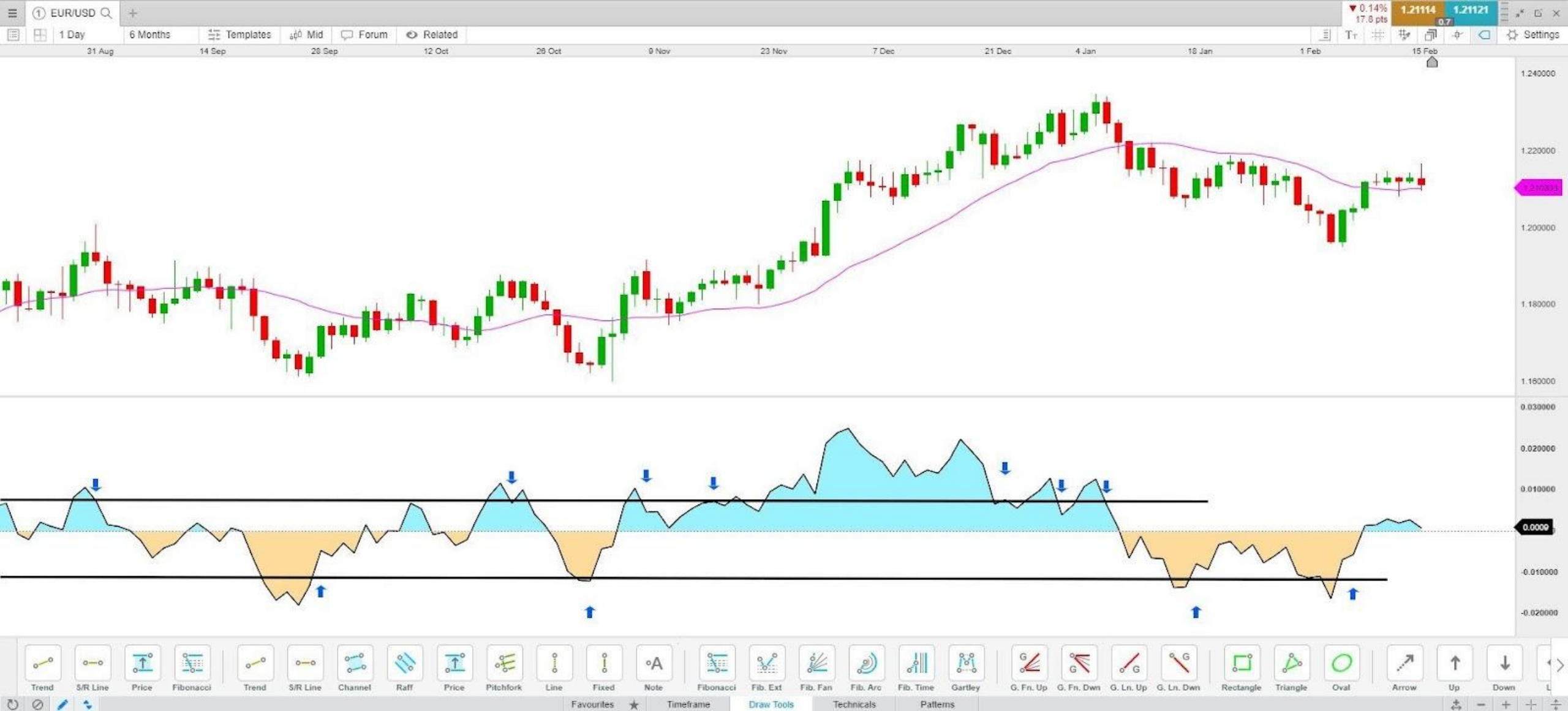
A strategy like mean reversion assumes that the price will remain in line with its historical trajectory. In actuality, that may not always happen. While prices may move smaller or more significant over time, they will still revert to the mean. Because the magnitude of price moves may change over time, a stop-loss order can help contain losses when the price does not behave as history indicates it should.
Mean reversion in pairs trading
Imagine two instruments with similar fundamentals, belonging to the same sectors and sharing similar economic links. An example would be stocks such as Google and Microsoft or Facebook and Twitter.
Since both stocks have the basis of similar fundamentals, one would expect the same behavior. You should also expect the ratios or spreads of these stocks to remain unchanged over time. There might be a divergence in the spread among two pairs due to a temporary change in supply and demand.
In such situations, one security performs better than the other. The mean reversion principle would predict that the divergence would return to normal with time. It is possible to conduct a pair trade in these scenarios of temporal variation. In this case, one would purchase underperforming security and sell the outperforming security.
Intraday mean reversion trading strategy
It is the concept of determining how far away a price has become from its mean and how quickly it will return to the mean when it does revert that is at the heart of mean reversion. Ideally, one would trade a price that has veered too far from "mean." If this happens, one will execute a trade-in in that direction.
The mean reversion style of trading relies on price action very differently from momentum and oppositely works in most cases. As a result, it takes considerable courage to apply it on a day-to-day basis. Nevertheless, people who do this trading style, particularly intraday, have good reviews.
The Bollinger Bands are a tool that has been in use for decades and can help us understand and execute this process. In addition, Bollinger Bands are readily available and commonly used.
Technical indicators
Mean reversion trading techniques are typically based on specific indicators on the market. Technical oscillators, economic or fundamental indicators, or sentiment indicators are all examples of these indicators. Technically based mean reversion indicators are familiar to most traders. However, fundamental and sentiment indicators are less typical to them. The following examples illustrate each type of mean reversion indicator.
Technical indicators - Indicators such as Bollinger Bands, Relative Strength Index, Stochastic, and Williams Percent R provide technical principles information about overbought and oversold conditions.
An oversold reading indicates a market has overextended to the downside, whereas an overbought reading indicates that it has overextended to the upside.
Financial information
Usually, mean reversion refers to the notion that prices and returns will return to their mean or average once a certain period has passed. Averages can describe the historical average price, returns, or other indicators, such as economic growth and industry returns. Since its conception, this strategy has been used in trading stocks and options.
The mean reversion indicator indicates whether prices or returns are likely to rise or fall over the long run.
This specifies that rising prices will drop into their lower state when the long-term rise is over.
In this system, you can use stock trading strategies.
By definition, mean reversion refers to a price returning to its initial value after a long period. Various investing strategies have arisen based on this theory involving purchasing and selling financial assets whose recent performance has significantly differed from their historical average. There's a possibility that the changes in return indicate the company isn't in the same situation as before.
Economic Indicators
Consider the possibility of having a wide range of stocks to choose from.
Firstly, it is necessary to categorize them according to their market capitalization, sector, daily traded volume, etc. once the securities segregate, you can check if the group correlates.
Correlation can filter the number of pairs down to a more manageable number. Once you arrange the securities into a small number of groups, you can select cointegrated pairs within the groups.
In forex, selecting pairs is much the same as in stock market investing. To find pairs, we must discover countries whose economic fundamentals are similar.
The following candidates would be suitable.
EUR/USD and CHF/USD
AUD/USD and CAD./USD or
USD/KRW (US dollar/South Korean won) and USD/HKD (US dollar/Hong Kong dollar).
In the same way, the Euro and Swiss Franc belong to the Eurozone, and these pairs belong to the same economic zone. The advantage of pairs trading on the currency market is that foreign exchange liquidity is higher, which reduces transaction costs.
Despite similar economic exposure, there are not many good pairs in the future market. The reason may be that demand and supply differ. Thus, for choosing a pair in the future, one cannot rely exclusively on economic exposures.
Sentiment Indicators
Market movements often reflect market sentiments, and some investors look to sentiment indicators to spot market turning points.
Limitations of mean reversion trading
Following are the limitations of the .mean reversion strategy
Survivorship bias
The study does not omit survivorship bias as we did not have the data that included all the stocks traded during the period but have been delisted or merged.
Brokerage, lippage, and taxes
Slippages and commissions will harm the overall system performance for this type of trading.
Since there are many discount brokers available nowadays, and many brokers offer free equity trades, trading these systems is not too challenging for commissions, but slippages and taxes are considerable.
Entry and exit
In addition, the system buys at the closing price and sells at the opening price, which is not easy to execute in reality.
A signal could be correct right before the closing, but the price could be adjusted, making the signal invalid. You also probably won't sell at the open price on the first tick, which can affect your results.
Final thoughts
A good mean reversion trade requires things to remain the same, which is something you have noticed in this article of mean reversion. Stocks dropping 10 or 20 percent usually have a reason, and you can typically figure out what it is.
There's a much smaller chance of that stock snapping back and giving you a profit after it drops for a significant reason, such as structural changes or real news changing the game.
Momentum develops when this occurs, which is the enemy of a mean reversion strategy.
However, a stock's price can occasionally plummet for less apparent reasons. Perhaps an insider placed a big sell order, causing an imbalance in the market.
There are times when the stock drops because of an overreaction to a short-term event (such as an election result, terrorist attack, or oil spill). But, unfortunately, these moments are often most conducive to mean reversion.
There is a big move, but not too much has changed. The mean reversion strategy requires that things remain unchanged. A mean reversion trade is not about structural or intrinsic change but overreactions and irrational price movements.


Trending Articles
- Who Is Andrew Tate and Why Is He Famous? 10 Things to Know the Controversial Influencer
Discover who is Andrew Tate and why he's making waves in the digital sphere. Uncover 10 intriguing facts about this controversial influencer, his journey, and his impact on the online world.
2024-03-01 TOPONE Markets Analyst - Andrew Tate Net Worth 2024: Is the Internet's Most Controversial Man Worth $800 Million?
Explore the enigmatic Andrew Tate's net worth and delve into the controversies surrounding the internet's most polarizing figure. Is he truly worth $800 million? Uncover the truth behind his wealth and reputation here.
2024-02-23 TOPONE Markets Analyst - 20 Strongest Currencies in the World in 2024
Want to know the strongest currencies in the world in 2024? Here are the list for you!
2024-01-30 TOPONE Markets Analyst - Falling Wedge Pattern: The Ultimate Guide
A falling wedge is a bullish pattern characterized by a wide top and shrinking bottom. It is an extremely bullish pattern in a trading market.
2023-09-25 TOPONE Markets Analyst

 Bonus!

Bonus rebate to help investors grow in the trading world!