English





Is the US Interest Rate Hike Cycle Really Coming to An End
The U.S. economy's health often hinges on the Federal Reserve's interest rate decisions, used to stimulate growth or curb inflation. Recently, a notable upward trend, the "interest rate hike cycle," has been observed. But are we seeing the end of this cycle?

 12210
12210Preface
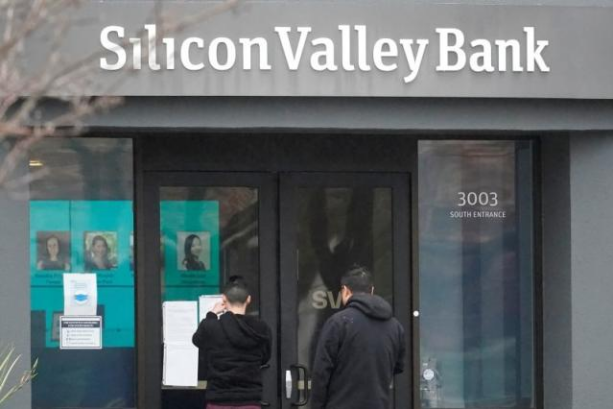
In early 2023, Silicon Valley Bank went bankrupt. At that moment, many people believed that the Fed would start cutting interest rates, as the risk of bank chain failures was not something that the United States could afford.
However, the scale of this incident was quickly brought under control. Although the amount of loss was huge, the impact did not expand due to the fact that the clients were single and mostly legal entities.In the following months, just as inflation in the United States gradually cooled, the Fed's June meeting did not raise interest rates.
Many people believed that the Fed's rhetoric of raising interest rates was just to prevent inflation from spiraling out of control. However, on July 27th, the Fed raised interest rates by another yard.This not only made the federal benchmark interest rate to its highest level in 22 years, surpassing the interest rate hike in the United States before the financial tsunami to curb housing prices, but also has been suggested by Powell that interest rates may continue to rise in September. He even said that the inflation target of 2%, which he had been talking about since last year, still has a long way to go, making many investors very curious about the Fed's views on the current and future.
This article will share with you three questions: causal analysis of the US interest rate hike cycle, whether US bond ratings have an impact on the rate hike cycle, and how long high interest rates will last, which will be full of much practical information. We hope you do not miss it.
Introduction to the US interest rate hike cycle
To understand when the interest rate hike will end, it is important to first figure out how it will begin.
The interest rate hike initiated by the United States last year was not a temporary move, but a powerful action taken after long-term observation.
The US CPI has continued to rise from the 4.2% announced in May 2021, without a decrease. Moreover, before the pandemic, non farm employment was relatively 200000 to 300000 people per month. But after 2021, it often broke through the employment market of 400000 to 500000 people, and even newly added nearly a million non farm employment in May.
This high inflation and overheated job market requires a season of strong medicine to suppress, otherwise sustained inflation will collapse a country's economy.
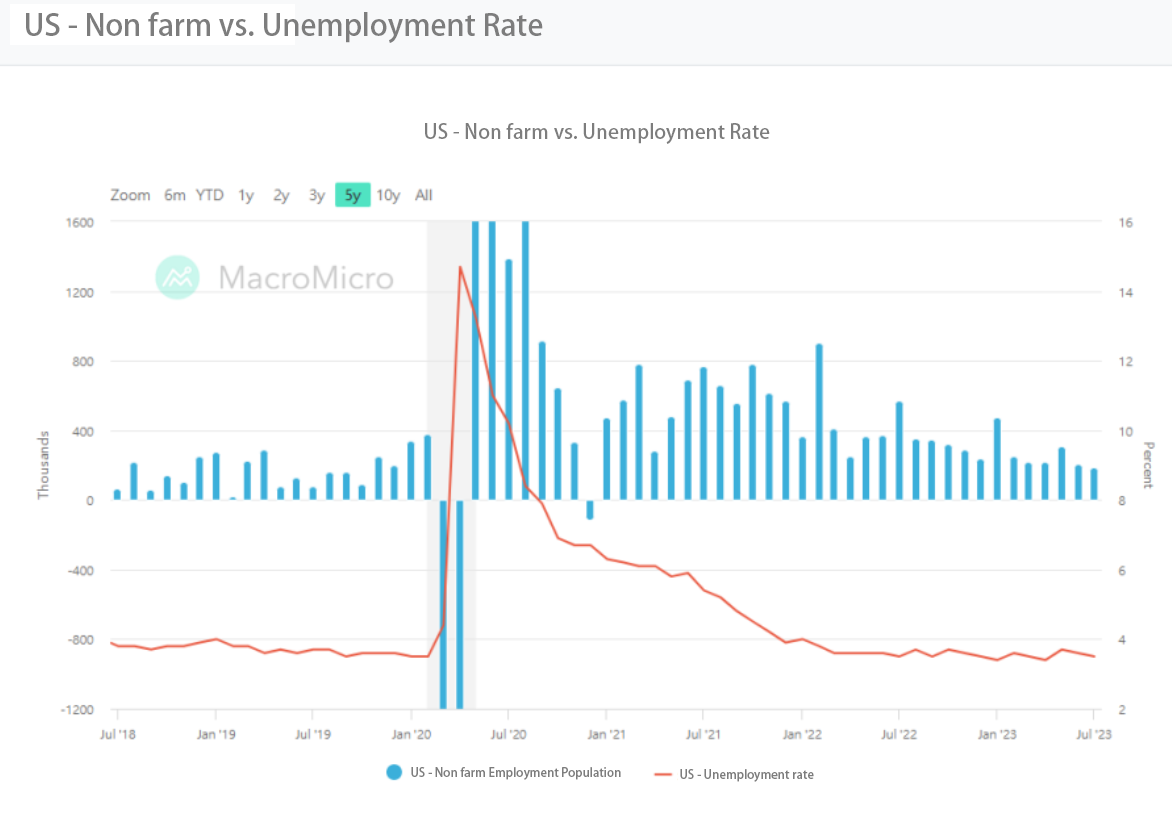
Image Source: employment condition
The Federal Reserve has been saying they want the CPI to be lowered back to 2%, but I think what they should be more interested in is a relief from market frenzy. Therefore, I believe what they really wants to see is a decrease in non farm employment data. And before that, the Fed should still adopt an austerity policy.
According to Powell's latest meeting record, they believe that there will be enough reaction time for the market after the interest rate hike in September. After all, in the context of such high interest rates, companies will not be rash to borrow and expand, and will be very cautious in hiring employees. After this situation continues for a period of time, there will be slow pump priming.
The following table summarizes the timing of the Fed's interest rate decision-making meeting from the end of 2021 to the present, along with the CPI and non agricultural data for your reference.
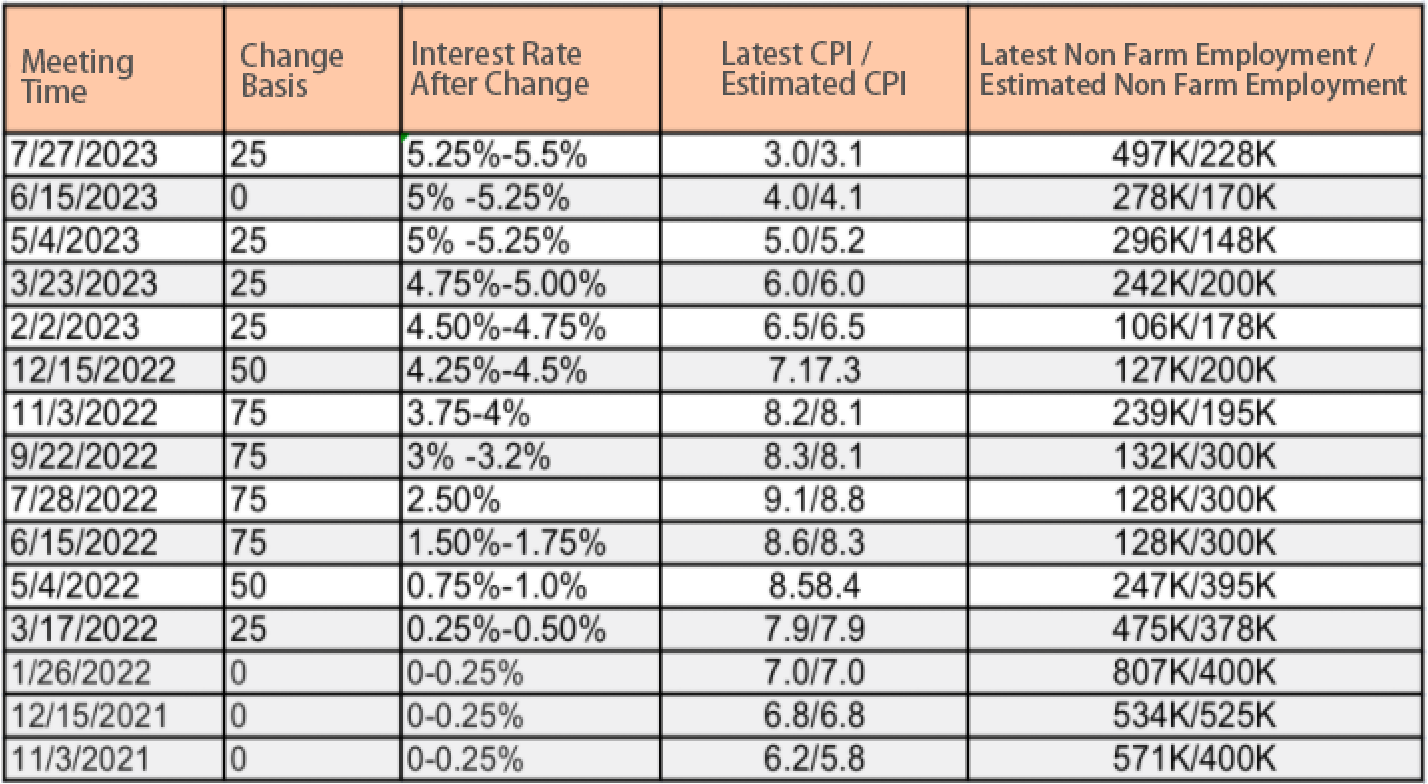
Image Source:Investing.com
Whether the downgrading of U.S. bonds will have an impact on interest rates
On August 1st, FITCH suddenly downgraded its US bond rating from AAA to AA+, which has had a significant impact on the capital market. Some investors may be concerned whether this will affect the global economy, as a downgrade of bonds is likely to trigger a sell-off.
The downgrade of US Treasuries will affect the global investors’ willingness to purchase. And if the United States cannot transfer the risk of inflation to the whole country, it will destabilize the national foundation. Therefore, if such situation occurs, the United States will continue to raise interest rates to attract global purchases of US Treasuries.
But will such a situation arise? I don't think so. Three main reasons are as follows.
The downgrade of US Treasuries occurred two months after Congress raised the borrowing limit, which means there is already one less potential risk, so the impact is minimal.
Referring to 2011, the downgrade did not cause a sell-off in US Treasuries, but rather a purchase due to market concerns. After all, this is the safest financial asset in the world.
Big shot's attitude:Buffett has previously stated that as long as US bonds are still denominated in US dollars, there is no risk of down debt. Moreover, during an interview with CNBC this month, Buffett also stated that 'The dollar is the reserve currency of the world, and everybody knows it.' Therefore, the risk of US bond swaps is very low. ELON MUSK also holds the same view, and of course, some fund managers such as Bill Ackman took the opportunity to short US Treasury bonds. However, they mainly trade short-term spreads through options and other tools, so this event has no impact on the overall direction of the financial market.
In summary, I believe that the purpose of this US bond downgrade by FITCH is twofold.
Attract attention
The credit rating company, engaged in for-profit business, wants to make some achievements to attract public attention. The reason for the US debt reduction is very clear. After all, it is a fact that the US debt is massively high. But FITCH ignores that the US government can print dollars by itself, so I think this kind of operation is purely eye-catching.
Give government warnings
Although the US dollar, a global currency, can be printed at will, and the inflation caused by misprinting is a global responsibility, exceeding it too much can still trigger a chain reaction. After all, the money printed during the epidemic in the United States "doubled" the balance sheet. That is to say, the money printed from Washington to Trump was already completed by the Biden government two years ago. If it is excessive, it will lead to fiscal deterioration, high government debt, and debt ceiling disputes eroding government governance.
Therefore, FITCH's reduction in US debt may also be a manifestation of public opinion, hoping that the ruling party can find more ways to solve the problem rather than just printing money. However, these impacts are all my superficial speculations. From the perspective of this interest rate hike cycle, I believe that the Fed will not change their original plan due to the adjustment of credit rating.
How long will high interest rates last?
The peak of the interest rate hike cycle in the United States in 2005 lasted for a year before interest rate cuts began, and it was only after a large number of people were unable to afford their mortgages that they began to take action.
Referring to this point, it can be seen that the more the market amplifies the news that the US interest rate hike cycle is approaching its end, the less the Fed wants to lower interest rates. After all, the Fed wants everyone to be conservative and the market to cool down.
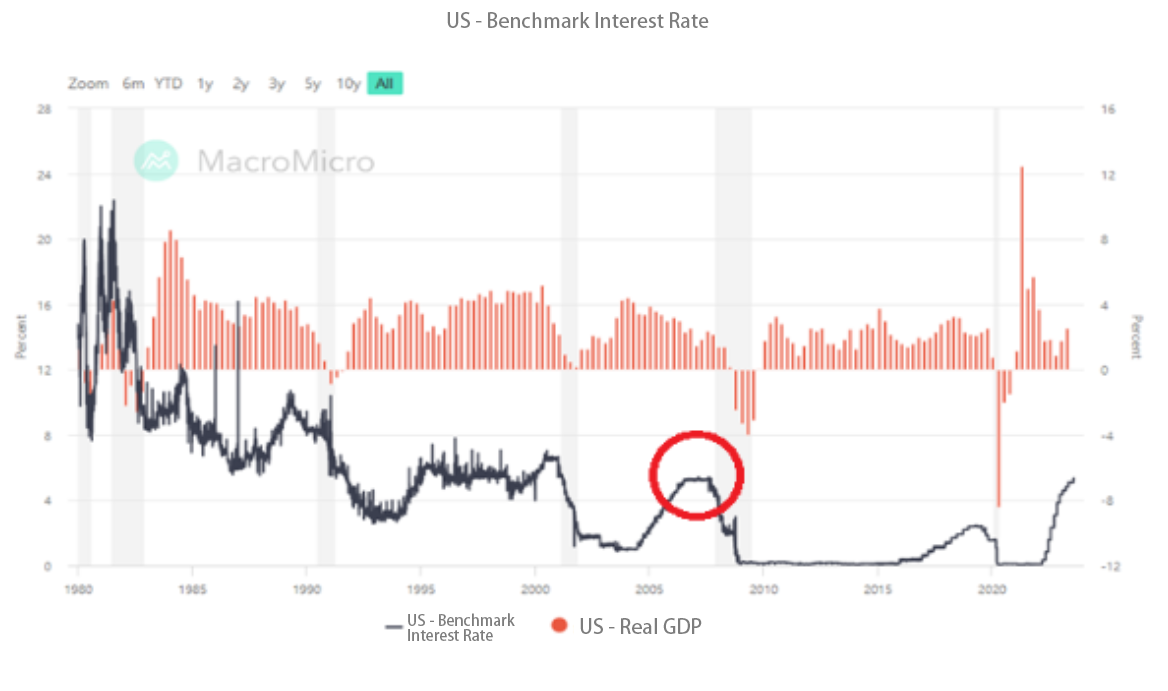
And maintaining a high interest rate environment allows the Fed to prepare more means when the financial crisis arrives.
Therefore, from a historical perspective and a comprehensive analysis of Powell's current conversation, the Fed predicts that it will maintain high interest rates for at least six months or even longer after the rate hike in September.
Afterwards, it is likely that it will need to wait until the unemployment rate increases to over 4% or the non farm sector slows down before starting to lower interest rates. Before this, if the public wants to leverage investment, they must pay attention to interest rate risk and not layout based on the premise of 'definite rapid interest rate cuts'. Especially for investors in highly leveraged commodities such as real estate, they must be very careful so as to not easily be in debt.
Conclusion
Judging from Powell's conversation alone, the interest rate hike is indeed nearing its end. But no one is 100% certain about how long the high interest rate environment will last, and whether there will be new black swans appearing during this period to affect the decisions of the Fed.
As an investor, I don't think we need to think too far. In the short term, I think a 5% or even 6% interest rate in the US dollar is a great subject matter. Investors can invest in short-term US government bonds, as the BUY AND HOLD profit is also greater than the current inflation rate of around 3%.
In addition, various signs indicate that the Fed wants a higher unemployment rate, although the US government cannot explicitly state. Therefore, if similar indicators are observed, it is likely to be the eve of interest rate cuts. Readers who invest in macroeconomics can pay more attention to relevant data on the job market.


Trending Articles
- Who Is Andrew Tate and Why Is He Famous? 10 Things to Know the Controversial Influencer
Discover who is Andrew Tate and why he's making waves in the digital sphere. Uncover 10 intriguing facts about this controversial influencer, his journey, and his impact on the online world.
2024-03-01 TOPONE Markets Analyst - Andrew Tate Net Worth 2024: Is the Internet's Most Controversial Man Worth $800 Million?
Explore the enigmatic Andrew Tate's net worth and delve into the controversies surrounding the internet's most polarizing figure. Is he truly worth $800 million? Uncover the truth behind his wealth and reputation here.
2024-02-23 TOPONE Markets Analyst - 20 Strongest Currencies in the World in 2024
Want to know the strongest currencies in the world in 2024? Here are the list for you!
2024-01-30 TOPONE Markets Analyst - Falling Wedge Pattern: The Ultimate Guide
A falling wedge is a bullish pattern characterized by a wide top and shrinking bottom. It is an extremely bullish pattern in a trading market.
2023-09-25 TOPONE Markets Analyst

 Bonus!

Bonus rebate to help investors grow in the trading world!