 English


 English


Futures vs. Options: Which Is Better for You in 2026?
 TOPONE Markets Analyst
 Reading time 12 minutes
Key Points Summary
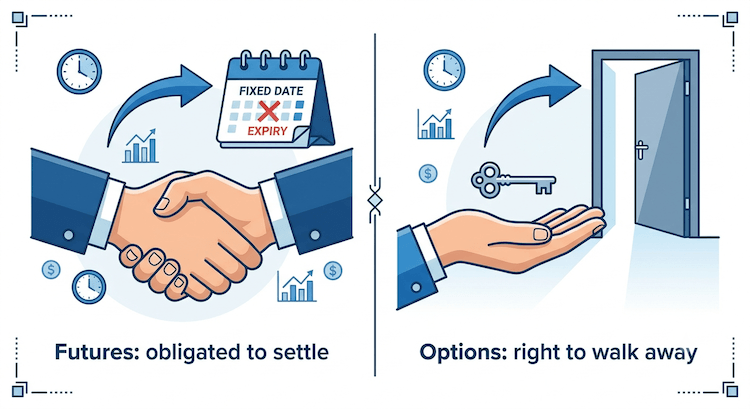
A futures contract binds both sides to settle; an options buyer can walk away.
Futures use high leverage and margin calls; options buyers risk only the premium paid.
CME moved precious-metals margins to a percentage model in Jan 2026 (~5% of notional for gold).
Options lose value daily as expiry nears, and that time decay is the buyer's silent tax.
Beginners should start with micro contracts or small option premiums, never standard size.
A gold futures contract today controls 100 ounces of metal worth about $409,000, yet you can open it with roughly $20,000 in margin. A gold options contract on the same metal might cost a few hundred dollars in premium. Same market, same direction. The math on what you can lose is completely different. If you only remember one thing, remember this: futures oblige, options option. Everything else follows from that single word.
A futures contract obligates both buyer and seller to trade at the agreed price on the expiry date. An options contract gives the buyer the right, but not the obligation, to trade before expiry, so they can walk away and lose only the premium. That single difference in obligation drives every contrast in cost, leverage, and risk.
What Is a Futures Contract?
A futures contract is a standardized agreement to buy or sell a set amount of an asset at a fixed price on a fixed future date. It grew out of agriculture: a farmer and a buyer would lock in a price months ahead so neither got ruined by a bad harvest or a price crash. The "future" part simply means the trade settles later, not now.
Two facts make futures distinct. First, both parties are obligated to complete the deal at expiry. Second, you rarely pay the full value up front. Instead, you post margin, a performance bond that is a fraction of the contract. That is what creates the leverage.
Commodity and Financial Futures
Futures split into two broad groups. Commodity futures cover physical goods: oil, gold, natural gas, wheat, sugar. Financial futures cover indices, stocks, bonds, and currencies. A crude oil futures contract tracks 1,000 barrels; as of late July 2026 WTI crude trades near $85 a barrel, so one contract controls roughly $85,000 of notional value.
A Concrete 2026 Example
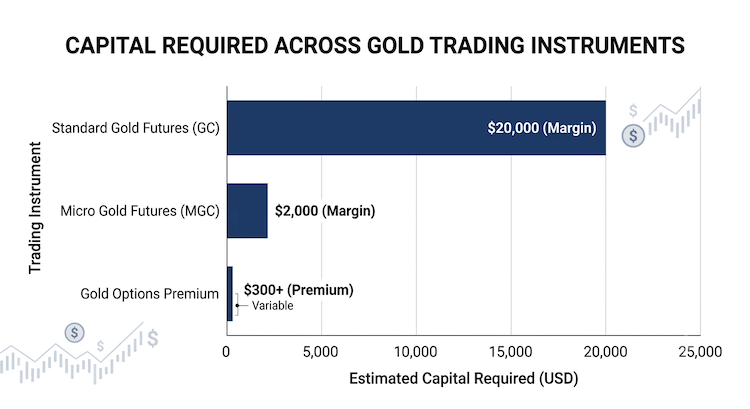
Spot gold sits around $4,090 per ounce in July 2026. One COMEX gold futures contract (ticker GC) represents 100 troy ounces, so it controls about $409,000 of gold. Each $1 move in gold changes the contract's value by $100. You do not pay $409,000. You post initial margin. After CME switched precious-metals margins to a percentage basis in January 2026, that margin runs near 5% of notional, about $20,000 per standard contract. The micro version (MGC, 10 ounces) needs roughly $2,000, which is why retail traders gravitate to it.
A $1 move in gold = $100 per standard futures contract. A 3% down day on $409,000 notional is about $12,000, more than half your margin. That is leverage doing both jobs at once.
What Is an Options Contract?
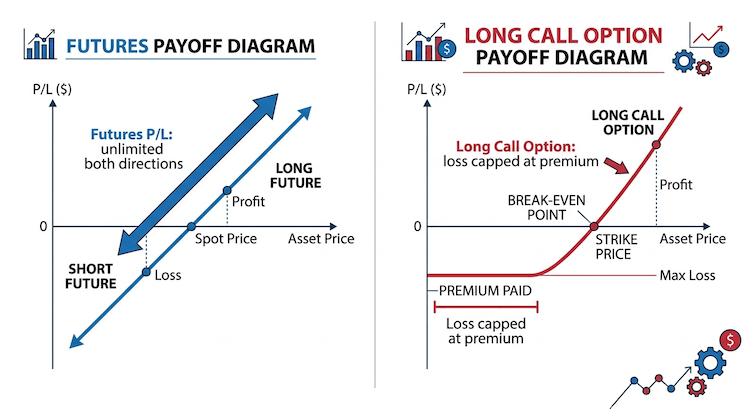
An options contract gives the buyer the right, but not the obligation, to buy or sell the underlying at a set strike price before a deadline. The buyer pays a premium to the seller for that right. If the market moves the wrong way, the buyer simply lets the contract expire and loses only the premium.
Call, Put, American, European
By right: a call is the right to buy, a put is the right to sell. By exercise style: an American option can be exercised any time before expiry; a European option only on the expiry date. The style changes flexibility but not the core idea: the buyer holds the choice, the seller carries the duty.
The Same Gold, Priced Differently
Using the July 2026 gold price of ~$4,090/oz: you might buy a call giving you the right to purchase 10 ounces at $4,090 within three months, paying a premium of a few hundred dollars. If gold climbs above $4,090, you exercise and buy cheap. If it falls, you walk away and your loss is capped at that premium. Compare that to the futures buyer, who must settle regardless of direction.
Futures vs. Options: Side-by-Side Comparison
For a "vs" article, the clearest way to see the gap is one table. The contrasts below are what most beginners miss when they first open a trading account.
| Dimension | Futures | Options |
|---|---|---|
| Obligation | Both sides must settle at expiry | Buyer may walk away; only seller is bound |
| Upfront cost | Margin (performance bond, returnable) | Premium (paid upfront, non-refundable) |
| Max loss (buyer) | Unlimited (margin call possible) | Limited to premium paid |
| Max gain (buyer) | Unlimited | Unlimited (calls), capped (puts) |
| Leverage | High (~20:1 on gold after 2026 margin rule) | Lower for buyer; control via small premium |
| Exercise timing | Single expiry date | Any time until expiry (American style) |
| Best suited for | Hedgers, active speculators | Defined-risk bets, income, protection |
The Leverage Reality Check
Leverage sells both instruments, and it sets the trap. On futures, margin amplifies every dollar of move. A standard gold contract at ~20:1 leverage means a 5% adverse move in gold wipes out roughly your entire margin, and the exchange can demand more. On options, the buyer's leverage is gentler: the premium is small, so a wrong call costs that small amount and stops there.
The 2026 twist: CME's January 2026 shift to percentage-based margins means your required margin now floats with the price. When gold ran toward $4,600 earlier in 2026, gold margins crept above $23,000 per standard contract automatically, with no separate announcement needed. Traders who sized positions for the old fixed numbers got margin-called overnight. Volatility, not the exchange calendar, now sets your buffer.
CME percentage margins (Jan 2026): gold futures margin now floats near 5% of notional. When gold hit ~$4,600 in early 2026, required margin auto-rose above $23,000 per standard contract, margin-calling traders who still sized for the old fixed numbers. Top-ranked pages still cite pre-2026 figures.
Micro contracts are the real beginner entry: CME Micro Gold (MGC, 10 oz) needs roughly $2,000 margin vs ~$20,000 for a standard contract. Most guides quote only the standard size and scare newcomers off.
Live prices, not 2023 levels: gold trades near $4,090/oz and WTI near $85 in July 2026, while the highest-ranking pages still cite $1,600–$1,800 gold examples.
How Settlement and Obligation Differ
The obligation gap shows up at settlement. A futures buyer must take (or the seller must deliver) the asset at the contract price on expiry, though in practice almost all retail traders close or roll the position and settle in cash. An options buyer faces no such pressure: exercise only if it pays, otherwise expire worthless.
Options suit defensive strategies because of that asymmetry. A trader who thinks gold might dip can buy a put to cap downside, risking only the premium. A futures short on the same view has no cap. A surprise rally brings a margin call, not a quiet expiry.
Who Should Trade Futures, Who Should Trade Options?
The honest answer is not "one is better." It depends on what you can stomach and what you are trying to do.
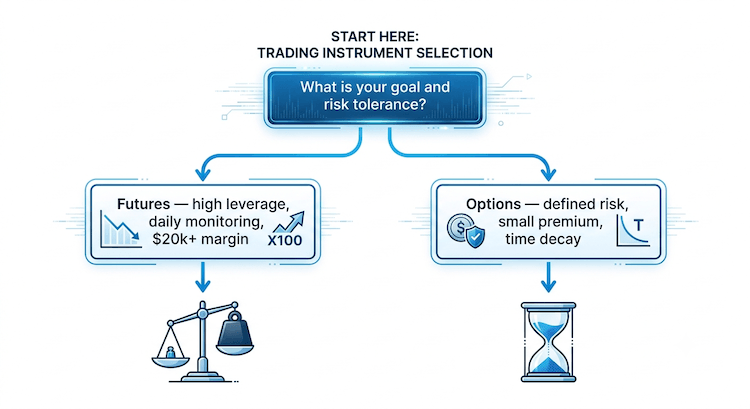
Choose futures if you watch the market daily, want maximum leverage per dollar, and can post $20,000+ margins without flinching. Hedgers locking in commodity prices and active speculators dominate this side.
Choose options if you want a defined maximum loss, prefer to express a view with a small premium, or need protection (a put) against a position you already hold. The cost is time decay, and the clock is always running.
Beginners should not touch standard-size futures. Start with CME Micro Gold (MGC, 10 ounces, ~$2,000 margin) or buy one or two cheap option contracts where the worst case is the premium.
Risks You Must Respect
Both instruments are speculative and both can empty an account. The failure modes differ.
Futures: Gap Risk and Margin Calls
Gold and oil trade nearly 24 hours, but gaps still happen at the Sunday open or during shock events. A standard contract can lose more than your margin in a single session, and the broker will liquidate or demand cash fast. Leverage is the primary reason most retail futures traders lose money.
Options: Time Decay and Cheap-Trap Contracts
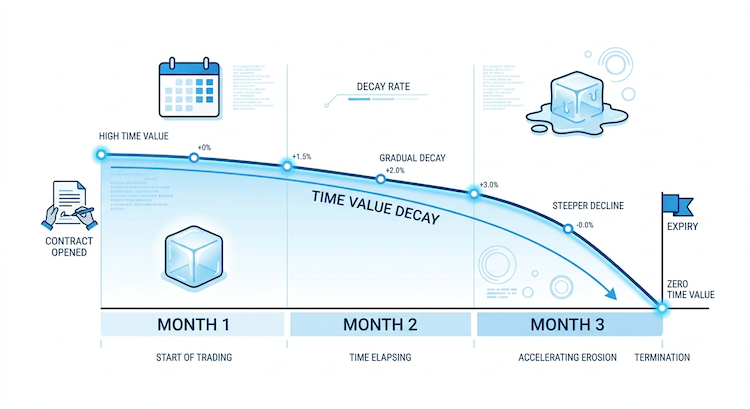
An option's price has intrinsic value (the price gap) plus time value (the chance of a move). As expiry nears, time value bleeds out daily. Many cheap out-of-the-money options expire worthless even when the underlying later moves the right way, just too late. Sellers, meanwhile, take on the buyer's risk and can lose far more than the premium collected.
How to Start Trading Futures and Options
Each needs a margin account with a broker that supports derivatives. You open the account, get approved for futures or options (usually a risk questionnaire and a minimum balance), fund it, then pick a contract. Stock-index derivatives and commodity derivatives trade on different exchanges, and contract sizes vary. The front-month contract is typically the most liquid.
For commodities, watch volatility: a sharp move can hand you a gain or a margin call within hours. Set your stop-loss and take-profit points before you click, not after. Keep leverage small until you have a track record.
Start Trading Futures and Options with a Clear Plan
You now know the one line that matters: futures oblige, options option. The next step is opening an account and sizing your first position small, using micro contracts or a single cheap premium, never standard size on day one.
TOPONE Markets offers futures and options trading with competitive spreads, fast deposits and withdrawals, and a mobile app to monitor positions around the clock.
Open a Free Account and Start Trading →FAQ
Risk Warning: Trading financial instruments involves significant risk and may result in the loss of your invested capital. Please ensure you fully understand the risks and seek independent professional advice if necessary. This article does not constitute investment advice or a trading recommendation. Past performance is not indicative of future results.

Bonus rebate to help investors grow in the trading world!


