English






What Is Bitcoin Mining? Everything You Need to Know
With Bitcoin, miners use specialised software to solve mathematical puzzles in exchange for a predetermined quantity of bitcoins. This offers a clever method of issuing the cash and also encourages more individuals to mine.

 2012
2012
The process of creating new bitcoins involves solving riddles. It consists of rival computer systems that use specialised chips to solve mathematical puzzles.
Introduction
When it peaked, the arms race that accompanied bitcoin mining raised the demand for graphics processing units (GPUs). In fact, the GPU manufacturer Advanced Micro Devices reported great financial results as the company's stock demand soared and shares reached their highest level in a decade.
The crypto mining gold rushes swiftly came to an end despite the rise in demand for GPUs since the complexity of mining popular cryptocurrencies, such as Bitcoin, rose at a similar rate. However, mining bitcoins can still be advantageous. Then, what is cryptocurrency mining, is it permitted, and how do you begin? These inquiries are explored in more detail in this essay.
The value of the Bitcoin currency has risen in popularity to the point where it is now on par with the price of gold over time. The future seems promising for Bitcoin miners and enthusiasts, and anyone who wants to give it a shot may find it to be a fruitful endeavour.
But first, let's take some time to learn about the basics of bitcoin mining. As transactions from the network are continuously added to the blockchain ledger, it continues to expand. Blockchain refers to a network of blocks that are linked together to form a chain of blocks made up of transactions. Hash functions and timestamps are used to identify the order of the transactions on a blockchain. This feature makes the data saved in the blockchain network permanent and unchangeable.
Bitcoin miners can obtain bitcoins in three different ways.Which are:
buying bitcoins on the exchange market
being accepted as payment for goods and services
mining fresh bitcoins
The most thrilling choice out of these three is probably bitcoin mining because it leads miners on a quest for knowledge. A warning is present.To answer difficult mathematical equations, a lot of computing power is required to authenticate transactions and add them to the blockchain digital ledger so mining bitcoin can be rather taxing.
Computers with specific hardware mine bitcoins. Miners are responsible for maintaining network security and processing each Bitcoin transaction. Miners accomplish this by resolving a computational puzzle that enables them to link blocks of transactions together (thus the renown "blockchain" of Bitcoin). Bitcoins that have just been minted and transaction fees are given to miners in exchange for this service.
What Is Bitcoin Mining?
New bitcoins are created by solving exceedingly difficult mathematics puzzles, enabling the verification of all financial transactions. After successfully mining a bitcoin, the miner receives a certain amount of bitcoins. Due to its jarring price swings and skyrocketing value since its introduction in 2009, Bitcoin has gained popularity.
Given the recent increasing prices of cryptocurrencies in general and Bitcoin in particular, it makes reasonable that interest in mining has surged. However, the complexity and expensive expenses of bitcoin mining make it a poor investment for most individuals. The mining process also produces brand-new Bitcoins.
The act of mining bitcoins results in the creation of new units of currency which entails checking new transactions against the Bitcoin network. The mining process adds new Bitcoin transactions to the blockchain, which are then electronically verified on the Bitcoin network.In order to validate updated transaction blocks on the decentralised blockchain ledger, difficult cryptographic hash problems must be solved.
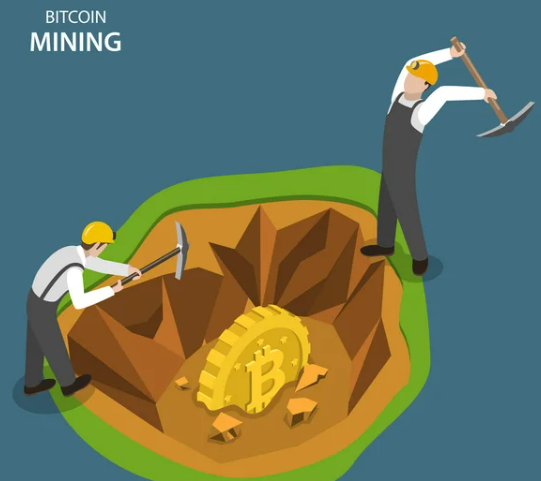
These riddles demand advanced tools and considerable processing resources to solve. In exchange, miners receive Bitcoin, which is then put into circulation and gives the activity its name.
One of the most popular categories of cryptocurrencies, which can only be exchanged digitally online, is bitcoin. Bitcoin operates on a distributed ledger or cryptocurrency transaction tracking decentralised computer network. When networked computers process and verify transactions, new bitcoins are generated or mined. These networked computers process the transaction, also referred to as miners, in exchange for a Bitcoin payment.
Bitcoin is powered by blockchain, a technology that is the foundation of many cryptocurrencies.A distributed ledger of all network transactions is known as a blockchain.
Sets of accepted transactions are joined to form a block and a chain. Think of it as a protracted public record that functions as a continual receipt. Bitcoin mining is the act of adding a block to the chain.
Proof-of-Work
To ensure that only reputable crypto miners may mine and confirm transactions, a proof-of-work (PoW) consensus system has been put in place. PoW further safeguards the network from outside dangers.
Mine for cryptocurrencies is comparable to mining for precious metals. A new batch of coins will enter circulation as a result of crypto mining, as opposed to precious metal miners who uncover gold, silver, or diamonds. To create new currencies, miners must install machinery that solves difficult mathematical equations expressed as cryptographic hashes. A hash is a compressed representation of a piece of data's digital signature.
To protect data shared on a public network, hashes are generated. The ledger is updated with the block and the first miner to crack the code receives a reward. Miners compete with one another to determine a hash value produced by a crypto coin transaction.
A chain of unbroken blocks that extends back to the first block is created when each block employs a hash function to refer to the block before it. Because of this, peers on the network can quickly determine if specific blocks are legitimate and whether the miners that verified each block correctly solved the hash to obtain the reward.
The complexity of equations on the network rises with time as miners use increasingly sophisticated equipment to solve PoW. The competition among miners also intensifies at the same time, which raises the cryptocurrency's scarcity.
In blockchain mining, miners verify transactions by figuring out a challenging math problem known as proof of work. To do this, the miner's main goal is to ascertain the nonce value, This is the answer to the equation that needs to be worked out in order to generate a hash that is less than the goal set by the network for a particular block.
How Does Bitcoin Mining Work?
Blockchain is a decentralised peer-to-peer network that has been praised for being extremely safe, transparent, and reliable. It is because entries in the blockchain network are protected using timestamps and cryptographic hash functions, making it nearly hard and impractical to change the transactions after they have been entered into the ledger. The lack of centralised control is fundamental to blockchain security.
Bitcoin miners compete to solve challenging math problems that demand the use of expensive computers and massive amounts of electricity in order to add a blockproperly. To complete the mining process, miners must be the first to identify the correct or closest solution to the question. "Proof of work" refers to the method of determining the appropriate amount (hash). Miners try to estimate the target hash by fast and randomly creating as many guesses as they can, which requires a lot of processing power. Adding more miners to the network just complicates matters.
The required computer hardware, known as application-specific integrated circuits, or ASICs, can cost up to $10,000. ASICs use a lot of electricity, which has drawn criticism from environmental groups and makes it harder for miners to make money.
If a miner can successfully contribute a block to the network, they will be paid 6.25 bitcoins.The prize value is halved every 210,000 blocks, or roughly every four years.
In September 2022, 6.25 bitcoins were worth $125,000 at a price of about $20,000 per bitcoin.
An explanation of what happens during bitcoin mining is provided below.
The Mining Requirements
The initial step for a bitcoin miner is to select and set up their working gear.
These include:
ASIC (application-specific integrated circuit), SSD for cryptocurrency mining, or GPU (graphics processing unit) hardware
Mining software
A wallet
Preferred mining pool (if one chooses the pool mining option instead of solo mining)
Once everything is configured and the system is up and running, it automatically begins mining.
Only when a system or network malfunctions, there is a power outage, or the system requires routine maintenance do humans get more involved.
Elements of a Bitcoin Transaction
When a transaction begins on the bitcoin network, three things happen:
A transaction input
A transaction output
The transaction amount
For each transaction input, a bitcoin mining algorithm generates a unique cryptographic hash problem that is difficult to decrypt.
The programme then arranges the number of transactions required to form a block into a Merkle tree.
The Merkle Tree and the SHA-256 Algorithm
The hashes in a block are organised into a Merkle tree, which serves as a summary of all the transactions in the block. The Merkle tree's transaction IDs or individual transaction hashes are repeatedly paired using the SHA-256 method until one hash can be used to identify the tree as a whole. The Merkle root or root hash is the name given to this hash.
The Bitcoin network can efficiently validate transactions thanks to the Merkle tree.
The Block Header
The block header contains the Merkle root, which serves as a Merkle tree's unique identification. The following elements can be found in the block header, which includes information on the block:
The version number of the bitcoin software
The hash of the previous block
The Merkle root (root hash)
Timestamp
Cryptographic nonce
The target
Miners will use this data to crack the hash problem and add a block transaction.
Solving the Hash Puzzle
Miners must solve the hash puzzle by locating the hash below a specified target through the difficulty criterion. The target, which is represented as a 67-digit number included in the header, will be used to figure out how hard mining is depending on how many miners are competing to solve a hash function. It is vital to note that this difficulty changes according to how long it took miners to solve an equation in the 2016 blocks before each new block is created. It contributes to keeping the blockchain's appending pace at 10 minutes per transaction.
Miners will attempt to calculate a block's hash by continuously appending a nonce to the block header until the generated hash value is less than the target in an effort to solve the hash puzzle. A new block is successfully formed after a mining machine solves the puzzle and is validated in the Bitcoin network after an agreement among the nodes. After being validated, a block is added to the chain, which also verifies the transactions it contains. It occurs every ten minutes, as was previously mentioned.
The first miner to obtain the right hash value receives a prize in Bitcoin because there will be numerous miners (systems) fighting to solve the problem. More Bitcoins can now be found in use thanks to this approach.
Is Bitcoin Mining Profitable?

It differs. The hefty initial equipment costs and recurring electricity expenses make it uncertain if Bitcoin miners' efforts would be cost-effective, even if they were successful. In a report released in 2019, the Congressional Research Service asserted that one ASIC might use as much electricity as 500,000 PlayStation 3 consoles.
The complexity and challenge of mining bitcoin have increased along with the amount of computer power required. The Cambridge Bitcoin Electricity Consumption Index estimates that, at 94 terawatt-hours yearly, bitcoin mining consumes more electricity than most countries. It would take an average American home 9 years to mine only one bitcoin by August 2021.
Joining a mining pool is one way to split some of the hefty mining costs. Pools let miners combine resources to increase their productivity, but as pooled resources also mean shared rewards, the potential payoff is lower while using a pool. It can be challenging to estimate your pay because of the fluctuation of the price of bitcoin.
How to Calculate Bitcoin profit?
One way to trade bitcoins and make money is with Bitcoin Profit, an automated robot. In order to find trading opportunities in the cryptocurrency market, it employs an AI algorithm. This algorithm can automatically close and open your transaction, saving you time and requiring no personal interaction. It asserts that in typical market circumstances, 85% of its trades result in profits. However, calculating the profit produced by the Bitcoin mining process requires technical expertise.
The cost of the AISC hardware, the amount of electricity used, and the efficiency of the mining software all play a role in how much money can really be made with Bitcoin. The profitability of Bitcoin mining has fallen recently compared to past years due to increased electricity bills, more expensive hardware, the difficulty of the mining due to increased competition, and falls in Bitcoin values. Bitcoin mining was first started utilising CPUs and simple AI algorithms, which made it profitable and less expensive.
Evaluating mining profits and costs are made more accessible by calculating the profitability of bitcoin mining. It can be done with the use of a Bitcoin mining calculator, which asks the user to enter information such as the hashrate of the Bitcoin network, the amount of power consumed in Watts, the price of electricity in $/kWh, and the maintenance costs. The hash rate settings are changed, and a suitable piece of mining hardware is chosen from the list of ASIC Bitcoin miners.
The Bitcoin profitability calculator employs techniques to deliver reliable and correct profitability data regarding bitcoins. For the miners, this information is essential since they rely on it to decide how to mine bitcoins. The miners can continue the procedure only when there is a significant profit and little cost of electricity usage.
How to Start Bitcoin Mining?
You can do it, after all. However, because mining is a very specialised industry, it is not profitable for the majority of people. Most Bitcoin mining takes place in huge warehouses since the electricity there is so inexpensive.You can begin mining bitcoin once you have met the requirements specified below:
Wallet
Bitcoins obtained from mining are immediately deposited into a Bitcoin wallet. Our guide to the top bitcoin wallets will assist you in choosing a wallet if you are unsure which one to purchase. Any Bitcoin you make as a result of your mining operations will be stored here.You can store, transmit, and receive Bitcoin and other cryptocurrencies using an encrypted online wallet. Only a few companies offer services for creating bitcoin wallets, including Exodus, Trezor, and Coinbase.
Search for a Bitcoin Exchange
You could have to sell the bitcoins you earn from mining to cover your energy expenditures. Additionally, you might need to buy coins on exchanges.
Mining software
Many of the companies that provide mining software make it accessible for download for free and work on Mac and Windows machines, respectively. You can begin mining bitcoin after the required hardware and software are connected.
Computer equipment
The hardware is the part of bitcoin mining that is most expensive. To successfully mine Bitcoin, you'll need a strong computer that consumes a lot of electricity. ASIC miners are specialised computers explicitly designed for mining bitcoins. Never even attempt to mine bitcoins on your desktop or laptop computer at home! You won't make more than one penny a year, and you'll spend money you don't have on electricity.
Select a Mining Pool
You must choose a mining pool after receiving your mining hardware. You could only get paid for mining if you found a block on your own in the absence of a mining pool. It's known as solo mining. Because it is quite improbable that your hardware will have a hash rate close to enough to solo mine a block, we do not advise doing this.
Best Methods of Mining Bitcoin
Different cryptocurrency mining processes demand varying amounts of time, for instance, in the early days of technology.
Most miners choose CPU mining as their primary method. However, because it takes months to amass even a small amount of profit these days, many individuals find CPU mining to be too slow and impractical due to the high expenses of electricity and cooling as well as the increased difficulty everywhere.
Another way to mine cryptocurrency is using a GPU.By integrating numerous GPUs into a single mining equipment, computational power is increased. The rig must have a motherboard and a cooling system in order to run GPU mining.
ASIC mining is an extra bitcoin mining method, much as that. ASIC miners produce more cryptocurrency units than GPU miners because, in contrast to GPU miners, they are designed specifically to mine cryptocurrencies. But because they are pricey, they quickly become obsolete as mining difficulty rises.
Cloud mining is becoming more and more common as GPU and ASIC mining become more and more expensive. By adopting cloud mining, individual miners can take advantage of the resources of strong corporations and specialised crypto mining facilities.
Miners of cryptocurrencies can hire a mining gear for a predetermined time.by finding free and premium cloud mining providers online. The greatest hands-free approach to mining cryptocurrency is with this technique.
What is Bitcoin Mining Hardware?
ASICs are highly specialised computers that are used to mine bitcoins. The ASIC market has grown complicated and cutthroat. Nowadays, mining equipment is only found in areas with inexpensive electricity.
GPU Mining
It is known as GPU mining, when you mine for Bitcoins (or any other cryptocurrency) using a graphics card. Right now, if you opened your desktop computer, you probably noticed a piece of hardware that is like the one below:

One of the first types of mining, GPU mining, is no longer profitable as a result of the development of ASIC miners. ASICs eventually overtook GPUs.
ASIC Miner
Application Specific Integrated Circuit is referred to as ASIC. That simply means that it is a chip made to perform a single, very specialised type of calculation, to put it plainly. The chip inside an ASIC miner for Bitcoin is made to solve issues utilising the SHA256 hashing algorithm.
An ASIC appears as follows:

You can find more information on ASIC miners on our mining hardware page.
Today, ASICs are used for all serious Bitcoin mining, which is often done in thermally controlled data centres with access to cheap electricity. Thus, economies of scale have resulted in a greater than expected concentration of mining power in fewer hands.
What Are Bitcoin Mining Pools?
Small miners can benefit from more frequent mining payouts thanks to mining pools.
A pool enables miners to locate blocks more frequently by joining forces with other miners in a group. However, as we'll describe, mining pools have certain issues.
Similar to GPU and ASIC mining, Satoshi appears to have overlooked the development of mining pools. Pools are collections of miners who work together and agree to split block rewards based on the mining power they have given.The distribution of total mining power by pools is shown in the pie chart below:

Although rewards are smoothed out and made more predictable by pools, this, unfortunately, concentrates power in the hands of the mining pool's owner.
In order to improve their odds of discovering and mining blocks on a blockchain, miners are able to pool their computational resources through the use of mining pools. When a mining pool is effective, the reward is divided among the miners in accordance with the resources they have provided to the pool.
The majority of cryptocurrency mining software includes a mining pool; however, nowadays, crypto fans can band together online to establish their mining pools. Miners can change pools at any time whenever they need to because certain pools pay out higher rewards than others.
Miners regard official crypto mining pools as being more dependable because they regularly receive updates and technical help from their host firms. CryptoCompare is the finest resource for finding mining pools, allowing users to evaluate several pools based on their dependability, profitability, and the coin they wish to mine.
What is Colocation Mining?
An agreement between a customer and a bitcoin mining management company is known as colocation mining. The management business finds a place to mine bitcoins and works out a deal with a power provider to receive cheap electricity.
In order to obtain affordable pricing for mining ASICs, the management organisation also maintains contacts with ASIC producers.
Finally, employees are employed by the management business to ensure that the ASICs function properly and that the facility is secure from thieves. The fact that the management business may not own any ASICs makes colocation miners quite special.
Who owns the miners?
Actually, the customer does. You speak with the management firm in charge of the colocation mine and order ASICs from them. The management firm performs a similar function to an ASIC broker. The management business will receive your ASICs at their mining site and install them for you after you have made your purchase.
What Is the Bitcoin Mining Industry?
Since the beginning of graphics card mining, the mining industry has advanced significantly. There are highly skilled industrial mining operations today. Let's examine their operation. A data centre and a mining farm have a similar appearance. They have rows of it and strong fans to prevent the miner gear from overheating.
The majority of mining farms have a fairly industrial appearance; they aren't fashionable. Most of the time, it's basically a warehouse with excellent temperature control.
ASIC miners are the only ones used by bitcoin mining operations to mine different coins. Many of these farms produce a number of Bitcoins each day. The cost of power is by far the biggest influence on how much money a mining farm makes. The equipment used by almost all mining farms is the same.
The only variable cost is electricity because the payout for discovering a block is constant andThe amount of processing power actively searching for blocks at any given time determines the difficulty. If you can obtain power at a lower price than other miners, you will be able to save costs while still producing the same amount of gold.
Mining farms, as was already mentioned, consume a lot of electricity. The size of their activity determines how much they consume. However, the most recent Bitmain ASIC miner uses roughly 1350 watts of power.
All mining farms' predicted total electricity consumption in 2021 is 127 Terawatt hours. That is nearly equal to Norway's annual energy use. There are mining farms all around the world. While we can't pinpoint the location of every mining farm in the world, we can make some educated assumptions. China has historically been the location of most mining operations.
Risks of Bitcoin mining
If you believe what some people say about Bitcoin mining, all it takes to start making easy money is to figure out a few problems. But always keep in mind that if something seems too good to be true, it generally is. Bitcoin has its share of drawbacks and risks, including the following:
No assurance of success exists; you could end up spending a tonne of money on the necessary equipment with essentially no return on investment (Return on Investment).
Because Bitcoin and other cryptocurrencies are so unstable, even if you are successful in mining a fair number of them, you could still find yourself in the red if their value of them suddenly drops.
Because cryptocurrencies are decentralised, they are not subject to any laws. There are no legal protections as a result· Bitcoin transactions cannot be undone. Your options to make things right are limited if you send the incorrect amount or give the proper amount to the incorrect individual.
Finally, despite cryptocurrencies' enormous excitement, they are not generally accepted.
Price volatility
The price of Bitcoin has experienced substantial swings since its introduction in 2009. Over the past year, the price of bitcoin has varied between less than $20,000 to around $69,000. Due to this unpredictability, it is challenging for miners to predict whether their reward will outweigh their high operating expenses.
Regulation
Since cryptocurrencies like Bitcoin are decentralised, very few governments have adopted them, and many are more likely to approach them with scepticism. Governments might decide to outright ban mining Bitcoin or other cryptocurrencies, as China did in 2021, citing the rise of speculative trading and other financial risks.
Taxes on Bitcoin mining
It's critical to keep in mind how taxes may affect Bitcoin mining. The IRS has been attempting to take action against cryptocurrency traders and owners as the value of the assets has skyrocketed in recent years. The main tax factors for Bitcoin mining are shown below.
Are you a company? If mining bitcoins is your business, you might be able to write off some of your costs as a tax deduction. The value of the bitcoins you earn would be your revenue. However, it's unlikely that you will be able to deduct expenses if mining is your hobby.
Bitcoin mined is money. The coins' current fair market value as of the time of receipt will be taxed at regular income rates if you are successful in mining Bitcoin or other cryptocurrencies.
Gains in the capital. Selling bitcoins for more than you paid for them counts as a capital gain, which is taxed similarly to gains from traditional assets like equities or bonds.
Is Crypto Mining Worth It?
Several factors determine whether crypto mining is profitable. The mining rig's hash rate, overall costs and electric power consumption, are the most crucial aspects to take into account, regardless of whether a prospective miner opts for a CPU, GPU, ASIC miner, or cloud mining. In general, crypto mining equipment generates a lot of heat and consumes a lot of electricity.
For example, it takes an average ASIC miner around 10 minutes and 72 terawatts of power to produce one bitcoin. As mining becomes more challenging and technology develops, these numbers are always changing.
Even if the machine's price is vital, it's also crucial to think about the amount of electricity used, local electricity prices, and cooling expenses, particularly when using GPU and ASIC mining rigs. To determine whether mining a specific coin would ever be profitable, it's also critical to consider the amount of difficulty.
Is Bitcoin Mining a Waste of Electricity?
The media frequently claims that mining Bitcoin uses unnecessary electricity. However, as we'll examine, their theories have several issues. Some conventional economists have condemned mining as being wasteful.
However, it must be remembered that this electricity is used for beneficial purposes: We are enabling a multi-billion-dollar (possibly trillion-dollar) financial network!
Bitcoin's environmental impact is insignificant when compared to the carbon emissions from merely the cars that PayPal workers use to get to work.
Bitcoin has the potential to easily displace PayPal, banks, credit card firms, and the bureaucrats that oversee them all, which raises the following query: Traditional finance is a waste, right?
Not just of electricity but also of resources like cash, workforce, and time!
Mining Challenges
Why hasn't the issuance of Bitcoin increased with the development of more powerful mining equipment suppose the number of Bitcoins produced would never exceed 21 million?
The difficulty, an algorithm that regulates issuance, modifies the Proof of Work problem's difficulty in response to how rapidly blocks are completed within a predetermined amount of time (roughly every 2 weeks or 2016 blocks).
The difficulty fluctuates when hashing power is used in order to maintain a 10 minute average between blocks. The average block time for the course of Bitcoin's existence has been around 9.7 minutes. Because the price is always increasing, mining power does enter the network quickly, resulting in speedier blocks. The block period has, however, often been around 10 minutes in 2019. This is due to the fact that throughout most of 2019, Bitcoin's price has been stable.
Block Reward Halving
Every 210,000 blocks, Satoshi cut in half the block reward that miners automatically earn for solving a block (or roughly 4 years).
Because of the significant increase in Bitcoin's price (which is anticipated to continue over time), mining is still profitable despite the declining block reward. At least for the miners who have access to affordable electricity and the most advanced mining equipment.
Honest Miner Majority Secures the Network
A deceitful miner would need to control the majority of the mining power in order to maintain the longest chain in order to successfully attack the Bitcoin network by generating blocks with a forged transaction record.
This is referred to as a 51% attack and gives the attacker complete control over how many times they spend the same coins and how they choose to obstruct other users' transactions.
An attacker must possess more mining equipment than all other honourable miners in order to succeed.
This makes any such attack expensive financially.
Only large corporations or governments would probably be able to cover this cost at this point in Bitcoin's development. However, it's not apparent what, if any, profit such individuals would receive in the long run from weakening or destroying Bitcoin.
Is Crypto Mining Legal?
The majority of governments and agencies have not yet passed legislation controlling cryptocurrencies. Therefore it is uncertain whether crypto mining is legal in most nations.
Crypto miners are regarded as money transmitters by the Financial Crimes Enforcement Network (FinCEN), and as such, they might be governed by the laws that apply to that activity. For instance, cryptocurrency mining is regarded as a business in Israel and is taxed as such. Regulatory uncertainty still exists in India and elsewhere, despite the fact that Canada and the US seem to be supportive of cryptocurrency mining.
However, very few nations forbid cryptocurrency mining, with the exception of those that have taken special action to do so. The legal status of cryptocurrencies is outlined for each nation having statutory or regulatory laws governing them on our Freeman Law Cryptocurrency Law Resource page.


Trending Articles
- 10 Best Cryptocurrencies to Invest in 2024
Over recent years, Bitcoin and various other cryptocurrencies have seen a significant surge in popularity. Are you considering investing in crypto? Here are the top 10 cryptocurrencies worth purchasing in 2024.
2024-05-09 TOPONE Markets Analyst - 10 Best Bitcoin Transaction Accelerators
BTC Nitro is a bitcoin transaction accelerator that helps you to speed up BTC transactions. This guide will teach you all you need to know about bitcoin transaction accelerators and more.
2023-11-30 TOPONE Markets Analyst - A Comprehensive Guide to Bitcoin Mining for Beginners
This article offers a clear introduction to the world of cryptocurrency mining, focusing on Bitcoin. Designed for newcomers, this guide covers the essentials, from blockchain technology and choosing the right tools to the economic and environmental aspects of mining. With Bitcoin's growing popularity and the complexities of mining, this resource ensures beginners have a solid foundation to start their journey in cryptocurrency mining
2023-10-18 TOPONE Markets Analyst

 Bonus!

Bonus rebate to help investors grow in the trading world!