English






Difference between NSE and BSE
The NSE and the BSE are vital components of the Indian economy, shaping it significantly and helping the country to grow.

 2877
2877
This blog guide will explain the difference between NSE and BSE. Investors and traders can purchase and sell stocks on the stock market with the support of brokers. The two biggest stock exchanges in India are the BSE and the NSE.
BSE is an abbreviation for "Bombay Stock Exchange," and NSE is for "National Stock Exchange."
Stocks, bonds, and other financial instruments are frequently linked to the BSE and NSE. However, only some individuals understand what these stock exchanges mean and how they differ.
What is BSE?
The BSE is a trading name for the NSE, an Indian stock exchange headquartered in Mumbai (Bombay Stock Exchange).
Mr. Premchand Roychand was a wealthy businessman in India in the 1800s, and his company is still in operation today. People dubbed him the Cotton King, the Bullion King, or simply the Big Bull when he made a fortune in the stockbroking business.
The BSE is Asia's oldest stock exchange. It was previously known as the Native Share & Stock Brokers Association. And it was originally known as "The Native Share & Stock Brokers Association" in 1875.
In 1855, 22 stockbrokers gathered in front of Mumbai's Town Hall under some banyan trees to establish the Bombay Stock Exchange (BSE). Because there were more brokers at the meetings, the location had to be relocated to accommodate everyone.
The Place Society relocated from its previous location to Dalal Street in 1874.
According to the Securities Contract Regulation Act of 1956, the Central Government of India stated in 1957 that the BSE was the best stock exchange in India.
In 1986, the first stock market index was established. The Sensex was based on more than ten industries and the top 30 trading corporations on the exchange.
In 1995, the BSE's Online Trading System (BOLT) went operational.
BSE provides various services, including market data, risk management, and depository services through CDSL (Central Depository Services Limited).
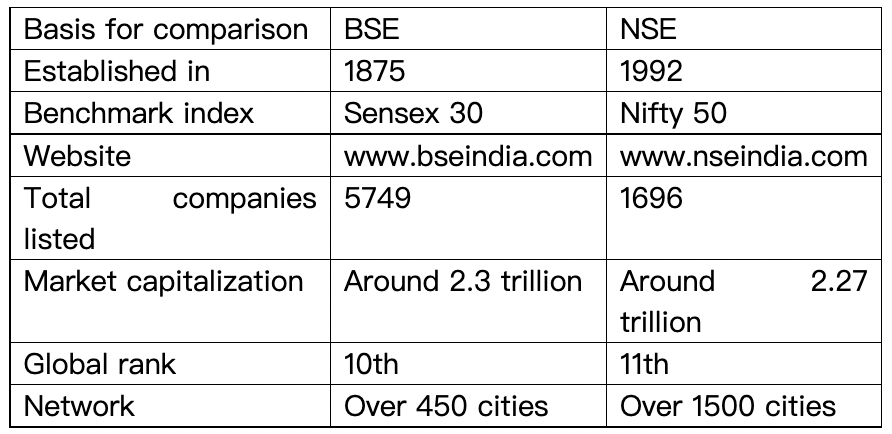
In addition, as of April 2018, the BSE was the world's tenth-largest stock exchange market, with a market capitalization of more than $2.3 trillion.
Important stock market indices include the BSE 500, 100, 200, MIDCAP, SMALL CAP (Symbol: Cons Dura), PSU, AUTO (Symbol: Ele Ele), PHARMACEUTICALS (Symbol), FMCG (FMCG), and CONSUMER GOODS.
Vision of BSE
The Bombay Stock Exchange (BSE) was founded in 1875. The stock exchange is one of Asia's oldest.
Thus, the BSE's mission is to "become the best stock exchange in India by having the world's top technology, product innovation, and customer service."
What is NSE?
The National Stock Exchange of India (NSE) is the country's newest stock exchange, having launched in 1992.
NSE was India's first exchange for offering a computerized, screen-based electronic trading system that was cutting-edge technology. It made it simple and quick to invest across India.
NSE's CEO, Managing Director, and President are Mr. Vikram Limaye.
NSE was the first company in India to develop a high-tech electronic trading system in 1992. This effectively replaced the previous paper-based settlement technique.
NSE's first purpose was to bring the farming industry into the twenty-first century. The NSE was founded in 1993 as a tax-paying corporation and became a stock exchange under the Securities Contract Regulation Act.
National Assets Depository Limited (NSDL) was founded in 1995 to assist investors in storing their securities.
The SEDL is a secure location where investors can store and exchange their stocks, bonds, or notes. It also allows consumers to purchase as little as one share or bond.
After 2004, the NSE's new securities clearing mechanism aided the growth of the Indian stock market by combining the Security Depository Limited's security system with the NSE's openness, efficiency, and decreased trade costs.
The same year, the NSE created the iconic Indian stock market index Nifty 50. It is home to the top 50 corporations that trade on the NSE stock exchange.
The NSE's trading systems are quite modern, having achieved significant technological advances in the last 20 years.
When the stock exchange opened for business in 1994, NSE technology could process two orders every second. By 2001, this had increased to 60 orders per second.
With over 20 million transactions daily, the exchange has become one of the most popular in Asia. If investors desire it, the NSE can handle approximately 1.6 million orders per second. This can be completed in a matter of minutes.
It has always attempted to reduce the time it takes to settle. As a result, the time required to settle several financial products has decreased from T+3 days to T+2 days or even T+1 days.
CNX Nifty Junior (CNX 100 plus 100 smaller companies in India), S&P CNX 500 (CNX 100 plus 400 big players in 72 industries in India), and so on are some of the most important indices on the NSE.
What is the main vision of NSE?
The NSE's mission statement states, "To continue to be a leader, build a global footprint, and assist people in reaching their financial goals."
NSE & BSE: which one is best for investors?
Some companies' equities may be listed on the BSE but not on the NSE. There is no need for a stock exchange for these companies.
However, if a company's shares are listed on the BSE and the NSE, the investor must pick between the two. Both are the largest stock exchanges in India.
The BSE and the NSE are India's financial market's two most important elements. Hundreds of thousands of brokers, traders, and investors trade stocks daily on these exchanges!
Both the BSE and the NSE are Indian stock exchanges that were established in the early 1990s to facilitate the purchase and sale of shares.
What are the main functions of BSE?
There isn't much of a distinction between BSE and NSE. So, let's put things in writing so we can understand them.
The Bombay Stock Exchange, or BSE, is used for various purposes. Here is a list of some of them.
Choosing a pricing
Prices for various financial segments on the secondary market are determined by two factors: demand and supply. The BSE assists in determining the value of listed firms and securities.
To keep track of the prices of various assets, you can look at different indexes (such as the SENSEX) to see how the market is moving.
Financial contribution
The Bombay Stock Exchange allows money and capital to move around by constantly selling and reselling assets. This flow of money contributes to the economy's growth and improvement.
Ability to raise funds
Companies that meet the qualifying conditions can be listed and raise funds through various financial segments.
Flow and marketability
These listed securities are far more liquid and straightforward to sell than any other investment. You can convert your stocks and bonds into cash at any moment.
The trader or investor makes all decisions regarding what to do with the securities.
Important functions of the NSE stock exchange
The National Stock Exchange's functions and objectives are outlined below. They are as follows:
It allows enterprises to raise capital.
Plus, it aspires to fulfill the worldwide requirements for securities markets that are currently in existence.
It provides electronic trading solutions to increase the trading market's fairness, efficiency, and openness.
NSE enables trading in various financial instruments, including equities, bonds, currencies, and hybrid financial assets.
Moreover, it also enables book-entry settlement methods and shortens settlement times.
BSE and the NSE: Know about its main features
You will notice a significant difference when you examine how the two stock exchanges operate.
BSE: Here are a few features that distinguish this stock exchange:
Securities listed on the BSE include stock options, futures, index options, weekly options, and index futures. It was India's first stock exchange.
The BSE's benchmark index is the SENSEX 30, which includes companies from 12 different industries. This stock exchange has aided the growth of India's capital market and the corporate sector.
NSE: The following are some facts about the National Stock Exchange:
This is a fully automated screen-based trading system (National Exchange for Automated Trading). Orders, not quotes, drive the NSE.
NEAT evaluates buy and sell orders to get the optimal price for selling and buying.
NEAT allows its members to add conditional clauses to previously submitted orders. These if/then clauses concern Quantity, Time, and Price.
How do NSE and BSE work?
Both the NSE and the BSE use comparable trading methods. Investors and traders utilize their brokers to connect to the exchanges and place buy and sell orders.
Why do they select the trading technique that they do? You have probably heard the terms "Nifty" and "Sensex" a lot. Both are indices, the first representing the NSE and the second the BSE. These indices play a significant role in the operation of these exchanges.
The indices represent how well the stocks on these exchanges are performing and how well the Indian economy is performing due to their scale.
A weighted formula that tells us the index's "worth" consists of 50 NSE stocks and 30 BSE stocks. The selection of stocks is based on the reputation, market value, and importance of their respective companies.
If any of these stocks' prices rise, the Nifty and Sensex also rise in value. When prices fall, the Nifty and Sensex fall as well.
That's all well and good, but what exactly do these stock markets do? What is their way of life?
A firm should first be listed on the stock exchange to raise funds from various investors, which is what an IPO is.
The corporation creates shares and sells them at a set price. • A shareholder buys shares in a firm and receives a fixed profit (called a dividend) for each share they possess. If the company expands, so does the dividend, and vice versa.
If the company continues to expand, it will need to issue additional shares to attract more investors. These transactions are tracked by stock exchanges such as the NSE and BSE. Companies list their shares on these markets, and investors acquire them.
Trading on the NSE and BSE: Guide for beginners
Now that you understand the NSE and BSE, you should be eager to begin trading on them. Here's how it's done:
First, open an online trading and Demat account. Without them, stocks cannot be purchased, sold, or stored.
Choose a genuine broker who is registered with SEBI.
Transfer funds from your checking to your trading account.
You can begin trading after everything is in place.
Where are BSE AND NSE located?
The NSE vs. BSE discussion is complete if we discuss where they are based. Even though they are both in Mumbai, India's financial center, they are not the same in this sense.
The National Stock Exchange of India Ltd. is headquartered in Mumbai, Maharashtra, at the Bandra Kurla Complex. The Bombay Stock Exchange, on the other hand, is located on Dalal Street in Mumbai, Maharashtra.
Differences between the BSE and NSE
There are numerous ways to compare the two stock markets. So, let's build a list of them and figure out the difference between BSE and NSE immediately.
Organization
The BSE is Asia's oldest stock exchange. NSE, on the other hand, began a fairly late period. BSE became a corporation in 1875, and NSE did so in 1992. However, NSE began to function in 1994.
The BSE is the world's tenth-best stock exchange, and the NSE is the world's eleventh-best.
Businesses are on the list.
This clarifies the distinction between BSE and NSE in the two discussions. The Bombay Stock Exchange (BSE) is the obvious winner regarding the number of companies listed on either stock exchange.
The National Stock Exchange (NSE) has about 1700 firms, whereas the Bombay Stock Exchange (BSE) has over 5000 companies.
This significant discrepancy between BSE and NSE is easy to understand. It is usually attributed to the fact that BSE has been in existence for a longer period than NSE.
Conducting business online
This clarifies the distinction between the BSE and the NSE.
Because the NSE was the first Indian stock exchange for allowing electronic trading, it has a significant advantage over the BSE, Asia's oldest stock exchange.
The NSE was a computer-only stock exchange. As a result, there will be less need for paper. In contrast, the BSE has used a paper-based trading mechanism. This system has been popular since it was first utilized when technology was limited.
BSE transitioned to electronic trading when BOLT (BSE On-Line Trading) became official in 1995.
Derivatives contract
Because it was the first stock exchange to allow trade derivatives, the NSE is well ahead of the BSE. Also, by taking the lead, NSE has effectively taken over the entire segment.
The two most important indices on the NSE are the NIFTY 50 and the Bank NIFTY. Both of these are extremely liquid. They claim to have the most contracts transacted in the Indian derivatives market.
Conversely, the BSE has fewer investors and traders who trade derivatives.
Participating in the stock market
When discussing how BSE differs from NSE, one distinction is that BSE is India's only listed stock market. The most shocking discovery is what comes next.
The BSE is traded on the National Stock Exchange (NSE), a rival.
Yes, you read that accurately!
NSE has attempted to be listed on a stock exchange but has been unable to do so due to a failure to meet the regulatory standards.
Comparison table between NSE and BSE
FAQs: Questions people frequently ask
Why is there a larger crowd at the NSE than at the BSE?
Even though the NSE has far fewer equities than the BSE, the companies listed on the NSE are more liquid. In this context, liquidity refers to the ease with which equities can be converted into cash.
Can you buy shares on the BSE and then sell them on the NSE?
Yes, as long as you have a depository (or DEMAT) account, you can buy stocks on the BSE and then sell them on the NSE. But it's worth considering why someone would do this, given that buying equities on the BSE and selling them on the NSE is dangerous.
Which stock exchange should investors use to buy and sell stocks?
Investors can trade on any exchange based on needs, wants, and requirements. People who are just getting started should buy in the BSE, which has a far larger number of stocks than the NSE.
On the other hand, seasonal investors and day traders frequently favor the NSE since it has a higher level of liquidity than the BSE.
Conclusion
The NSE and the BSE are vital components of the Indian economy, shaping it significantly. They also help the country grow, so their importance cannot be overstated.
Every day, tens of thousands of traders and brokers use these exchanges to try to profit from their trades. All these exchanges occur in Mumbai, the country's commercial capital.


Trending Articles
- 25 Richest People in the World in 2023
Compared with last year, these 25 richest people are $200 billion poorer than last year, but still worth $2.1 trillion.
2024-01-30 TOPONE Markets Analyst - Best Stocks for Covered Calls in 2024
A covered call strategy deploys by traders who wish to hold the stock in the future and minimize the risk by selling its call option. This guide will help you to find out the best stocks for covered calls.
2024-01-20 TOPONE Markets Analyst - 20 Most Recognized Brands in the World in 2024
The financial success of a corporation is frequently determined by its brand. Here, we'll walk you through the world's top 20 most recognizable businesses and how you can invest in their stock.
2024-01-05 TOPONE Markets Analyst - 10 Biggest Short Squeezes in History
Short Squeeze plays a vital role in short-term traders who randomly decide to reduce losses and leave their positions.
2023-10-20 TOPONE Markets Analyst

 Bonus!

Bonus rebate to help investors grow in the trading world!