English






Candlestick Patterns: A Complete Guide
Do you want to know about the most powerful candlestick patterns and how to trade them? This guide has complied with 20 different candlestick patterns and discussed their reliability.

 1712
1712The candlestick pattern is recognized as one of the most powerful indicators in the forex market.
When mastered, they provide very accurate results for beginners learning forex trading, which is an important aspect of technical analysis.
Whether the pattern is a continuation of a reversal, you can always get a glimpse of what might come next.
Regardless of experience level or deadline, they can be utilized by everyone.
In addition, these patterns may appear confluent with other trading strategies, price action indicators, or technical indicators. Combining them makes for an effective strategy.
This article intends to serve as your go-to resource when learning candlestick pattern basics.
The following information will allow you to identify these candlesticks correctly and know whether they indicate a bullish, bearish, or continual signal that you can act on to get profit from the market.
You will also learn why these patterns happen in order and momentum changes. This can give you a more comprehensive view of your trading scheme!
Next, let's discuss how to utilize the major candlestick patterns.
What are candlestick patterns?
Candlestick patterns evaluate financial markets through technical analysis that depicts the movement of the price on a daily chart. A candlestick chart represents the price movement patterns of securities, derivatives, and currencies in financial terms.
Within a month, there are approximately 20 trading days with 20 candlestick patterns because candles typically represent one whole day of price movement. Therefore, by looking at historical price patterns, they aid analysts in predicting future price movements.
How to read candlestick patterns?
A candlestick chart can be read in several ways. Candlestick charts can be analyzed differently depending on your trading strategy and timeframe. In some strategies, can formations are used as a trading tool, while in others, patterns are used to predict prices.
Interpreting single candle formations
The individual candlesticks can determine market sentiment. Candlesticks such as the hammer, shooting star, and hanging man provide insights into the market's momentum as well as where it may trend.
Looking at the given image, you can see that hammer candlestick formations sometimes indicate a trend change. It has a small upper body and a long lower wick. Prices closed above opening prices. In essence, the hammer formation says that the price was trying to decline, but buyers pushed it upward instead. Hence, the signal is bullish-entering the market, tightening stop-losses, or closing short positions.

Recognizing price patterns in multiple candles
Trading with candlestick charts allows traders to identify patterns in price movements. These patterns can be used as entry into or exit signals from a market when you recognize them, such as the bullish engulfing pattern or the triangle pattern.
An example of a bullish engulfing price pattern is shown in the image below. Bullish engulfing is formed when a red candle and a blue candle are combined and engulf the entire red candle. An indication that a currency pair could be about to end a period of weakness.
This provides an opportunity to enter a long position after the blue candle closes. Remember, when the second candle closes, the price pattern forms.

What is the reliability of candlestick patterns?
To predict price direction, traders rely on different candlestick patterns. Nevertheless, some patterns might not provide reliable signals since they are not accurate enough.
In addition to their massive popularity, candlestick patterns have also dramatically diminished their reliability since hedge funds use their algorithms to study them and then use the results to attract retail traders looking to profit from high-odds bullish or bearish outcomes.
As a result, rather than employing candlestick patterns alone, you might want to consider using them along with other strategies. Despite this, understanding candlestick patterns is a good way of understanding the market's mechanics.
Various factors highly influence candlestick patterns, but you can trade with increased confidence if you note them. They include:
Timeframe
Short timeframes have lower reliability than long ones because of high reliability. Trader sentiment is more likely to fluctuate frequently in the short term, whereas daily and weekly timeframes show longer-term trends more reliably.
Chart pattern
Keep in mind the circumstances in which the candlestick appears. For example, trade has a good chance of working out if support and resistance are nearby.
Instrument
Different instruments have different behaviors, but how much is traded (liquidity) matters. Depending on the type of candle, some work better with forex than others, but overall, the higher the volumes traded, the more reliable the candle will be.
Candlestick pattern
Different candlestick patterns have varying degrees of reliability. Generally, the more candles present in the formation, the more reliable it is. However, this isn't a very common occurrence.
Pattern size
Larger patterns tend to be more reliable. Important price movements provide strong signals as well.
To understand price movements, you are not required to memorize candlestick charts more effectively if you learn how markets work.
How many candlestick patterns are there in total?
Are you aware that there are more than 60 candlestick patterns that exist?
Despite their diversity in shape and size, they have something in common: they are all made from 1-5 candlesticks. You will find the 20 most powerful of them below.
There are likely many more candlestick patterns we are unaware of than the 64 above.
20 most powerful candlestick patterns every trader should know
Here we have compiled 20 different and powerful candlestick patterns that will help you effectively trade.
Morning star and evening star
Evening star candlestick patterns are formed at the end of downward trends and morning star candlestick patterns at the end of upward trends.
Star-shaped arrangements get their names from their shapes.
The first candlestick shows the trend direction on the chart below and is followed by a small bullish or bearish candlestick.
The third candlestick should close above two-thirds of the first candlestick, showing a reversal in trend.
This candlestick pattern can profit from a reversed trend if the confirmation candle follows the evening star in the direction of the reversed trend.


Bearish and bullish engulfing
A candlestick pattern with an engulfing candle indicates a reversal pattern in either case.
Bulls have taken control of overbears with the bullish engulfing candlestick formation. Here, the green body (bulls) completely covers the body of the first candlestick (bears).
As the name implies, bearish engulfing candlestick patterns are created when a green candle (bullish) is engulfed by a larger red candle (bearish).


Doji
Doji candlestick chart patterns are associated with market indecision. This trend indicator indicates that it may reverse or consolidate.
This pattern can be spotted near the top or bottom of an uptrend or downtrend.
Candlesticks have tiny bodies between the longer upper and lower wick.

Hammer
A Hammer candle is typically seen as a bullish reversal at the bottom of a downward trend.
There is a small body to this candle formation, where the open, high, low, and close are all roughly the same. Below the wick is a long candle body, which should be at least twice as long as wide. Bearish is generally considered more favorable, but bullish is also possible.

Bullish and bearish Harami
In bullish or bearish Haramis, reversal patterns can be spotted.
A pregnant woman is represented by this candlestick pattern called Harami, which means "pregnant" in Japanese. This pattern calls for the next candle to be enclosed within the first candle. See the image below. This pattern is valid for bullish and bearish Harami candles.
Downtrends and bearish ones by uptrends precede bullish Haramis.


Dark cloud cover
The Dark Cloud Cover pattern can be viewed as a bearish reversal pattern.
There must be an uptrend when this candlestick pattern occurs. For example, the image below shows that a bearish candle follows the bullish candle.
This bearish candle must confirm the Dark Cloud Cover pattern:
There must be a higher opening price than the previous day's close.
To close below the midpoint of the previous bullish candle, the price must close below its midpoint.
In its appearance, the Dark Cloud Cover pattern appears to be similar to the Bearish Engulfing pattern.
The second candlestick represents a difference between the two. The second candlestick of a Bearish Engulfing pattern appears above the close of the first. In contrast, the second candlestick of a Dark Cloud Cover appears above the high and closes below the midpoint of a first candlestick.

Piercing pattern
Piercing patterns appear during downtrends, pullbacks, or support areas as bullish candlestick reversal patterns.
Bullish candle
In a downward trending market, the Piercing Pattern occurs when a bullish candle (second) closes above the bearish candle (first).
According to the example below, the second candle should open lower and close above the middle of the preceding candle, showing a gap down at market open.

Inside bars
In trending markets, the Inside bar pattern uses the highs and lows of the previous candle or "mother bar," wherein the bar is within the confines of the previous candle.
When an Inside Bar is present, the trader will continue with a short position; if the market is descending, the trader may consider a long position. Uptrends are calculated similarly.
Key levels of support and resistance can indicate a reversal. Thus, trading in the trend direction isn't always a given.
The inside bar pattern is similar to the harami candlestick pattern, bullish or bearish. When using an inside bar, the highs and lows are considered, but the real body is excluded.

Long wicks
The long wick candlestick pattern typically indicates a trend reversal.
Prices are tested and then rejected when long Wicks occur. This indicates that the price is rejected.
The Long Wick's significance can be deduced by analyzing the trend.
Identifying key levels and price action with Long Wick patterns is often important.

Shooting stars
This candle type has a small real body near the day's low, a long upper wick, and little or no lower wick. A reversal to the downside may indicate a trend reversal after an uptrend.
There must be more than twice as much distance between the middle and high price of the candle than the body of the shooting star. In addition, there must be a very small or nonexistent difference between the day's lowest price and its closing price.

Three White Soldiers
Multiple candlestick patterns called the Three White Soldiers indicate that a trend has reversed after a downward trend. Candlestick charts with these patterns have three long bullish bodies that do not have a long shadow and are open inside the real body of the previous candle.

White Marubozu
This pattern is formed after the end of a downtrend and signals a bullish reversal. The bulls exert buying pressure, and the markets may turn bullish since the candlestick has a long body without upper or lower shadows.
If this candle is formed, sellers should be cautious and close their short positions.

Three Inside Up
This pattern consists of multiple candlesticks that appear after the bottom of a downtrend, signaling a bullish reversal. Three candlesticks are displayed in this pattern: the first is a long bearish candle, the second is a small bullish candle, and the third is a long bullish candle.

Applying the bullish harami candlestick pattern to the first and second candlesticks is recommended.
If the candlestick pattern has been completed, traders may take a long position.
Tweezer Bottom
A Tweezer bottom candlestick pattern occurs at the end of a downtrend and signifies a bullish trend reversal. There are two candlesticks, with the first candlestick being bearish and the second being bullish. Both candlesticks make almost the same low. In the case of the Tweezer bottom candlestick pattern, the previous trend has been downward.
Bearish tweezer candlesticks are forming, which indicates that the downtrend is continuing. Similarly, the second day's low of a bullish candle indicates a support level on the next day. Almost the same lows on the bottom-most candles indicate the strength of support and that an uptrend could develop. Bulls then take advantage of this and move the price upward.
A bullish candle is formed the next day, confirming this bullish trend reversal.

Falling three method
An example of a falling three method is a bullish, five candle continuation pattern. A downward trend is interrupted but not reversed.
The candlestick pattern consists of three shorter candlesticks in the middle and two long candlesticks at the beginning and end of the pattern.

Traders rely on candlestick patterns to determine whether the bulls are strong enough to reverse the trend.
Rising three methods
A rising three method is a bullish five-candle continuation pattern informing of an interruption in the upward trend but not its reversal.
Three short candlesticks appear in the middle, with two longer candlesticks at the beginning and end. As you know, candlestick patterns consist of two long candlesticks that point in the trend direction accompanied by three shorter candlesticks that are counter-trending.

Traders rely on candlestick patterns to see whether the bears possess sufficient power to reverse a trend.
Upside Tasuki gap
An uptrend results in a bullish continuation candlestick pattern.
Three candles are present in this candlestick pattern; the first is a bullish long-bodied candle.
After an upward gap, the second candlestick also represents a bullish candlestick chart.
The third candlestick, which closes the gap between the two previous candles, shows bearish momentum.

Downside Tasuki Gap
The pattern is a continuation pattern that indicates a bearish trend.
Several candlestick patterns combine to form this pattern; the first is a long-bodied bearish candlestick formed following a gap down. The second candlestick is also a bearish candlestick formed following the gap down.
There follows a third bearish candle whose end is in the gap formed between the two preceding bearish candles.

Mat-Hold
Candlesticks formed as part of a mat hold pattern indicate a trend continuation.
A mat hold pattern can be either bullish or bearish. This pattern consists of a large bullish candle followed by three lower candles, with a gap higher in the middle.
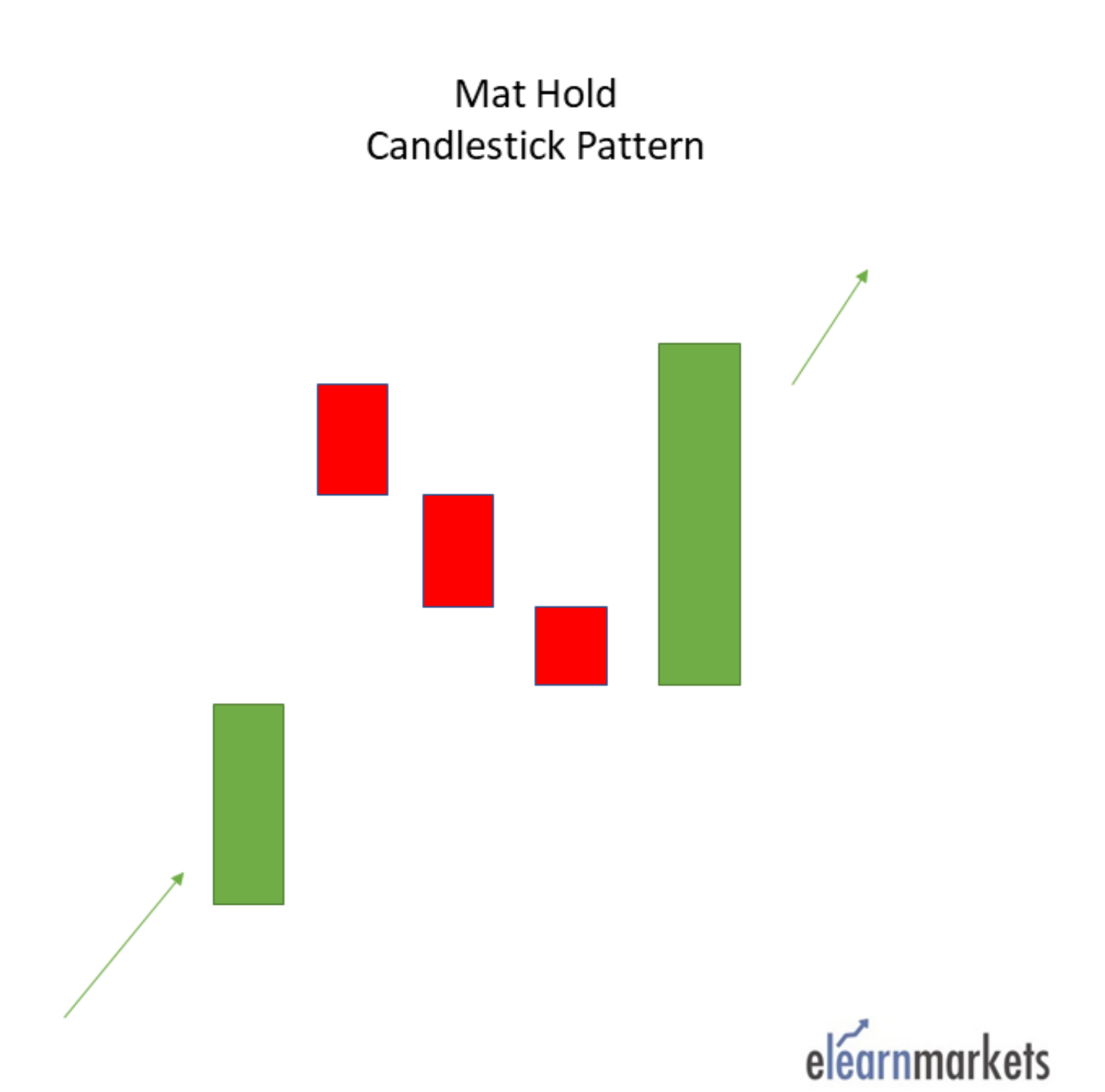
To stay below the first candle's low, these candles must stay above it. Candle number five is another large candle that moves upwards. The candle form falls within a general uptrend.
Bottom line
When using the candlestick patterns that we have discussed above, it is important always to combine them with other technical indicators since there is a possibility that some of the signals provided by them could be incorrect.
The emotions of investors that surround the trading of an asset have a massive impact on its value, as Japanese rice traders discovered centuries ago. To make better predictions about where a stock may go, candlesticks help traders gauge the emotions surrounding a stock or any other asset.
Traders use chart patterns to forecast price movements based on their unique shapes. For example, there are several chart patterns that candlesticks form, which are divided into continuation patterns and trend reversal patterns. In addition, traders use various technical tools to predict where the money is in the trade.
Candles might not provide additional information despite their visual appeal and color-coding, but they certainly stand out because of their visual appeal. Moreover, candles provide an alternative to complex numbers and graphs by visual representation of market conditions. By focusing on candlestick patterns, traders can better understand market psychology and act accordingly.


Trending Articles
- Who Is Andrew Tate and Why Is He Famous? 10 Things to Know the Controversial Influencer
Discover who is Andrew Tate and why he's making waves in the digital sphere. Uncover 10 intriguing facts about this controversial influencer, his journey, and his impact on the online world.
2024-03-01 TOPONE Markets Analyst - Andrew Tate Net Worth 2024: Is the Internet's Most Controversial Man Worth $800 Million?
Explore the enigmatic Andrew Tate's net worth and delve into the controversies surrounding the internet's most polarizing figure. Is he truly worth $800 million? Uncover the truth behind his wealth and reputation here.
2024-02-23 TOPONE Markets Analyst - 20 Strongest Currencies in the World in 2024
Want to know the strongest currencies in the world in 2024? Here are the list for you!
2024-01-30 TOPONE Markets Analyst - Falling Wedge Pattern: The Ultimate Guide
A falling wedge is a bullish pattern characterized by a wide top and shrinking bottom. It is an extremely bullish pattern in a trading market.
2023-09-25 TOPONE Markets Analyst

 Bonus!
Bonus rebate to help investors grow in the trading world!