 English


 English


Vistra Is Down a Third From Its High — Is the AI Power Story Still Intact?

Vistra Corp. (NYSE: VST) closed at $138.02 on September 28, 2026, down roughly 31–33% from its 52-week high near $217 set around October 2025. The stock has pulled back even as second-quarter adjusted EBITDA from continuing operations rose more than 30% year over year, and the company continues to sign large, multi-decade power agreements tied to AI data centers, including deals with Amazon Web Services and Meta. Analyst consensus remains strongly bullish, with average 12-month price targets around $217–221, implying roughly 57% upside from current levels. The gap between where the stock trades and where analysts think it should trade comes down to a specific worry: whether softening forward power prices in Texas's ERCOT market will offset the AI-driven demand story before 2027 hedges lock in.
What Vistra Actually Is
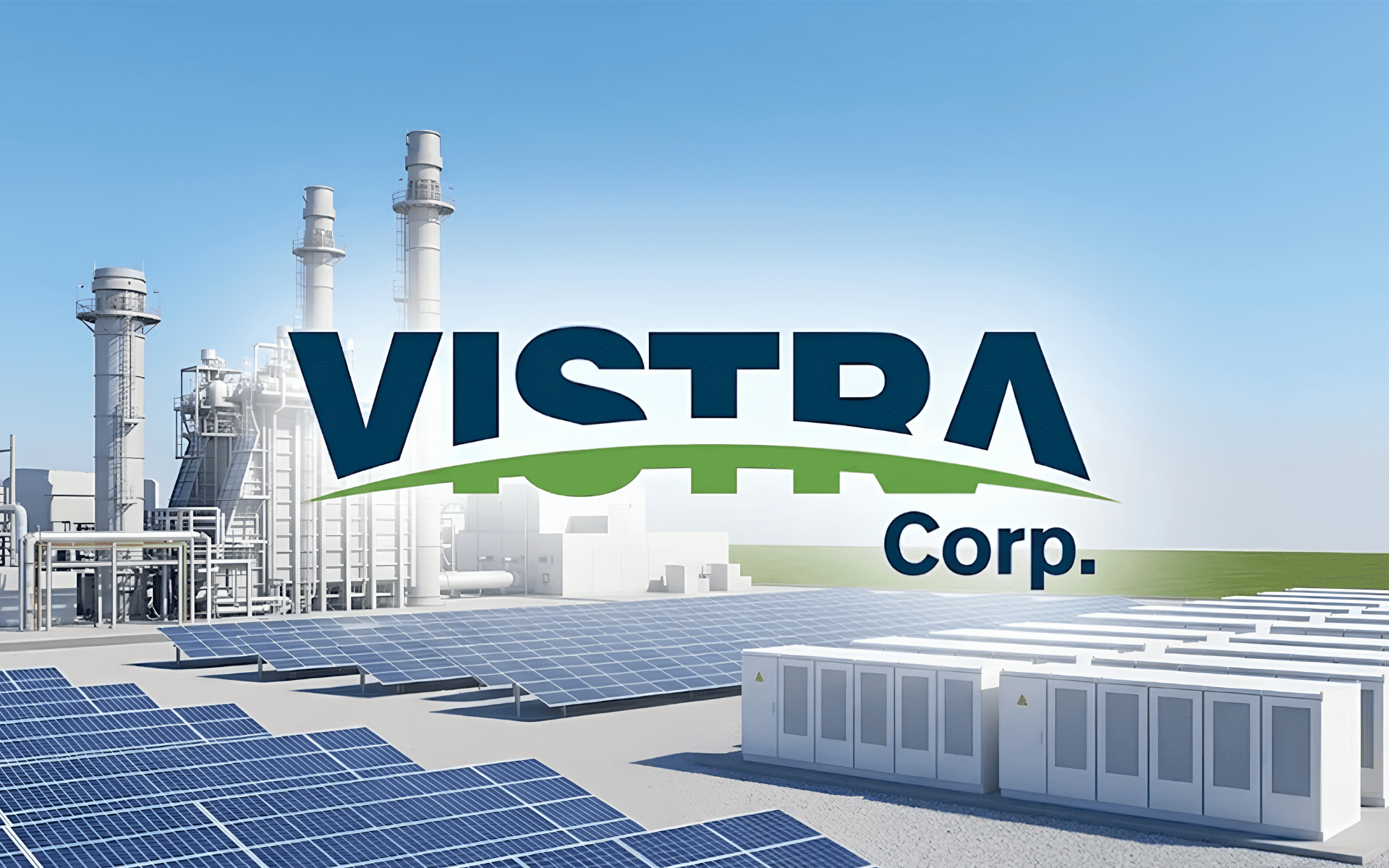
Vistra is an integrated power company with about 44 gigawatts of generation capacity, split roughly between natural gas (about 27 GW), nuclear (about 6.5 GW), coal (about 8.7 GW), and solar plus storage (about 1.3 GW). Its retail arm, including the TXU Energy brand in Texas, serves approximately 5 million customers. That combination — owning both generation and retail — means Vistra captures value both from selling power at wholesale and from serving end customers directly, which is part of why the AI data-center demand narrative applies to more than one part of its business.
Why the Stock Has Pulled Back Despite Strong Results
Second-quarter 2026 revenue came in around $4.02 billion, down year over year, and GAAP net income was $305 million, which included roughly $472 million in unrealized hedging losses — a reminder that Vistra's GAAP earnings can swing significantly from quarter to quarter based on mark-to-market hedge accounting rather than underlying cash generation. The more relevant operating metric, adjusted EBITDA from continuing operations, reached $1.767 billion for the quarter, up more than 30% year over year, driven by higher realized power and capacity prices and by contribution from generation assets acquired in the Lotus deal. First-half adjusted EBITDA from continuing operations totaled about $3.26 billion.
Management reaffirmed full-year 2026 guidance of $6.8–7.6 billion in adjusted EBITDA from continuing operations and $3.925–4.725 billion in growth-adjusted free cash flow, and said the company expects to hit or exceed the midpoint of that range. A previously disclosed 2027 midpoint opportunity range of $7.4–7.8 billion does not yet include contributions from the Cogentrix acquisition or portions of the Meta long-term agreements, meaning the disclosed 2027 figure is likely conservative relative to what the fully integrated business could generate. So the operating trend looks solid on paper — the stock's decline reflects forward-looking concern about ERCOT power price softness heading into 2027 and 2028, a period where Vistra's hedge coverage thins out from about 94% in 2027 to about 72% in 2028, leaving more of the business exposed to spot-market pricing in exactly the years the AI demand story is supposed to matter most.
The AI Power Contracts Driving the Bull Case
The most concrete evidence for the AI-demand thesis is in Vistra's signed contracts, not just industry narrative. The company has a roughly 20-year agreement with Amazon Web Services for about 1.2 GW tied to the Comanche Peak nuclear plant, and a roughly 20-year agreement with Meta covering a combined approximately 2,609 MW across existing capacity and planned upgrades at the Perry, Davis-Besse, and Beaver Valley plants. In September 2026, subsidiary Luminant signed a 20-year agreement with New Era Energy & Digital to supply up to approximately 207 MW to a Texas data-center project from the Odessa gas plant, targeting power delivery starting in the third quarter of 2027; Vistra will also receive non-voting equity interests related to that project.
Separately, Vistra is involved in Helix Digital Infrastructure, a data-center power and infrastructure platform developed alongside KKR, NVIDIA, and the Kuwait Investment Authority, where Vistra has committed up to approximately $1 billion and will serve as the preferred power supplier. These are long-duration, contracted revenue streams rather than speculative capacity additions, which is the core argument for why Vistra's current valuation multiple — a forward P/E of roughly 13–15x — looks inexpensive relative to the demand visibility the company has already locked in through contract.
Cogentrix and the Balance Sheet
Vistra's pending acquisition of Cogentrix, which would add approximately 5.5 GW of modern gas-fired generation, has received FERC approval and is awaiting closing; the earlier Lotus gas-fired acquisition has already been contributing to results, as reflected in the Q2 EBITDA growth. On the financing side, Vistra completed a $1.5 billion subordinated debt offering on September 24, 2026, split between 7.000% Series A and 7.250% Series B notes maturing in 2057. The company pays a quarterly dividend of $0.23 (annualized $0.92), a yield of about 0.66% at the current price, and holds investment-grade ratings of BBB- from both S&P and Fitch, with some collateral requirements already released as a result.
FAQ
Why has Vistra stock fallen from its highs?
Vistra shares have declined roughly 31–33% from a 52-week high near $217 set around October 2025, largely on concern that softening forward ERCOT power prices could offset AI-driven demand growth as the company's hedge coverage declines from about 94% in 2027 to about 72% in 2028.
Is Vistra's underlying business actually growing?
Yes, by the operating metric that matters most: second-quarter 2026 adjusted EBITDA from continuing operations rose more than 30% year over year to $1.767 billion, and management reaffirmed full-year guidance of $6.8–7.6 billion, saying it expects to hit or exceed the midpoint.
What are Vistra's major AI data-center power contracts?
The company has roughly 20-year agreements with Amazon Web Services (about 1.2 GW tied to Comanche Peak nuclear) and Meta (a combined approximately 2,609 MW across three nuclear plants), plus a newer 20-year deal to supply up to about 207 MW to a Texas data center via the Odessa gas plant starting in Q3 2027.
How much leverage does Vistra carry?
The company's debt-to-equity ratio is approximately 3.6–3.7x, and it added $1.5 billion in subordinated debt in September 2026, though it maintains investment-grade credit ratings (BBB-) from both S&P and Fitch.


Risk Warning: Trading financial instruments involves significant risk and may result in the loss of your invested capital. Please ensure you fully understand the risks and seek independent professional advice if necessary. This article does not constitute investment advice or a trading recommendation. Past performance is not indicative of future results.
Bonus rebate to help investors grow in the trading world!


