 English




 English


Carvana Stock After Q3: Record Volume, Thinner Margins Per Car

Carvana sold a record 217,385 used cars in Q3 2026, up 39%, while the industry was flat. Revenue rose 42% to $8.04 billion, and the stock jumped 15.7% the next day despite an EPS miss. The concern is profit per car. Adjusted EBITDA margin fell to 10.0% from 11.3% as Carvana passed savings to customers and absorbed higher fuel and interest costs. Full-year guidance implies Q4 EBITDA below Q3 even as volume grows. At about $68 a share, roughly 33 times trailing earnings, CVNA stock is pricing the 3-million-unit plan and leaving little room for further margin slippage.
Carvana (NYSE: CVNA) closed at $68.29 on October 30. The stock is down about 19% for the year and well below its 52-week closing high of $95.69 from January. The Q3 report showed the company is still taking share quickly. The open question for investors is whether that share gain comes at the expense of the margins that turned Carvana profitable.
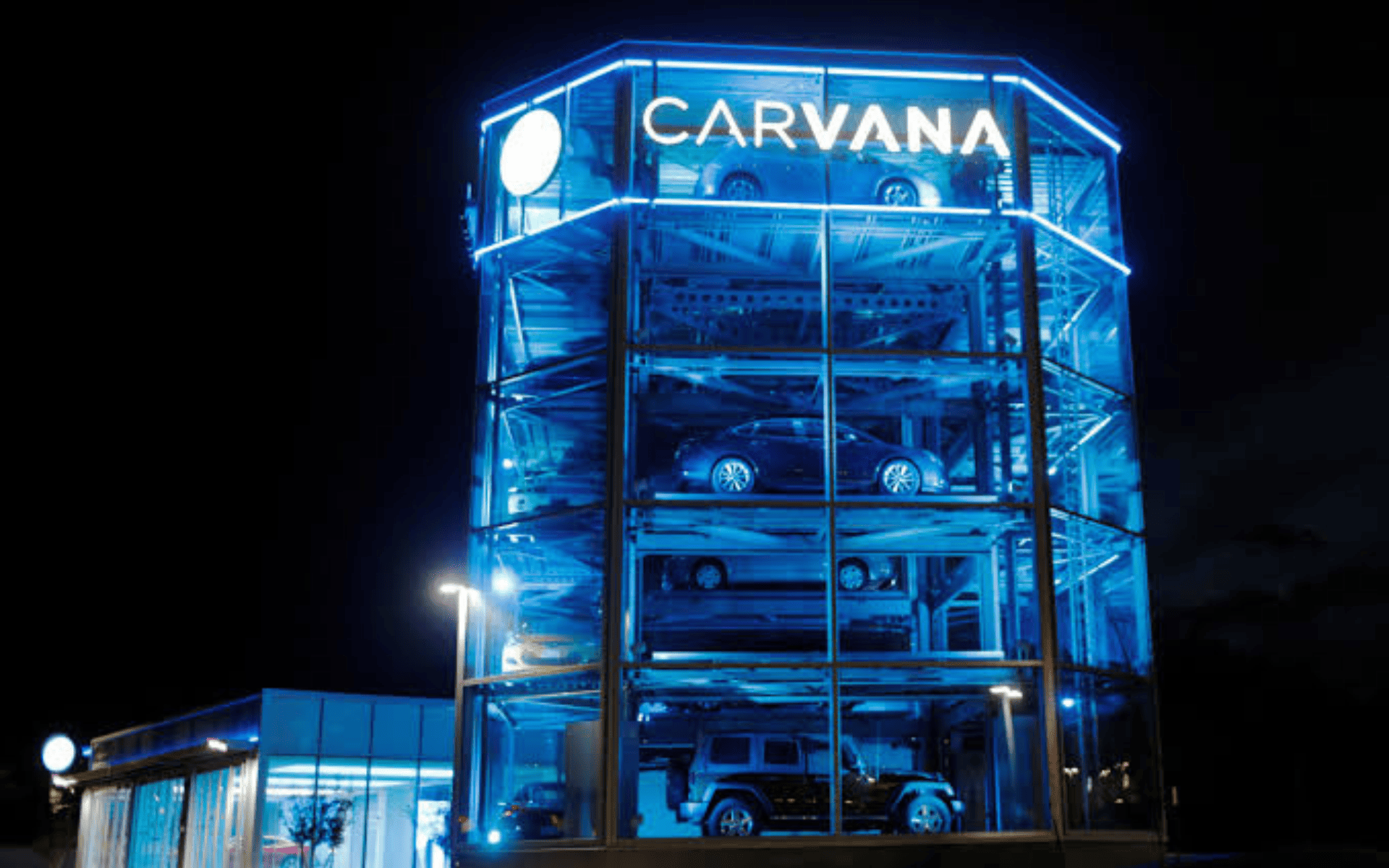
Why did Carvana stock rise 15.7% after missing on EPS?
Investors weighed the volume records more heavily than the earnings miss. Carvana stock rose 15.7% on October 29 while the S&P 500 fell 0.3%. Revenue of $8.04 billion beat the $7.71 billion estimate, while EPS of $0.39 fell short of the $0.44 analysts expected. Reports linked the rally to the records outweighing the miss.
The gap with traditional dealers was wide that day. CarMax rose 4.0% and AutoNation 3.1%, a fraction of Carvana’s move. Retail units sold reached 217,385, up 39%, while the broader industry was roughly flat. Carvana passed 200,000 units in a single quarter for the first time.
Short-term positioning likely added to the move. Going into the report the stock had lost 13.7% over six months, while the S&P 500 gained 7.7%, so a strong volume print met a market that expected less. With a five-year beta of 3.55, double-digit daily moves on earnings are normal for CVNA.
A note on the price: Carvana split its stock 5-for-1
New readers sometimes see conflicting quotes. Carvana did a 1:5 stock split on May 8, 2026. Today’s $68.29 is equivalent to about $341 on a pre-split basis (my calculation). Some quote pages still show unadjusted pre-split 52-week highs, such as $486.89, next to post-split prices. On a split-adjusted basis, the 52-week range is $54.46 to $97.38.
Is Carvana’s growth sustainable?
Volume growth has been unusually steady. Q3 was Carvana’s 11th consecutive quarter of industry-leading retail unit growth. The 2026 quarters show it: 187,000 units in Q1 (up 40%), 197,325 in Q2 (up 38%), and 217,385 in Q3 (up 39%). For 2025 as a whole, Carvana sold 596,641 retail units, up 43%, on revenue of $20.3 billion.
Carvana’s run rate is now about 870,000 retail units a year, roughly 2% of the US used-car market. Management’s long-term goal is 3 million retail units a year at a 13.5% adjusted EBITDA margin by 2030 to 2035. At 39% annual growth, 870,000 units would reach about 3 million in roughly four years. Growth rates usually slow as a company scales, so the realistic timeline runs toward the middle of management’s range.
Guidance points to continued growth: Carvana expects a sequential increase in retail units in Q4. The company cites three long-term drivers: a continuously improving customer offering, rising awareness and trust, and the benefits of scale, including wider inventory selection.
Are Carvana’s unit economics getting worse?
Yes, modestly, and this is the main bear argument. Adjusted EBITDA hit a record $800 million, but the margin fell to 10.0% from 11.3%. Management attributed the decline to a higher-priced vehicle mix and to giving back value to customers through lower loan rates.
Per car, the decline is easier to see. Q3 adjusted EBITDA was about $3,680 per retail unit, compared with roughly $4,080 a year earlier, a drop of about 10%.
Management named several drivers. Carvana chose to offer customers lower loan rates relative to benchmark rates. Wholesale gross profit per unit fell because retail volume grew faster than the wholesale marketplace. Partly offsetting this, spreads between retail and wholesale prices were higher. Q3 was also hit by elevated fuel prices and rapidly rising benchmark interest rates. Operations expense rose $109 per retail unit because of fuel and logistics costs, partly offsetting gains in overhead efficiency.
Over a longer period, the decline is still small. Carvana’s operating margin was 8.7% for the four quarters ended September 2026, versus 9.4% the year before, which had been its best twelve-month reading since 2016. The current level is still above 34 of the last 40 quarter-end readings. Management says the 13.5% EBITDA goal corresponds to an operating margin of about 12.5%.
What does Carvana’s Q4 guidance imply?
The guidance implies volume up and margin down in Q4. Carvana expects full-year 2026 adjusted EBITDA at the higher end of its $2.7–3.0 billion range. Adjusted EBITDA through nine months totals about $2.24 billion ($672M in Q1, $769M in Q2, $800M in Q3). Even at the top of the range, Q4 EBITDA would be about $760 million, below Q3’s $800 million. At a midpoint of the “higher end” (say $2.9 billion), Q4 would be about $660 million.
With units expected to rise from Q3, falling EBITDA means lower profit per car again in Q4. Seasonality explains part of this, since Q4 is typically softer for used-car pricing, and fuel and interest rates explain more. Q4 results will show whether the margin slip is seasonal or still deepening.
How profitable is Carvana now?
Carvana is now solidly profitable on a GAAP basis. Q3 net income was $483 million, up $220 million, a net income margin of 6.0% versus 4.7% a year earlier. GAAP operating income was a record $714 million, 89% of adjusted EBITDA. That high conversion rate means adjusted EBITDA is not hiding large non-cash adjustments.
The full-year picture is strong. Net income for the first three quarters of 2026 totals about $1.4 billion. In 2025 Carvana earned record net income of $1.9 billion on adjusted EBITDA of $2.2 billion.
Is Carvana stock overvalued?
That depends on whether the 3-million-unit plan delivers. At $68.29, Carvana’s market value is about $75.7 billion, with a trailing P/E of 32.83 on EPS of $2.08. Against guided 2026 adjusted EBITDA of about $3 billion, the market value is about 25 times EBITDA. That is a growth multiple, not a car-dealer multiple.
Analysts nudged targets up after the print. Barclays kept an Overweight rating and raised its target from $80 to $82; Citizens moved to $85 from $83; and UBS reiterated Buy. MarketBeat’s consensus target is $82.09 with a Moderate Buy rating, about 20% above the current price.
Long-run returns are a reminder of the stock’s history. Over the five years to October 2026, Carvana stock rose 12.7%, versus 126% for Penske Automotive. That period includes the near-collapse of 2022–2023 and the recovery since, which shows how far the share price can swing on the same underlying business.
FAQ
Q1: How many cars did Carvana sell in Q3 2026?
A1: Carvana sold a record 217,385 retail units in Q3 2026, up 39% from 156,205 a year earlier. It was the first quarter above 200,000 units.
Q2: Why did Carvana stock go up after earnings?
A2: Carvana stock rose 15.7% on October 29, 2026, as record units and revenue of $8.04 billion (above the $7.71 billion estimate) outweighed an EPS miss of $0.39 versus about $0.44 expected.
Q3: What is Carvana’s adjusted EBITDA guidance for 2026?
A3: Carvana expects full-year 2026 adjusted EBITDA at the higher end of its $2.7–3.0 billion range, after a record $800 million in Q3 2026. It also expects retail units to rise in Q4.
Q4: Did Carvana split its stock?
A4: Yes. Carvana completed a 1-for-5 stock split on May 8, 2026. Its October 30, 2026 close of $68.29 is about $341 on a pre-split basis.
Q5: What is Carvana’s long-term goal?
A5: Carvana aims to sell 3 million retail units a year at a 13.5% adjusted EBITDA margin by 2030 to 2035. Its current run rate is about 870,000 units, roughly 2% of the US used-car market.


Risk Warning: Trading financial instruments involves significant risk and may result in the loss of your invested capital. Please ensure you fully understand the risks and seek independent professional advice if necessary. This article does not constitute investment advice or a trading recommendation. Past performance is not indicative of future results.
Bonus rebate to help investors grow in the trading world!


