 English


 English


9 Best Day Trading Platforms: Ranked & Compared
 TOPONE Markets Analyst
 Reading time 12 minutes
Key Points Summary
In June 2026 the US repealed the PDT rule. The $25,000 floor was replaced by real-time intraday margin, but a standard margin account still needs $2,000.
There is no single best platform. Stock scalpers want IBKR or TradeStation; forex day traders want Pepperstone, IC Markets, or a CFD broker like TOPONE Markets; futures traders want NinjaTrader.
You do not need MT4, MT5, or cTrader to start. Most brokers' web platforms are enough to learn; pick a terminal only when your strategy demands it.
ECN accounts are not automatically cheaper. Below roughly 20 lots a month on EUR/USD, a standard account's markup often costs the same or less.
$100 opens an account but will not build a career
On June 4, 2026, the United States deleted one of the most famous rules in retail trading. The SEC approved amendments to FINRA Rule 4210 that ended the Pattern Day Trader framework: no more $25,000 minimum, no more "four trades in five days" counter, no more 90-day freeze. Day trading buying power now updates in real time from your actual margin. If you last looked at day trading a few years ago and walked away because you did not have $25,000, the math changed. This guide is built for people choosing a day trading platform in that new landscape. We rank the brokers and apps that day traders actually use today, split by what you trade (stocks, forex, futures, crypto), then walk through the rules that still matter, the markets worth your attention, and the costs that eat beginners alive. A platform will not make you profitable. The wrong one, though, will make losing more expensive than it needed to be.
Best Day Trading Platforms: Our Ranked Shortlist
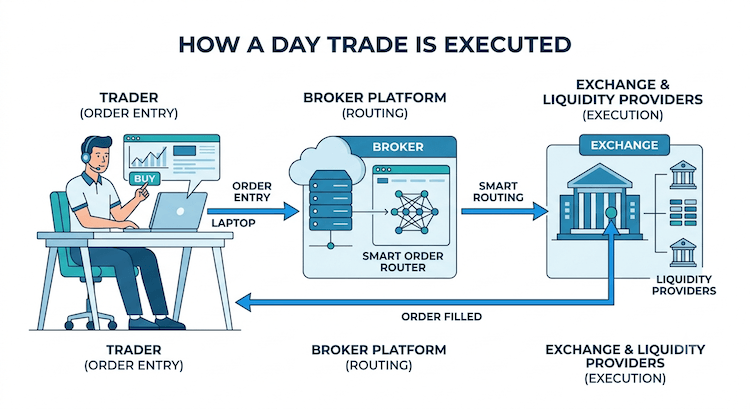
The best day trading platform depends on what you trade. For US stocks and options, Interactive Brokers and TradeStation lead on cost and routing. For forex and CFDs, Pepperstone, IC Markets, and TOPONE Markets offer tight spreads and fast execution. For futures, NinjaTrader stands alone. Pick the market first, then the platform, because a stock broker's zero commissions are useless if you actually want to scalp EUR/USD.
| Platform | Best for | Markets | Apps | Key cost note | Regulation |
|---|---|---|---|---|---|
| Interactive Brokers (IBKR) | US stocks, options, futures, multi-asset | Stocks, ETFs, options, futures, forex, bonds | Trader Workstation, IBKR Mobile | US equities from $0.0035/share, $0.35 min; smart order routing | SEC, FINRA, CFTC, FCA, ASIC |
| TradeStation | Backtesting and automation, US stocks + futures | Stocks, ETFs, options, futures | TradeStation 10, web, mobile | $0 equity commissions on plan; competitive futures fees | SEC, FINRA, SIPC, CFTC |
| tastytrade | US options day trading | Options, stocks, futures, crypto | tastytrade desktop, web, mobile | Low per-contract options pricing | SEC, FINRA, SIPC |
| Webull | Mobile-first beginners, paper trading | Stocks, ETFs, options, futures | Mobile, desktop, web | $0 commissions on US stocks and ETFs | SEC, FINRA, SIPC |
| NinjaTrader | US futures day trading | Futures, forex, stocks | NinjaTrader 8, web, mobile | Futures ~$1.29/side (free plan) down to ~$0.59 (lifetime); micros from ~$0.09 | NFA, CFTC |
| Pepperstone | Forex day trading on raw spreads | Forex, indices, commodities, CFDs | MT4, MT5, cTrader, TradingView | Razor account ~0-pip spread + $3.50 per side per lot | FCA, ASIC, CySEC, BaFin |
| IC Markets | High-volume forex scalping | Forex, indices, commodities, CFDs | MT4, MT5, cTrader | Raw spreads from 0.02 pip; $200 minimum deposit | ASIC, CySEC, FSA-Seychelles |
| IG | CFD breadth, UK and EU users | CFDs, spread betting, shares, forex, options | Web, app, ProRealTime, MT4, MT5, TradingView | Spread-based; product and tax treatment vary by region | FCA, ASIC, and others |
| TOPONE Markets | Forex, gold, and indices CFDs via MT4/MT5 | Forex, gold, indices, CFDs | MT4, MT5 | Spread-based with micro-lot support; confirm entity for your region | CFD broker (verify regulated entity per country) |
Rankings shift by what you trade. If your entire plan is scalping EUR/USD, a stock broker's zero commissions are irrelevant because they do not offer the market. Start with the market, then pick the platform that prices it cheapest at your trade size.
How to Choose the Right Day Trading Platform
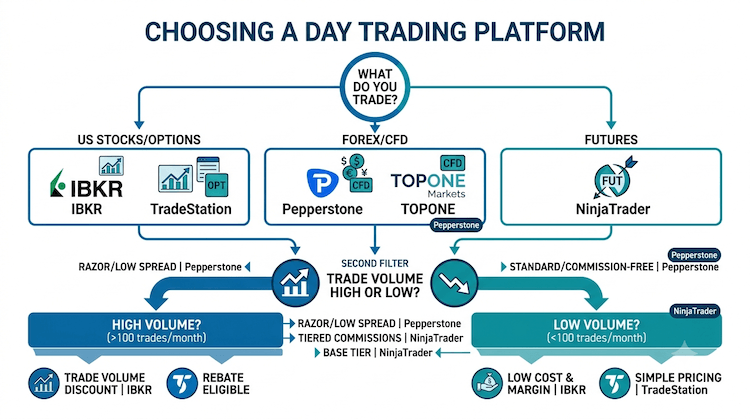
Choose by four filters: the market you trade, execution cost at your volume, platform stability under load, and regulation. Everything else is preference. Most "best platform" arguments online collapse once you apply these four, because the right answer for a $500 forex account is the wrong answer for a $50,000 options account.
Market access comes first. No platform trades everything well. US equities and options live at IBKR, TradeStation, tastytrade, or Webull. Forex and CFDs live at Pepperstone, IC Markets, TOPONE Markets, or IG. Futures live at NinjaTrader or TradeStation. If your broker does not list the market, no amount of charting tools will help.
Cost at your volume, not the headline. A "zero commission" stock broker may still cost you through payment for order flow, where the effective spread is wider than at a broker charging $0.0035 per share. A forex ECN with a 0-pip spread adds a $3 to $7 per-lot commission. Compute your own break-even: total cost per trade times your daily trade count plus fixed overhead. If that number beats your average daily gross profit, the platform is the problem.
Stability at 9:30 AM. Platforms feel identical at 11 PM in a demo. They do not feel identical at the US open, when everyone hits the server at once. Look for published latency, one-click close, and a track record of surviving volatility without freezing. A crash during the open is worse than a slightly wider spread.
Regulation and asset protection. Favor tier-1 regulators: SEC, FINRA, CFTC in the US; FCA in the UK; ASIC in Australia; CySEC or BaFin in the EU. Ask what protects your cash if the broker fails. US brokers carry SIPC coverage; EU and UK brokers must offer negative balance protection. If a broker is vague about its regulator, that is your answer.
Day Trading Rules Around the World
Day trading is legal in most major economies, but the rules are local. The US repealed its PDT minimum in June 2026; the UK, EU, and Australia never had it but cap retail leverage; Canada never had a PDT-style rule at all. Where you open your account, not where you live, often decides which rule applies.
| Region | Regulator | PDT-style minimum | Retail leverage cap | Tax note |
|---|---|---|---|---|
| United States | SEC, FINRA, CFTC | Repealed Jun 4 2026; $2,000 margin min | None on stocks; futures exempt | Capital gains tax; wash-sale rule applies |
| United Kingdom | FCA | None | ESMA-style (30:1 major FX) | CGT plus allowance; spread betting tax-free |
| European Union | ESMA (per member) | None | 30:1 FX, 20:1 minor, 5:1 stocks, 2:1 crypto | MiFID II; varies by state |
| Australia | ASIC | None | Retail CFD caps (30:1 FX) | Capital gains tax |
| Canada | CIRO / provincial | None (no PDT rule) | CIRO-set | Capital gains treatment |
| Singapore | MAS | None specific | Leverage limits apply | No CGT; active trading may be taxed as income |
Two traps to avoid. First, if you use a US-regulated broker, you follow US rules no matter where you sit, so the 2026 repeal helps you even if you are in Asia. Second, futures are regulated by the CFTC, never by FINRA, so the PDT rule never applied to them. That is why micro futures became a popular workaround for small accounts long before the repeal.
Which Markets Are Best for Day Trading
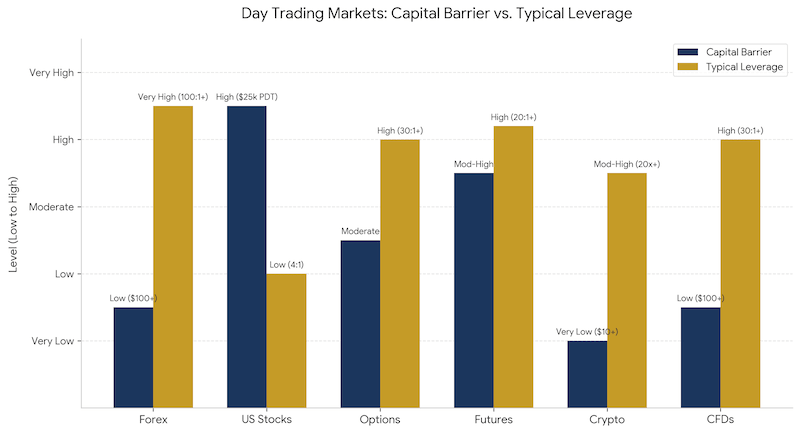
Forex and futures suit small accounts because of leverage and round-the-clock or indexed liquidity. US stocks work since the PDT floor was removed, but they need more capital per trade. Crypto trades 24/7 but on less regulated venues. Match the market to your capital and your hours before you pick a platform.
| Market | Hours | Capital barrier | Leverage | Best for |
|---|---|---|---|---|
| Forex | 24/5 | Low ($100 micro) | High at retail | Tight-spread majors like EUR/USD |
| US stocks / ETFs | Session only | Moderate ($2k margin) | Intraday 2:1 typical | Liquid names with real volume |
| US options | Session only | Moderate | Defined risk | Multi-leg strategies (~$0.65/contract) |
| Futures (ES, NQ, CL) | Near 24/5 | Low via micros | Exchange-set | Index and oil day trades; no PDT |
| Crypto | 24/7 | Very low | Exchange-set, high | Volatility hunters; venue risk |
| CFDs | Mirrors underlying | Low | Capped by region | Derivative access outside the US |
Forex is the cheapest on-ramp: a 1-pip spread on EUR/USD is about $10 per standard lot, and micro lots let you risk pocket change while you learn. Futures are the cleaner small-account choice for index traders, because micro contracts like MES and MNQ let you trade the S&P 500 from roughly $1 to $5 per point. Crypto attracts beginners with 24/7 access and no PDT of any kind, but exchange failure and wild gaps are the real tuition.
What Is the Pattern Day Trader (PDT) Rule?
The PDT rule was a US FINRA rule that flagged traders making four or more day trades in five business days in a margin account and forced them to keep $25,000 in equity. As of June 4, 2026, it no longer exists. The SEC approved amendments to FINRA Rule 4210 that repealed the framework and replaced it with real-time intraday margin.
The old rule worked like this: hit four day trades in a rolling five-day window and your account was flagged. Drop below $25,000 and you could only close positions, with a 90-day restriction if you could not meet the call. Traders hated it because a single hot week could freeze a small account for three months.
The new system, effective June 4, 2026, removes the trade counter entirely. Buying power is now calculated as Intraday Margin Buying Power (IMBP), updated in real time from your actual margin excess rather than the prior day's closing balance. A standard margin account still needs the usual $2,000 minimum. If an intraday margin deficit is not resolved within five business days, the account can face a new 90-day liquidation-only restriction, so risk control did not disappear, it just moved from counting trades to watching margin.
What did not change: cash accounts were never subject to PDT and still settle in T+2; margin interest still applies to overnight positions; options still need approval; short selling still needs a margin account and borrowable shares. And the repeal applies to US-regulated brokers. Non-US brokers never had a PDT rule, and Canada has never had one either, so the $25,000 wall was never a factor for Canadian accounts.
Is $100 Enough to Start Day Trading?
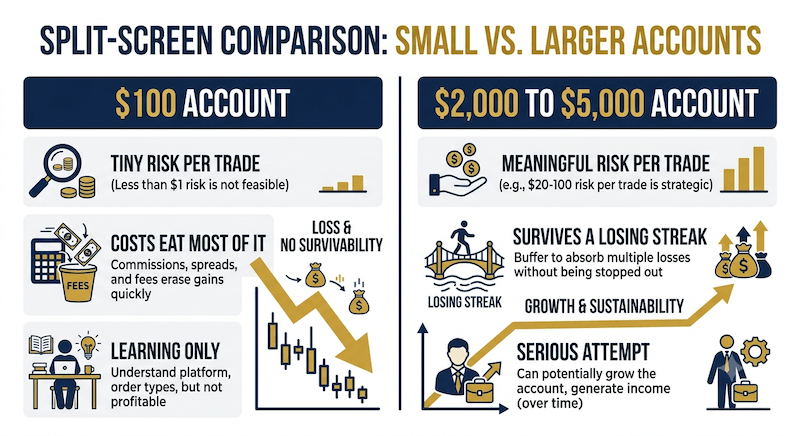
Technically yes, a $100 forex micro or crypto account is easy to open. Realistically no, $100 is a tuition account, not an income account. At 1% risk per trade that is just $1, and spreads plus commissions will eat most of it before you learn anything useful.
Here is the math that matters. Risk 1% of $100 and you can lose $1 per trade. On a micro lot of EUR/USD, one pip is about $0.10, so a 10-pip stop is your full $1 risk, and the spread already costs you roughly $0.10 to $0.20 on each side before the trade moves. You can place trades, but your edge has to be enormous just to break even after costs. That is fine for learning the buttons. It is not fine for paying rent.
The realistic floor for a serious attempt is $2,000 to $5,000. At that size, 0.5% to 1% risk is $10 to $50 per trade, which is meaningful enough to feel and small enough to survive a losing streak. This is also where micro futures become practical: MES and MNQ let you trade the S&P 500 and Nasdaq from about $1 to $5 per point, so a small account can day trade real indices instead of gambling on penny stocks.
My honest take: fund a $100 account only to learn mechanics on a real feed, then treat the first $2,000 like tuition you might lose. Anyone promising that $100 becomes a living is selling a course, not a strategy.
Hidden Costs Most Day Traders Ignore
The commission you see is the smallest cost. The spread, slippage, swap, data fees, currency conversion, and withdrawal rules usually cost far more across a year of active trading. Most beginners obsess over the headline commission and never add up what actually leaves the account.
The spread. The gap between bid and ask is the biggest hidden cost in forex and scalping. On EUR/USD, one pip is about $10 per standard lot, paid on both entry and exit. A trader making ten round trips a day can bleed $15,000 to $50,000 a year in total friction before a single winning or losing trade even matters.
Slippage. Your fill is often worse than the price you clicked, especially in the first minutes after the open and around news. In fast markets, prices gap past your level. At a fair broker slippage averages out; at a bad one it is 100% negative, which is a manipulation red flag.
Commissions. Per-share pricing like IBKR's $0.0035 runs about $1 per side on 200 shares but $25 per side on 5,000 shares. Forex ECN commissions run $3 to $7 per lot per round turn. Small at low volume, heavy at scale.
Swap and overnight financing. Day traders mostly avoid this by closing before the bell, but a position held overnight pays or earns a swap, and on some pairs it dwarfs the spread over a week.
Data, regulatory, and structural fees. Real-time Level II and market data subscriptions can run $1 to $15 a month. Regulators charge too: the SEC Section 31 fee and TAF apply on sells, and options carry a per-contract fee. Then there is payment for order flow on "free" brokers, currency conversion markups of 0.3% to 0.7% at fair brokers (2% to 5% at abusive ones), withdrawal fees of $5 to $50, turnover requirements above 3x that block withdrawals, inactivity fees, margin interest, and borrow costs of 1% to 10% plus annually on hard-to-borrow shorts.
Do I Need MT4, MT5 or cTrader to Start Day Trading?
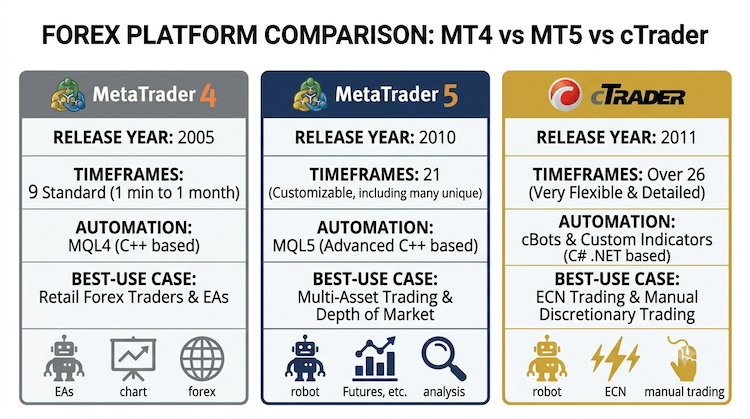
No. You need a platform that executes your orders and shows your charts, and most brokers' free web and mobile apps already do that. MT4, MT5, and cTrader matter only when you run automated strategies, need Level II pricing, or trade many asset classes at once.
| Platform | Released | Strengths | Weakness | Best for |
|---|---|---|---|---|
| MT4 | 2005 | Largest EA and indicator library; near-universal broker support | 9 timeframes, no DOM, dated UI | Forex algos and max compatibility |
| MT5 | 2010 | 21 timeframes, DOM, economic calendar, multi-asset | Not compatible with MT4 EAs | Multi-asset and new algo builders |
| cTrader | 2011 | Level II pricing, 70+ indicators, cleanest UI, ECN-native | Smaller automation community | Scalpers and transparency seekers |
MT4 is still the safe default only if you already own MQL4 Expert Advisors you do not want to rewrite, because MT4 and MT5 are architecturally separate and incompatible. MT5 is the better long-term pick for anyone starting fresh or trading stocks and futures alongside forex. cTrader is the one active forex traders tend to prefer for execution transparency and Level II visibility. None of them is required on day one. Start on your broker's web platform with TradingView for charting, then adopt a terminal when your strategy actually demands it.
Are ECN Accounts Always Cheaper Than Standard Accounts?
No. ECN accounts show near-zero spreads but add a commission, while standard accounts bake a small markup into the spread with no commission. At low volume the two cost about the same, and ECN only pulls clearly ahead past roughly 20 to 80 lots a month.
Here is the EUR/USD math that ends the debate. A standard account might quote a 1.0-pip spread, so a round turn on one standard lot costs about $20 (one pip is $10, paid entering and exiting). An ECN account might show a 0.1-pip spread, about $2 round turn, plus a $7 commission per round turn, for a total of about $9. On EUR/USD the ECN saves roughly $11 per round turn, which is about $1,100 a month at 100 lots and $5,500 at 500 lots. Below about 20 lots a month that gap is noise, and the standard account's simplicity wins.
The trap is that most beginners open an ECN account for the tight headline spread, then trade five lots a month and pay more in commission than they saved in spread. ECN accounts also usually ask for a higher minimum deposit, often $500 to $1,000 versus $100 to $500 for standard. Choose ECN if you scalp or trade high volume. Choose standard if you are learning or hold for hours. The label "ECN" is not a quality grade, it is a different way to price the same trade.
Want to day trade forex, gold, or indices?
TOPONE Markets offers MT4 and MT5, tight spreads, and micro-lot support for day trading forex, gold, and indices. Open a practice account and feel the execution before you fund.
Open an AccountFinal Thoughts
A platform is a tool, not a strategy. The PDT repeal in 2026 lowered the entry barrier in the US, but it did nothing to lower the skill barrier. The traders who survive are not the ones with the fastest day trading platform. They are the ones who knew their cost per trade before they placed it.
If you are starting with forex, gold, or indices, a CFD broker with MT4/MT5 and tight spreads is a practical on-ramp, and that is the lane TOPONE Markets sits in. If you are starting with US equities, a zero-commission stock broker with good routing is enough. Either way, open a demo, trade the open for a week, and read your own statement before you chase a single signal. The cheapest trade you will ever make is the one where you understood the cost before clicking buy.
FAQ
Risk Warning: Trading financial instruments involves significant risk and may result in the loss of your invested capital. Please ensure you fully understand the risks and seek independent professional advice if necessary. This article does not constitute investment advice or a trading recommendation. Past performance is not indicative of future results.
Bonus rebate to help investors grow in the trading world!


