 English


 English


Gold CFD Trading in Malaysia 2026: How XAU/USD Works, Rules and Risks
 TOPONE Markets Analyst
 Reading time 18 minutes
Key Points Summary
A gold CFD (XAU/USD) lets you trade gold price moves with leverage, in both directions, without owning physical metal.
Malaysians can trade gold CFDs through offshore brokers regulated by the FCA, ASIC, CySEC, or the Labuan FSA. Bank Negara restricts ringgit pairs, not the US dollar quoted gold contract.
Against physical gold, bank gold accounts, and the Bursa gold ETF, a CFD wins on flexibility and leverage but loses on ownership and peace of mind.
One standard lot is 100 troy ounces. At about USD 4,080 per ounce that is roughly USD 408,000 of notional value, so even a 0.01 lot needs careful margin maths.
Regulators require brokers to warn that 70 to 89 percent of retail CFD accounts lose money. Gold's near 27 percent swing from its Jan
Gold has always been part of Malaysian life. It shows up at weddings and sits in family savings boxes, and it means more than its price tag suggests. Most Malaysians know gold as jewellery or a bank gold account, but a fourth option has been gaining ground: trading gold as a CFD. The setup is simple to describe and easy to misuse. You are not buying a bar. You are entering a contract that pays the difference between the gold price when you open and when you close. Gold briefly touched an all time high near USD 5,600 per ounce in January 2026, then fell back to around USD 4,080 by late July, a swing of roughly 27 percent in half a year. That kind of move is exactly what pulls new traders in, and exactly what punishes them when leverage is misused. This guide walks through what a gold CFD actually is, how the maths works, how it compares with the gold you can buy locally, the Malaysian legal picture, and the risks that most beginners underestimate.
What is gold CFD trading?
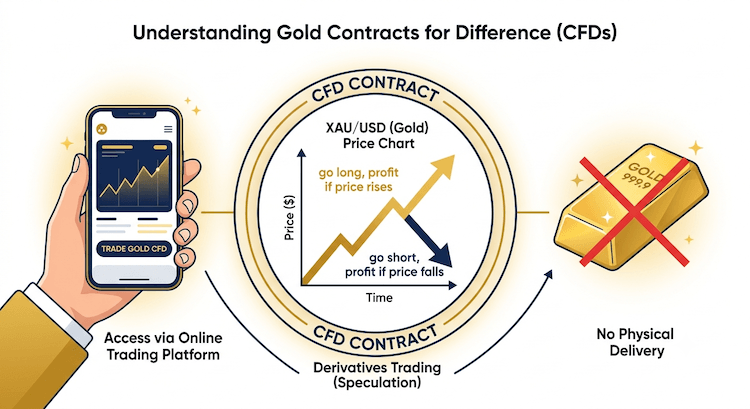
A gold CFD is a contract for difference on the price of gold, quoted as XAU/USD. XAU is the international code for gold, and USD means the price is in US dollars per troy ounce. When you trade it, you never take delivery of a single gram. You agree with your broker to exchange the difference between the gold price when you open the trade and the price when you close it. If the price moves your way, the difference is credited to your account. If it moves against you, the difference is debited.
That structure is what makes a gold CFD different from every other way Malaysians hold gold. You can take a long position if you expect the price to rise, or a short position if you expect it to fall. Physical gold and gold ETFs only make money when the price goes up, because you own something you must later sell at a higher price. A CFD pays either direction. Gold is also a classic safe haven, so during periods of inflation fear or geopolitical tension its price often climbs, which is why it draws attention when headlines turn ugly.
Here is a concrete example using the late July 2026 price of about USD 4,080 per ounce. Suppose you buy 0.1 lots of XAU/USD, which equals 10 troy ounces, and the price rises to USD 4,130. The move is USD 50 per ounce, so your profit is 10 ounces times USD 50, or USD 500, minus the spread you paid to open and close. The same trade in reverse, a USD 50 drop, would be a USD 500 loss. The number looks small next to the full contract, but leverage turns it into a meaningful slice of a typical account, which is the subject of the next section.
How gold CFD trading works
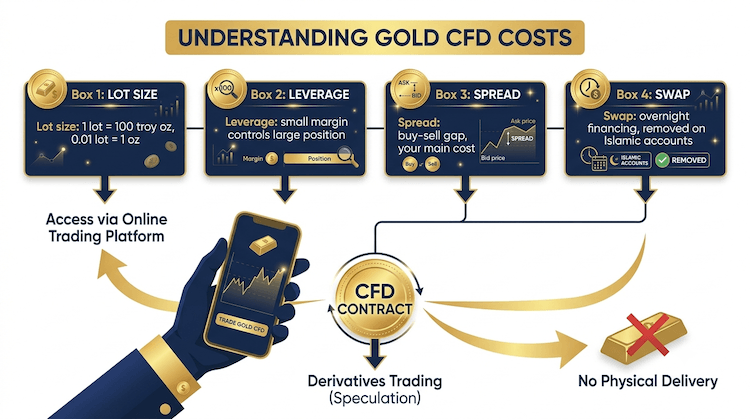
The mechanics come down to four numbers: lot size, leverage, spread, and swap. Get those four right and you are trading with a plan. Get them wrong and you are gambling on a price you do not control.
Lot size and pip value
In gold CFD trading, one standard lot represents 100 troy ounces. A troy ounce is about 31.1 grams, heavier than the everyday ounce. The smallest order most brokers accept is 0.01 lots, which is exactly one troy ounce. The quote has two decimal places, and the second decimal is the pip. On one full lot, a one pip move (0.01) is worth about USD 10. On a 0.01 lot, that same pip is worth about USD 0.10. At the late July 2026 price of roughly USD 4,080 per ounce, one full lot controls close to USD 408,000 of gold value.
Leverage and margin
Leverage lets you control a large position with a small deposit, called margin. A broker offering 1:100 leverage on gold requires about 1 percent of the position value as margin. On a 0.1 lot position (10 ounces, about USD 40,800 of notional value at USD 4,080), the margin would be roughly USD 408. Here is the trap: a 1 percent move in gold, about USD 40.80 per ounce, equals USD 408 of profit or loss on that 0.1 lot, which is 100 percent of your margin. Leverage of 1:1000, offered by some offshore brokers, makes that swing ten times larger. That is why professional gold traders often use 10:1 to 50:1 rather than the maximum available.
Spread and swap
The spread is the gap between the buy price and the sell price, and it is your primary cost. On gold, standard account spreads often run from about 0.1 to 1.0 pip (roughly USD 0.10 to USD 1.00 per ounce), while raw or ECN accounts quote from near zero and add a small commission per lot. Spreads widen during volatile news events and tighten during the London and New York sessions when liquidity is deepest. The swap is the overnight financing charge for holding a position past the daily close. Gold is one of the instruments most commonly covered by swap-free Islamic accounts, which remove that interest charge for traders who need it.
Gold CFD vs physical gold and gold ETF in Malaysia
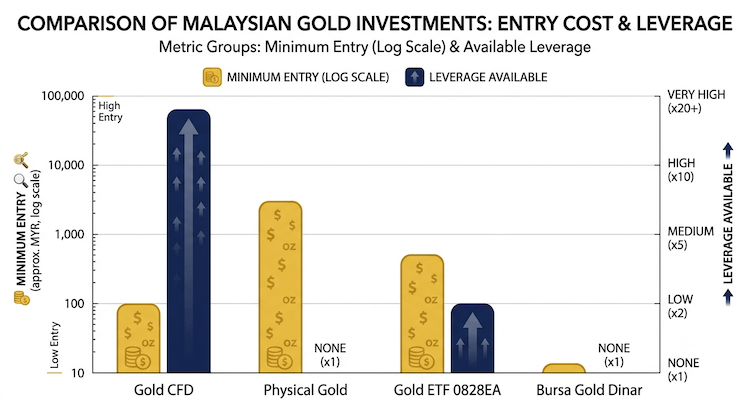
Malaysians have more ways to own gold than most people realise, and each one serves a different goal. The table below puts the four main routes side by side.
| Option | What you own | Leverage | Short sell | Min entry | Storage | Shariah friendly | Best for |
|---|---|---|---|---|---|---|---|
| Gold CFD (XAU/USD) | Price contract, no metal | Yes, up to 1:1000 offshore | Yes | From ~USD 5 to 100 deposit | None | Via swap-free account | Active trading, both directions |
| Physical gold and bank gold account | Real metal or allocated savings | No | No | From ~1 gram (RM tens) | Yes, safe or vault | Yes, naturally | Long term family savings |
| Gold ETF (0828EA) | Fund units, physical backed | No | No | From ~RM 100 (100 units) | None, held in CDS | Yes, BIMB certified | Medium to long term holding |
| Bursa Gold Dinar (BGD) | Digital allocated gold | No | No | Small, RM denominated | None, on Bursa platform | Yes, physical backed | Shariah savings in ringgit |
The Bursa Malaysia gold ETF, the TradePlus Shariah Gold Tracker (code 0828EA), is backed by physical gold and certified Shariah compliant by BIMB, with entry from around RM 100. The Bursa Gold Dinar is a digital gold platform run by Bursa Malaysia itself, also physical backed and ringgit denominated. Maybank and Public Bank offer gold savings accounts where you accumulate allocated gold without taking delivery. All three are natural fits for Malaysian Muslim investors because they avoid the interest and leverage questions a CFD raises.
A gold CFD is the odd one out. It is the only option that lets you short the metal and the only one built for active, frequent trading. It is also the only one where leverage can erase your capital faster than the price move alone would suggest. If your goal is to build family wealth slowly and sleep well, the ETF, BGD, or a bank account is the straighter path. If your goal is to trade the daily swings, the CFD is the tool, provided you respect the risk.
Is gold CFD trading legal and safe for Malaysians?
The short answer is yes, with the right broker. Malaysia does not license retail CFD brokers domestically, and Bank Negara Malaysia restricts residents from trading the ringgit against foreign currencies except through licensed onshore banks. Gold CFDs are quoted in US dollars, so XAU/USD sits outside that ringgit restriction. In practice, Malaysians trade gold CFDs through brokers authorised by strong overseas regulators such as the UK FCA, Australia's ASIC, Cyprus's CySEC, or the Labuan FSA in Malaysia's own offshore zone.
Safety is not automatic. The regulator behind the entity holding your money is what protects you, not the brand on the website. A few practical checks matter more than any bonus offer. Confirm the broker's licence on the regulator's own register, not a link on the broker's site. Look for segregated client funds, negative balance protection, and transparent spread disclosure. If a broker is registered only in Saint Vincent, the Marshall Islands, or a bare offshore shell, the recourse if something goes wrong is thin.
For Malaysian Muslim traders, the Islamic account question is central. Gold is a permissible asset, which is why local ETFs and bank gold accounts carry Shariah certification. The issue with a CFD is the overnight swap interest and the leverage structure. Most major brokers offer a swap-free or Islamic account that removes the overnight interest on gold positions, though some apply an administration fee instead. If this matters to you, confirm in writing that XAU/USD is covered before you fund.
Our platform: TOPONE Markets
Full disclosure: TOPONE Markets is the broker behind this guide, so read this as our own pick, not an independent verdict. Here is the honest case, measured against the checklist above.
Regulation, stated plainly. TOPONE Markets operates a dual structure: an ASIC Authorised Representative arrangement in Australia (aimed at professional and institutional clients) and a retail entity licensed by the Vanuatu Financial Services Commission (VFSC). A Malaysian retail gold account sits under VFSC oversight, backed by segregated funds and audits. That is an offshore licence, and we would rather tell you directly than dress it up.
Built for Malaysian traders. Swap-free Islamic accounts cover XAU/USD, with ringgit-friendly funding and Malay-language support matched to how local traders actually deposit and trade.
Trading conditions. More than 100 instruments including gold (XAU/USD), spreads from 0.6 pips with zero commission on standard accounts, and a choice of MT4, MT5, or a proprietary app.
Fund safety. Segregated client accounts, independent external audits, and negative balance protection so you cannot lose more than your balance.
Do not take our word for it. Run the same licence check on us that you would on any broker: confirm the entity and licence number on the regulator's own register before you fund a cent.
Why trade gold CFD: the Malaysian angle
Gold CFDs fit Malaysian traders for reasons that go past the usual safe-haven story.
First, the cultural comfort with gold is already there. Malaysians grow up around gold as savings and celebration, so the asset is familiar even if the contract is new. That familiarity helps when you are reading a gold chart, because you already have a feel for why the price matters.
Second, gold is a ringgit hedge. Because gold is priced in US dollars, when the Malaysian ringgit weakens, the ringgit cost of gold rises even if the dollar price is flat. A Malaysian holding gold in any form gets a built-in cushion against a softer MYR. For an active trader, a gold CFD captures that same dynamic with far smaller capital than buying bars.
Third, the access is genuinely convenient. Gold CFD markets run nearly 24 hours on weekdays, which fits a nine to five schedule. You can analyse after dinner and trade the London or New York session from your phone. Combined with micro-lot sizing, a CFD lets you act on a gold view without committing a chunk of savings to physical metal you then need to store and insure.
How to start gold CFD trading in Malaysia
To start gold CFD trading in Malaysia, open an account with a regulated broker, verify its licence yourself, practise on a demo, fund a small amount, then trade micro lots with a strict stop loss. The whole setup takes an afternoon. The discipline takes longer.
Learn the basics first. Understand lots, pips, leverage, margin, and stop losses before risking real money. If those five terms are unclear, you are not ready to fund an account.
Shortlist regulated brokers. Use the checks from the section above. Confirm the entity accepting Malaysian clients is the regulated one, not an offshore subsidiary with weaker oversight.
Verify the licence. Open the regulator's own register and search the licence number. Never trust a register link posted on the broker's site.
Open a demo account. Trade gold on paper for at least two to four weeks. Get a feel for how fast a USD 50 move shows up in your balance.
Fund small through local methods. Deposit an amount you can afford to lose, ideally via FPX or local bank transfer to avoid conversion fees. Do not start with your savings.
Trade micro lots with a hard stop. When you go live, risk no more than one to two percent of your account per trade and set a stop loss on every position. This is survival, not strategy.
The mistake I see most often is skipping to step five. Someone hears gold is pulling back from its highs, funds RM1,000, and puts half of it on one leveraged XAU/USD trade during a quiet afternoon. The market barely moves, then a news headline spikes it the wrong way, and the account is gone by Friday. Steps one to four exist precisely to prevent that.
Gold CFD trading hours and the best time to trade
Gold trades almost around the clock on weekdays. On most platforms XAU/USD opens Sunday evening and closes late Friday, with a short daily break for rollover. In Malaysia time (MYT, UTC+8, no daylight saving), that means trading runs from about 7:00 AM Monday to 6:00 AM Saturday, with a daily pause around 6:00 to 7:00 AM MYT.
Malaysia does not observe daylight saving, so MYT stays at UTC+8 all year, but the London and New York sessions still shift by an hour because the UK, EU, and US move their clocks. The table below shows the standard (winter) window, with the summer shift noted underneath.
| Session | Opens (MYT) | Closes (MYT) | Gold behaviour |
|---|---|---|---|
| Sydney | 6:00 AM | 3:00 PM | Quiet, small ranges |
| Tokyo | 8:00 AM | 5:00 PM | Moderate, USD/JPY linked |
| London | 4:00 PM | 1:00 AM | High liquidity, larger moves |
| New York | 9:00 PM | 6:00 AM | Deepest volume, news driven |
During northern hemisphere summer, London shifts to about 3:00 PM to 12:00 AM MYT and New York to about 8:00 PM to 5:00 AM MYT. The London and New York overlap is the best window for gold, roughly 8:00 PM to 12:00 AM MYT in summer and 9:00 PM to 1:00 AM MYT in winter. Liquidity peaks then, spreads tighten, and the big economic releases that move gold tend to land in that window. For a Malaysian with a day job, that overlap falls conveniently after dinner. If you can only trade in the morning, the Sydney and Tokyo overlap from about 7:00 AM to 2:00 PM MYT suits slower, range-bound gold movement.
Risks every gold CFD trader should know
The upside of a gold CFD is real, but the risk is the part most marketing skips. Here is where it actually lives:
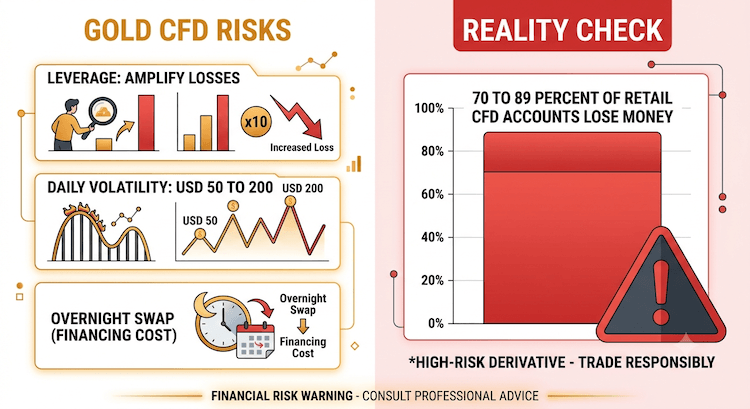
Leverage magnifies losses as fast as gains. Because one lot controls about USD 408,000 of gold at late July 2026 prices, a small adverse move can wipe a small account, and without negative balance protection a losing trade can cost more than you deposited. Always know your margin and stop-out level before you click buy.
Volatility is the second risk. Gold's 52 week range ran from roughly USD 3,270 to USD 5,594, and single sessions can move USD 50 to USD 200. A position that looks safe at dinner can be deeply underwater by midnight if a geopolitical headline hits during the New York session.
The third risk is the one regulators shout about. Brokers are required to warn that between 70 and 89 percent of retail CFD accounts lose money. That is not a scare line. It reflects how leverage plus impatience plus a fast market tends to end. Treat it as the base rate, not as something that happens only to other people.
The fourth risk is broker selection itself. An unregulated or weakly regulated entity can restrict withdrawals, widen spreads without notice, or fail to segregate your funds. This is why the licence check is not optional homework. It is the single most important step in the entire process.
Trade gold CFD with TOPONE Markets
TOPONE Markets offers XAU/USD on MetaTrader with swap-free Islamic account options, micro-lot sizing, and fast execution. Open an account and put this guide to work.
Open your accountFAQ
Risk Warning: Trading financial instruments involves significant risk and may result in the loss of your invested capital. Please ensure you fully understand the risks and seek independent professional advice if necessary. This article does not constitute investment advice or a trading recommendation. Past performance is not indicative of future results.

Bonus rebate to help investors grow in the trading world!


