 English


 English


Commodities Trading: The Ultimate Guide for 2026
 TOPONE Markets Analyst
 Reading time 8 minutes
Key Points Summary
Commodities are raw materials traded on exchanges — gold, oil, copper, wheat, natural gas — standardized so one producer's barrel of oil equals another's.
As of July 3, 2026: gold trades at $4,174/oz, WTI oil at $68.26/bbl, copper at $6.11/lb, silver at $60.42/oz.
Five ways to trade: physical purchase, futures contracts, commodity stocks, ETFs/mutual funds, and CFDs — each with different risk, cost, and complexity profiles.
OPEC+ raised output by 188,000 bpd in July 2026, pressuring oil below $70; central bank gold de
On July 1, 2026, something odd happened in the commodity markets. Gold rose 1% to $4,079 an ounce while crude oil fell below $70 a barrel — on the same day, in the same session. That divergence tells you everything you need to know about commodities: they don't move together. Each one has its own supply, its own demand, its own geopolitical risk. And if you're trading them like they're all the same asset class, you're going to lose money. This guide won't tell you which commodity will go up next week. It'll teach you the mechanics — how prices move, how to get exposure, and where the hidden costs are.
What Are Commodities?
A commodity is a basic good that's interchangeable with other goods of the same type. One ounce of gold from a mine in Nevada is the same as one ounce from a mine in Australia — that's the defining feature. There's no brand premium, no "artisanal" markup. The price is the price, set by global supply and demand on exchanges like the Chicago Mercantile Exchange (CME) and the New York Mercantile Exchange (NYMEX).
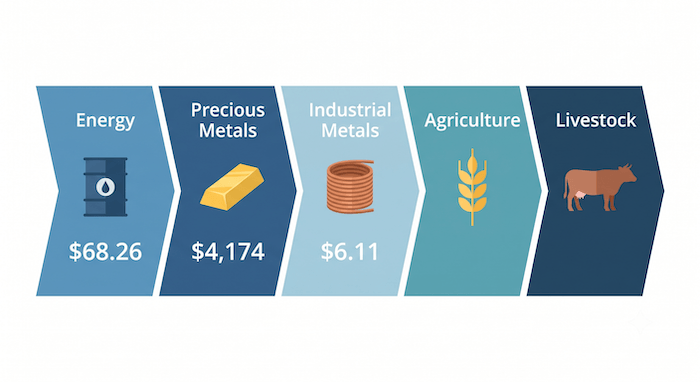
Commodities split into two broad categories: hard commodities (mined or extracted — oil, gold, copper) and soft commodities (grown or raised — wheat, coffee, cattle). Within those, there are four main sectors:
| Sector | Key Commodities | Price (July 3, 2026) | Main Price Drivers |
|---|---|---|---|
| Energy | WTI Crude, Brent, Natural Gas | WTI $68.26/bbl Brent $71.35/bbl NG $3.21/MMBtu | OPEC+ decisions, geopolitical risk, US shale output (record 13.6 mb/d in 2026) |
| Precious Metals | Gold, Silver, Platinum, Palladium | Gold $4,174/oz Silver $60.42/oz Platinum $1,595/oz | Real interest rates, USD strength, central bank purchases, geopolitical safe-haven demand |
| Industrial Metals | Copper, Aluminum, Nickel, Zinc | Copper $6.11/lb | AI data center demand, EV transition, construction cycles, China stimulus |
| Agriculture | Wheat, Corn, Soybeans, Coffee, Sugar | Varies by crop & season | Weather (El Niño/La Niña), planting reports, trade policy, population growth |
| Livestock | Live Cattle, Lean Hogs | Varies by season | Feed costs, disease outbreaks, consumer demand, export markets |
Notice how each sector responds to completely different forces. A drought in Brazil doesn't move gold. An OPEC+ meeting doesn't move wheat. That's why commodities traders often specialize — you can't be an expert in everything.
How Does Commodities Trading Work?
When you trade commodities, you're betting on price direction. Think gold will go up? You go long. Think oil will crash? You go short. The mechanics are simple — the execution is where people lose money.
Most commodities trading happens through futures contracts. A futures contract is an agreement to buy or sell a specific quantity of a commodity at a predetermined price on a set date. You don't actually want 1,000 barrels of oil delivered to your house. You're speculating that the price will move in your favor before the contract expires, then you close the position and pocket the difference.
Here's a concrete example. On July 1, 2026, WTI crude traded at $68.26. Say you believe OPEC+'s 188,000 bpd production increase won't be enough to offset declining US shale inventories (Cushing stocks are near 19 million barrels — below operational minimum). You buy a WTI futures contract at $68.26. If oil rises to $75 before your contract expires, you profit $6.74 per barrel × 1,000 barrels = $6,740. If it drops to $62, you lose $6,260.
That's the leveraged nature of futures. You didn't put up $68,260 (the full contract value). You put up a margin deposit — typically 5-10% of the contract value, so around $6,800. A 10% move in oil price can double your investment or wipe it out entirely.
Spot vs. Futures vs. CFDs: Three Different Animals
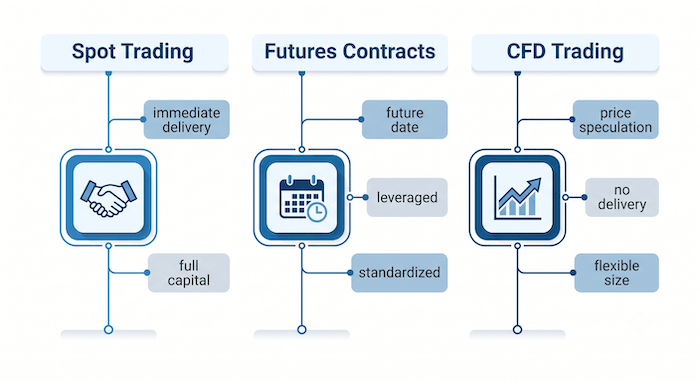
Spot trading means buying or selling the commodity at its current market price for immediate delivery. This is how physical gold dealers operate — you pay today's price, you get the gold. Most retail traders never touch the spot market for anything except precious metals.
Futures trading is what professional commodity traders use. Contracts are standardized (1,000 barrels of WTI, 100 troy ounces of gold, 5,000 bushels of corn), traded on regulated exchanges, and settled daily. The leverage is high, but so is the risk of margin calls.
CFD trading (Contracts for Difference) is the simplest way for retail traders to speculate on commodity prices. You don't buy a contract or take delivery — you simply bet on whether the price will go up or down. No expiration date, no margin calls in the traditional sense, and you can start with a much smaller account. TOPONE Markets offers CFD trading on gold, silver, oil, natural gas, and other commodities with competitive spreads.
5 Ways to Trade Commodities in 2026
There's no single "best" way to trade commodities — the right method depends on your capital, experience, and how much time you want to spend staring at charts. Here are the five main approaches, ranked roughly from simplest to most complex.
1. Commodity ETFs and Mutual Funds
The easiest entry point. You buy shares of a fund that tracks a commodity or a basket of commodities. GLD tracks gold. USO tracks oil. DBC tracks a broad commodity index. You trade them through a standard brokerage account — no specialized futures account, no margin requirements.
The trade-off is that ETFs don't perfectly track spot prices due to "contango" — when the fund rolls expiring futures contracts to the next month, it can lose money if future prices are higher than current prices. Over years, this "roll yield" drag can eat into your returns. But for beginners, the simplicity and liquidity far outweigh this cost.
2. Commodity Stocks
Instead of buying gold, you buy shares in a gold mining company. Instead of buying oil, you buy an oil major. The advantage: companies have operating leverage — their profits can grow faster than the commodity price. A 20% rise in copper prices might translate to a 50% rise in a copper miner's earnings.
The catch is that you're exposed to company-specific risks that have nothing to do with the commodity. Management quality, labor strikes, environmental lawsuits, debt levels — all of these can tank a commodity stock even when the underlying commodity is rising. As Craig Turner, senior commodities broker at Daniels Trading in Chicago, notes: "A well-managed corporation could still turn a profit even if the value of the item itself declines."
3. Physical Commodity Purchase
Buying the actual stuff. This works for gold and silver — you can buy bars and coins from a dealer, store them in a safe, and sell them later. For anything else (oil, wheat, cattle), it's impractical for individual investors. You can't store 1,000 barrels of crude oil in your garage.
Even for gold, the markups can be significant. As Giannotto (a commodities expert quoted in industry publications) explains: "This approach is only workable for high-value commodities, such as gold, silver, or platinum. Even then, huge markups over spot pricing on the retail market would be paid by investors."
4. Futures Contracts
The professional's tool. Futures give you maximum leverage and direct exposure to commodity prices, but they require a specialized brokerage account and a deep understanding of margin management. In 2026, many retail traders use "micro futures" — contracts that are 1/10th the size of standard contracts — to keep risk manageable.
The danger is real. Margin requirements for commodities are often lower than for stocks (5-10% vs. 50%), which means leverage of 10:1 or higher. A 5% adverse price move can trigger a margin call where your broker demands additional funds. If you can't deposit more, your position gets liquidated at a loss.
5. CFDs (Contracts for Difference)
CFDs let you speculate on commodity price movements without owning the asset or dealing with contract expirations. You simply choose a commodity (gold, oil, silver, natural gas), decide whether you think the price will rise or fall, and open a position. The platform handles the rest.
The advantages for retail traders are clear: no contract sizes to worry about, no expiration dates, the ability to go short as easily as going long, and flexible position sizing. TOPONE Markets offers CFD trading on major commodities with competitive spreads and 24/5 market access.
The main cost to watch is the overnight financing fee (swap rate) — if you hold a CFD position overnight, the broker charges a small fee. For day traders who close positions before the end of the session, this cost is zero.
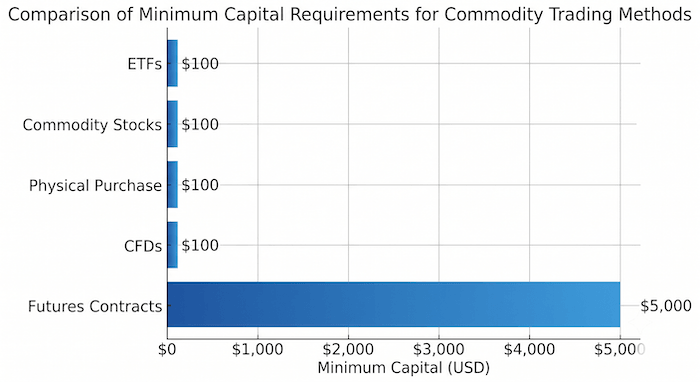
| Method | Min. Capital | Leverage | Difficulty | Best For |
|---|---|---|---|---|
| ETFs / Mutual Funds | $50–$100 | None (1:1) | Low | Long-term diversification, beginners |
| Commodity Stocks | $100+ | None (1:1) | Low–Medium | Dividend income, indirect exposure |
| Physical Purchase | $100+ (gold/silver only) | None | Low | Wealth preservation, gold bugs |
| Futures Contracts | $5,000–$10,000 | 10:1 or higher | High | Professional traders, hedgers |
| CFDs | $100+ | Flexible | Medium | Retail speculation, short-term trading |
Commodities vs. Stocks: What's the Difference?
If you're coming from stock trading, commodities will feel different in several important ways.
Leverage works harder. Stock margin in the US is regulated at 2:1 (50% margin requirement). Commodity futures margins can be 10:1 or higher (5-10% margin). That means a 5% price move against you in commodities can wipe out your entire account — while the same move in a stock only costs you 5% of your position.
Time horizon is shorter. Stocks can be held for decades. Futures contracts have expiration dates — you can't hold them indefinitely. If you want long-term commodity exposure, ETFs or stocks are better vehicles than futures.
Trading hours are longer. Commodity futures trade nearly 24 hours a day, five days a week. Stock markets have regular session hours (9:30 AM to 4:00 PM ET in the US). This means commodity prices can gap significantly between when you go to sleep and when you wake up.
Correlation is low. This is the main reason investors add commodities to a stock portfolio. Commodities often move in the opposite direction of equities — when stocks crash, gold tends to rise. During the 2026 Iran-Hormuz crisis, Brent spiked to $118 while the S&P 500 pulled back 8%. That negative correlation is why Turner suggests that "many utilize roughly 20% or less of their portfolio for higher risk/reward" in commodities.
| Feature | Commodities | Stocks |
|---|---|---|
| Typical Leverage | 10:1 or higher | 2:1 (Reg T) |
| Trading Hours | ~23 hours/day, 5 days/week | 6.5 hours/day (regular session) |
| Time Horizon | Short-term (contracts expire) | Long-term (can hold indefinitely) |
| Price Drivers | Supply/demand, weather, geopolitics | Earnings, management, market sentiment |
| Dividends | None (except commodity stocks) | Yes |
| Correlation with Stocks | Low to negative | High (by definition) |
What Moves Commodity Prices in 2026?
Commodity prices are driven by supply and demand — but the factors that shift supply and demand are wildly different depending on which commodity you're looking at. Here's what's driving prices right now.
Oil: OPEC+ and Geopolitics
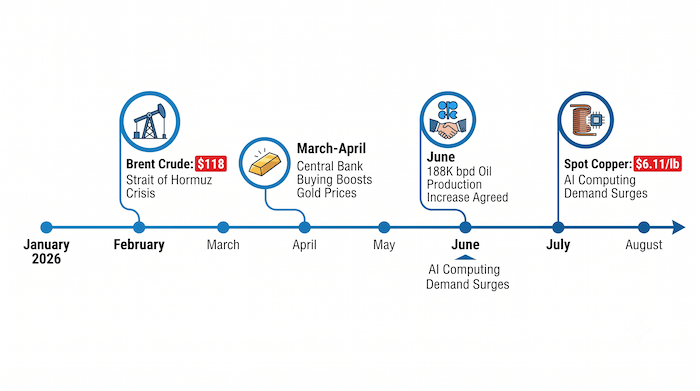
2026 has been one of the most volatile years on record for oil. Brent swung from $72 (pre-conflict) to above $118 (during the February Hormuz crisis) and back to $71 (as of July 1). The seven OPEC+ producers unwinding voluntary cuts — Saudi Arabia, Russia, Iraq, Kuwait, Kazakhstan, Algeria, and Oman — agreed to raise output by 188,000 bpd in July, keeping the market well-supplied.
But the structural picture is bearish. The IEA estimates a 3.7–3.8 million bpd overhang in 2026. US crude output hit a record 13.6 mb/d. J.P. Morgan's structural baseline for Brent sits around $60. The floor? US shale breakeven costs around $60 WTI — below that, ~90% of operators expect production to decline, which naturally tightens supply.
Gold: Central Banks and Real Rates
Gold above $4,000 isn't a speculative bubble — it's structural. Central banks have been buying gold at record pace for reserve diversification, and that demand shows no sign of slowing. The main headwind is US real yields: when the Fed keeps rates high, the opportunity cost of holding non-yielding gold increases. But with the Fed holding rates at 3.50–3.75% as of June 2026, and real yields declining from their 2024 peaks, gold has found a comfortable floor.
On July 1, 2026, gold rose 1.01% to $4,079, with silver outperforming at +1.58% to $60.42. The gold-to-silver ratio narrowed to roughly 67.5, suggesting silver's dual role as a precious and industrial metal (critical for solar panels) is attracting incremental demand.
Copper: "The New Oil"
Copper is frequently called "the new oil" in 2026 — and for good reason. AI data centers, EV manufacturing, and renewable energy infrastructure all require massive amounts of copper wiring. A single AI data center uses 3-5× more copper than a traditional data center. As of July 1, copper traded at $6.11/lb, down 1.33% on the day but up significantly from multi-year lows.
The long-term supply picture is tight. New copper mines take 10-15 years to bring online, and existing mines are seeing declining ore grades. Meanwhile, demand from the electrification transition is only accelerating.
Agriculture: Weather and Seasons
Grain prices are notoriously volatile during summer months when weather can make or break a harvest. A drought in the US Midwest can send corn futures soaring. El Niño and La Niña patterns affect global crop yields. Population growth and changing dietary habits in emerging markets create long-term demand pressure.
Benefits and Risks of Commodities Trading
The Upside
Inflation hedge. When fiat currencies lose purchasing power, hard assets tend to hold theirs. Gold rose from $2,000 in early 2024 to over $4,000 in 2026 — a period marked by persistent inflation concerns and central bank balance sheet expansion.
Portfolio diversification. Commodities have low or negative correlation with stocks and bonds. Adding a 5-20% commodity allocation can reduce overall portfolio volatility without sacrificing returns. During the 2026 oil crisis, commodity positions would have offset equity losses.
Leverage. Futures and CFDs allow you to control large positions with relatively small capital. This amplifies returns when you're right — and amplifies losses when you're wrong.
24-hour markets. Commodity futures trade almost around the clock, giving you flexibility to react to news as it happens, not just during stock market hours.
The Downside
Volatility. Commodities can move 5-10% in a single day based on a weather report, a pipeline attack, or an OPEC+ headline. If you're using leverage, that kind of move can wipe out your account before you have time to react.
Geopolitical black swans. A sudden export ban, a war, or a canal blockage can cause prices to "gap" — jumping from $50 to $70 instantly without trading in between. Your stop-loss order at $55 won't help if the market opens at $70.
Contango and roll yield. If you hold commodity ETFs long-term, the cost of rolling expiring futures contracts to the next month can silently erode your returns. This is why some commodity ETFs underperform the spot price of the commodity they're supposed to track.
Counterparty risk. In futures and CFDs, you're relying on your broker and the exchange to honor the contract. If your broker defaults, you could lose your entire position — even if you were on the right side of the trade.
The golden rule: never risk more than 1-2% of your total account balance on a single commodity trade. And if you're just starting out, commodity ETFs or CFDs with small position sizes are far better than jumping straight into futures.
How to Start Trading Commodities
Ready to put your toe in the water? Here's a step-by-step roadmap that won't get you burned.
Step 1: Define your goal. Are you looking for long-term inflation protection (buy and hold gold or a broad commodity ETF)? Or short-term speculation (trade oil CFDs based on OPEC+ headlines)? Your goal determines which instrument you should use.
Step 2: Pick your instrument. Beginners should start with ETFs or CFDs — not futures. ETFs give you simple, low-cost exposure. CFDs give you flexibility to go short and size positions precisely. Both avoid the complexity of contract expirations and margin calls.
Step 3: Choose a platform. If you're going the CFD route, look for a broker with competitive spreads, a user-friendly platform, and strong regulatory oversight. TOPONE Markets offers CFD trading on gold, silver, crude oil, natural gas, and other commodities, with a free demo account so you can practice before risking real money.
Step 4: Learn fundamental analysis. Commodities aren't valued like stocks — there are no P/E ratios. Instead, you track supply and demand data: EIA weekly inventory reports for oil, USDA crop reports for agriculture, World Gold Council demand data for gold, London Metal Exchange stockpiles for industrial metals.
Step 5: Learn technical analysis. Because commodities are traded heavily by algorithms and institutional hedgers, they tend to respect technical levels — support, resistance, moving averages — more cleanly than individual stocks. Learn to read candlestick charts and identify trend patterns.
Step 6: Start small. Open a demo account first. Trade with simulated money for at least a month. When you switch to real money, start with 1-2% of your total investable capital. Never add to a losing position. And always use stop-loss orders — especially in commodities, where a single headline can move prices 10%.
Start Trading Commodities Today
Gold, silver, oil, natural gas — all available as CFDs with competitive spreads. Open a free demo account, practice with virtual funds, and switch to live trading when you're ready.
No wallet setup. No contract expirations. Trade 24/5 from your phone, tablet, or desktop.
Open Your Free Account →FAQ
Risk Warning: Trading financial instruments involves significant risk and may result in the loss of your invested capital. Please ensure you fully understand the risks and seek independent professional advice if necessary. This article does not constitute investment advice or a trading recommendation. Past performance is not indicative of future results.

Bonus rebate to help investors grow in the trading world!

Need Assistance?
7×24 H

Gold & 100+ Assets from $20
